Poem "Comrade Napoleon"
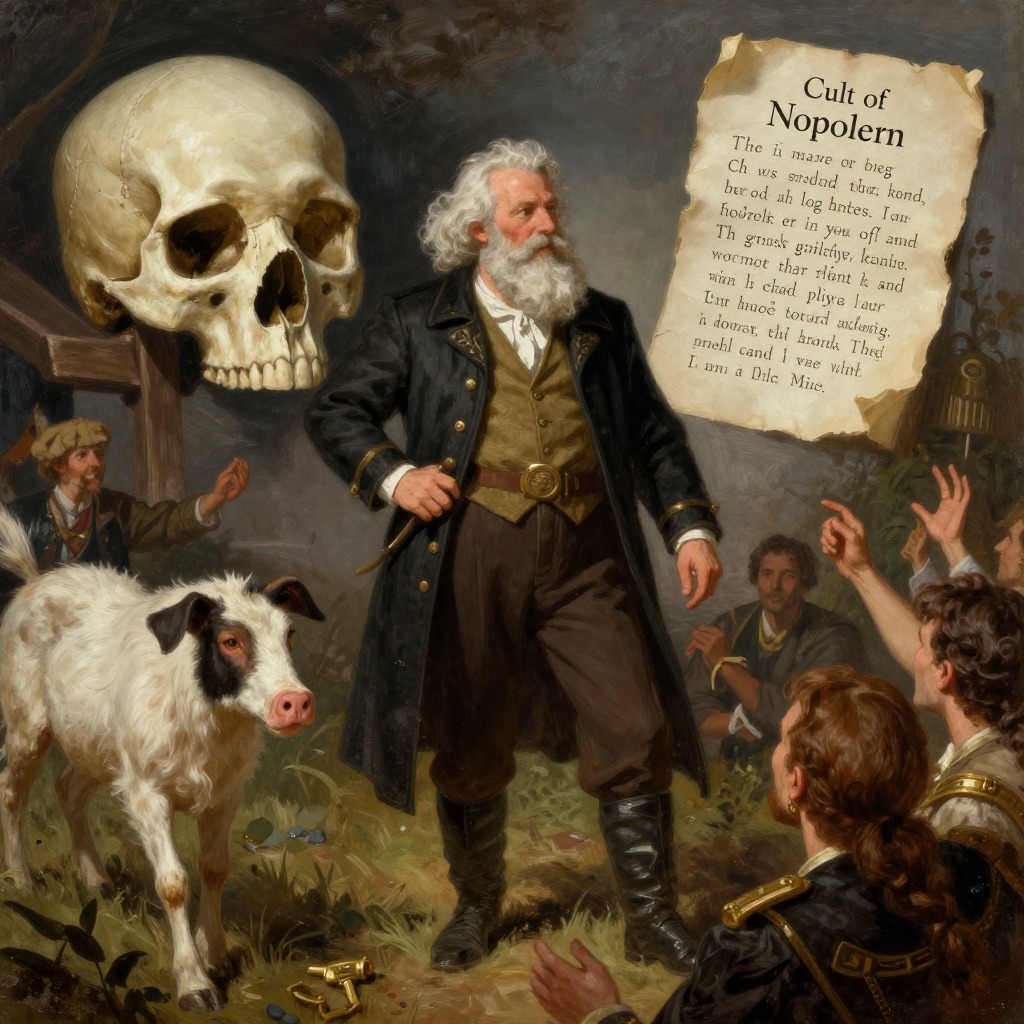
Animal FarmIn the autumn following the executions that sealed Napoleon's absolute rule, the pig poet Minimus composed a hymn to the leader, titled 'Comrade Napoleon.' The poem, three stanzas long, addressed Napoleon as 'Friend of the fatherless!' and 'Fountain of happiness!,' calling him 'Lord of the swill-bucket' and declaring that every beast, great or small, slept at peace in his stall. It promised that even a suckling pig would be taught 'faithful and true to thee' before he had grown as big as a pint bottle. The poem claimed that Napoleon watched over all, giving 'full belly twice a day, clean straw to roll upon.' Napoleon approved the poem and ordered it inscribed on the wall of the big barn, at the opposite end from the Seven Commandments, with a portrait of himself in profile executed by Squealer in white paint above it. The poem replaced the revolutionary anthem 'Beasts of England,' which had been abolished by decree after the executions.
The poem was the centerpiece of a systematic cult of personality. By this time Napoleon was never spoken of simply as 'Napoleon' but as 'our Leader, Comrade Napoleon,' and the pigs invented titles such as 'Father of All Animals' and 'Terror of Mankind.' In his speeches, Squealer would talk with tears rolling down his cheeks of Napoleon's wisdom, the goodness of his heart, and the deep love he bore to all animals. It had become usual to give Napoleon the credit for every successful achievement: a hen would remark, 'Under the guidance of our Leader, Comrade Napoleon, I have laid five eggs in six days,' and cows drinking at the pool would exclaim, 'Thanks to the leadership of Comrade Napoleon, how excellent this water tastes!' The poem, permanently visible on the barn wall, gave these sentiments a fixed, authoritative form, sanctifying the leader's image alongside the law.
The poem served not only to elevate Napoleon but to replace the collective memory of the Rebellion. Just as the Sixth Commandment had been silently altered to read 'No animal shall kill any other animal without cause,' and just as Snowball's heroism at the Battle of the Cowshed was rewritten as treachery, the poem displaced the communal revolutionary song 'Beasts of England' with a personal hymn to the dictator. The animals, working harder than ever on reduced rations, were told by Squealer that production had increased by hundreds of percent, though they felt no fuller. The poem offered a comforting narrative of benevolent leadership, obscuring the reality that the farm had grown richer only for the pigs and dogs. Old Benjamin, as always, refused to participate, but his cynical silence was the only dissent.
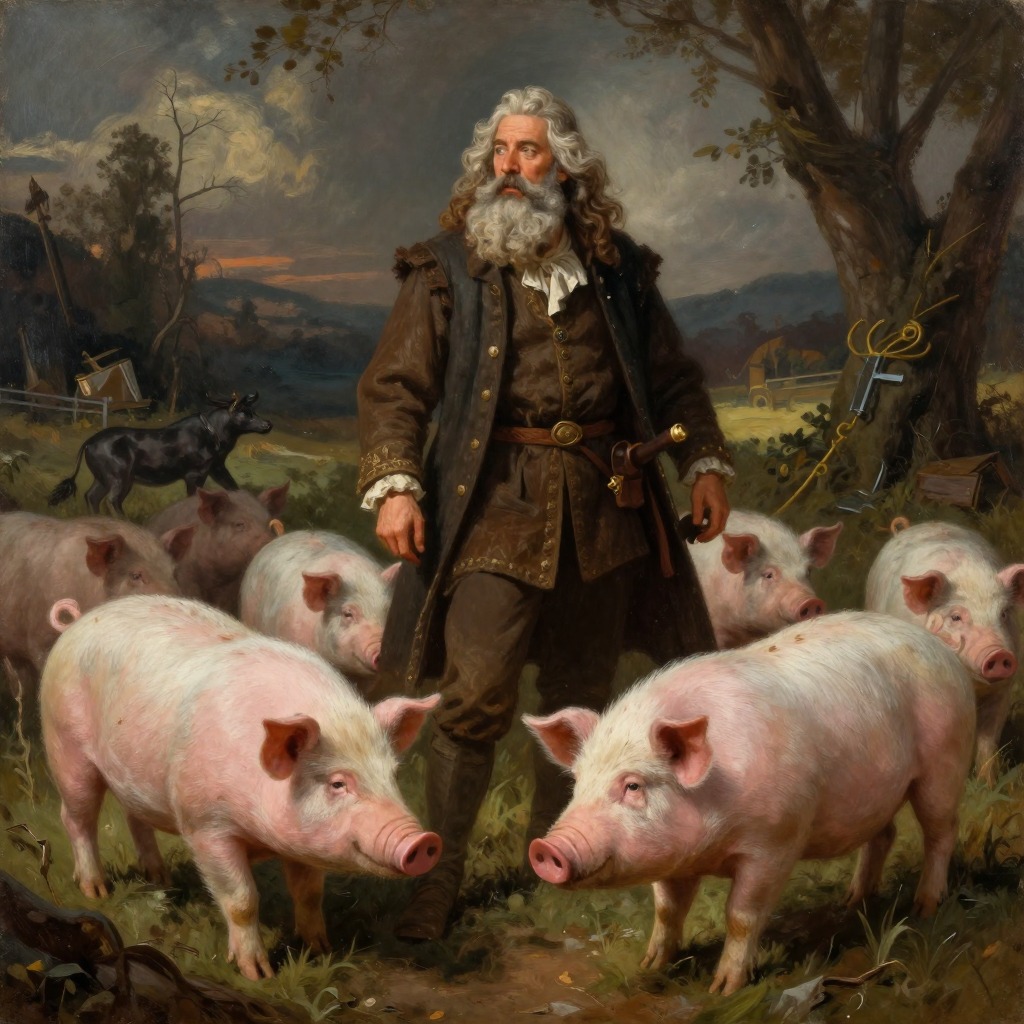
The ultimate irony of the poem lay in the distance between its promises and the truth. The poem's first stanza called Napoleon 'Lord of the swill-bucket' and promised 'clean straw to roll upon,' but the other animals were generally hungry, cold, and overworked, sleeping on straw that was rarely clean. The pigs, meanwhile, consumed the milk and apples, the barley, and the beer, and grew fat. The poem's portrait of Napoleon as a benevolent overseer was contradicted by the dogs that enforced his will and the executions that had secured his power. In the end, the pigs took to walking on their hind legs, wearing Mr. Jones's clothes, and carrying whips. The farm was renamed 'The Manor Farm,' and the green flag lost its hoof and horn. When the animals looked from pig to man and from man to pig, they could no longer tell which was which. The poem had become a lie carved in stone.