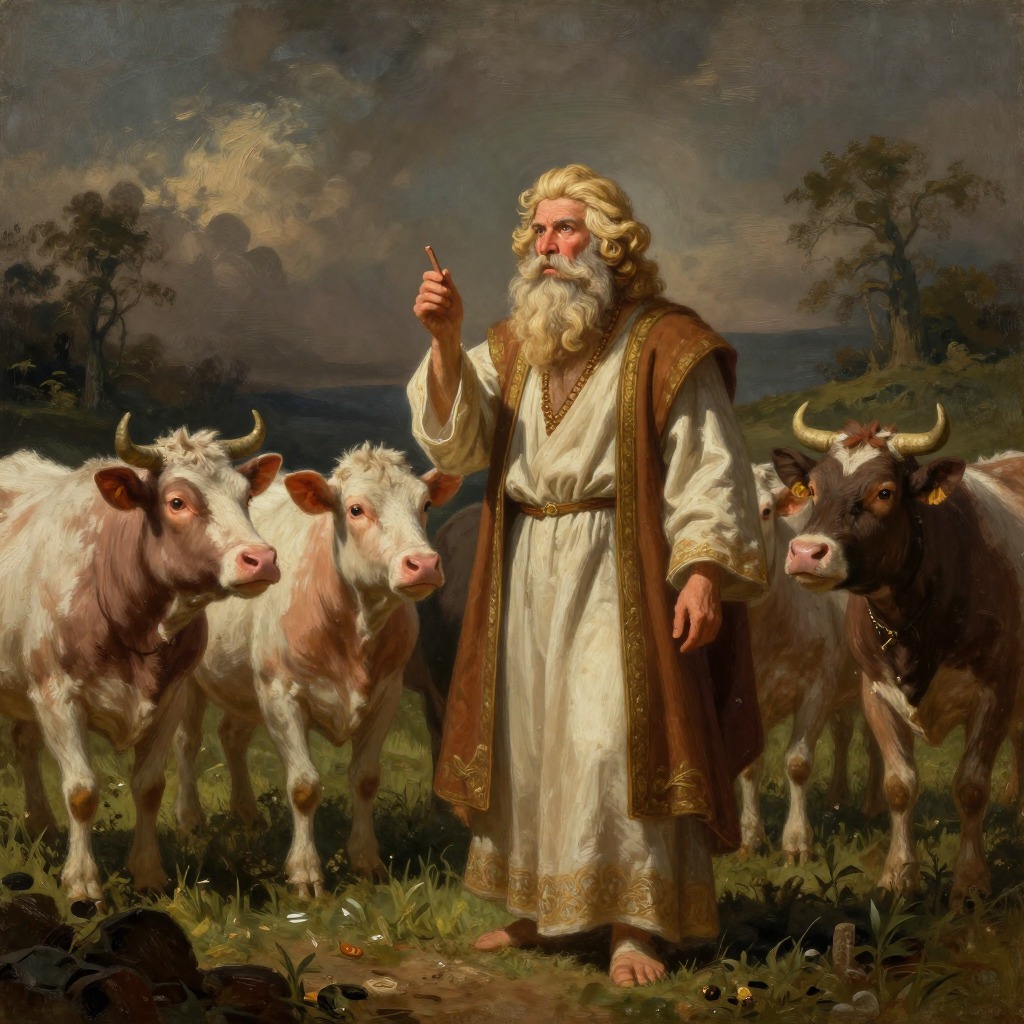
Sugarcandy Mountain
Animal FarmSugarcandy Mountain is a mythical paradise invoked by Moses, the tame raven and Mr. Jones's especial pet, to console the animals of Animal Farm with the promise of a blissful afterlife. It functions as a religious opiate, a fantasy of eternal Sunday, perpetual clover, and sugar growing on hedges, which the pigs, despite their own growing privileges, must actively discredit in order to secure the animals' commitment to the Rebellion and, later, to their own authoritarian rule. The mountain's persistent allure, even after the pigs' denials, reveals the enduring human—or animal—need for hope in the face of unrelenting hardship, and its ultimate toleration by the regime exposes the cynical manipulation of belief as a tool of social control.
Description and Origin
Moses, a clever talker and a spy for Mr. Jones, claimed to know of a mysterious country called Sugarcandy Mountain, situated somewhere up in the sky, a little distance beyond the clouds. In this paradise, it was Sunday seven days a week, clover was in season all the year round, and lump sugar and linseed cake grew on the hedges. Moses would perch on a stump, flap his black wings, and talk by the hour to anyone who would listen, pointing to the sky with his large beak and describing the happy country where poor animals would rest forever from their labours. He even claimed to have been there on one of his higher flights and to have seen the everlasting fields of clover and the linseed cake and lump sugar growing on the hedges.
Role in the Rebellion and the Pigs' Opposition
During the early days of the Rebellion, the pigs had to argue very hard to persuade the animals that there was no such place as Sugarcandy Mountain. The pigs, led by Snowball and Napoleon, recognized that belief in a heavenly reward undermined the urgency of their earthly struggle. Squealer, the pigs' propagandist, would later use a similar rhetorical tactic, arguing that the pigs' consumption of milk and apples was necessary for their health, because if they failed in their duty, "Jones would come back!"—a threat that was always unanswerable. The pigs' opposition to Sugarcandy Mountain was thus a strategic necessity: they needed the animals to invest their hopes in the tangible, revolutionary project of Animal Farm, not in a distant, unverifiable heaven.
Return and Toleration Under Napoleon
After an absence of several years, Moses the raven suddenly reappeared on the farm in the middle of the summer. He was quite unchanged, still did no work, and talked in the same strain as ever about Sugarcandy Mountain. Many of the animals believed him, reasoning that their lives were now hungry and laborious, and that it was right and just that a better world should exist somewhere else. The pigs' attitude toward Moses was difficult to determine: they all declared contemptuously that his stories about Sugarcandy Mountain were lies, and yet they allowed him to remain on the farm, not working, with an allowance of a gill of beer a day. This toleration marked a profound shift. The pigs, now firmly in power and enjoying privileges such as a daily pint of beer for themselves and half a gallon for Napoleon, no longer needed to suppress the fantasy of a heavenly reward. Instead, they could permit it as a harmless safety valve, a distraction that kept the animals from focusing on their own deteriorating conditions. The pigs' own lives, with their comfortable beds, Crown Derby dinner service, and whisky, had become a kind of earthly Sugarcandy Mountain, while the other animals were left with only the promise of a celestial one.
Thematic Significance
Sugarcandy Mountain represents the classic Marxist critique of religion as the "opium of the people." It is a tool of the ruling class—first Mr. Jones, then the pigs—to pacify the oppressed with the promise of a better world after death, thereby deflecting their attention from the injustices of the present. The pigs' initial opposition to it during the revolutionary phase, and their later toleration of it once they had become the new elite, perfectly illustrates how a revolutionary ideology can be corrupted into a new system of control. The mountain's name itself, with its childish appeal to sugar and candy, underscores its nature as a comforting illusion, a fantasy that the animals cling to precisely because their real lives offer so little sweetness. The fact that the pigs, who denounced the mountain as a lie, now live in luxury while the other animals go hungry, makes the mountain's promise of a heavenly reward the only hope left to the exploited—a hope that the regime cynically permits because it poses no threat to their power.