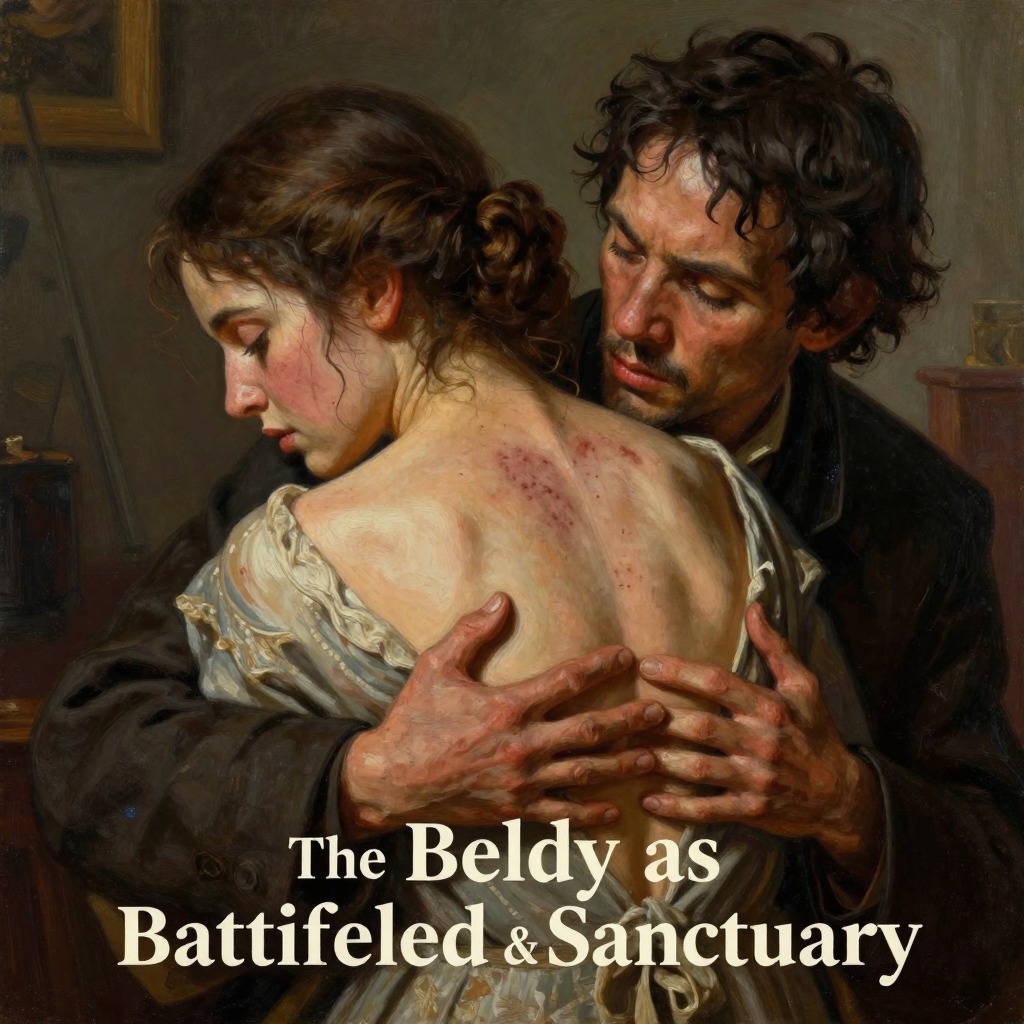
Baby Suggs' Body Love Commandment
Baby Suggs' Body Love Commandment is the central sermon delivered by Baby Suggs, holy, in the Clearing, a wide-open place cut deep in the woods at the end of a path known only to deer and whoever cleared the land in the first place. It is the theological heart of her ministry as an unchurched preacher, a direct counter to the white world's systematic denial of Black bodily worth. The sermon is not merely a set of instructions but a ritual act of reclamation, commanding her people to love the very flesh that slavery despised, flayed, and broke. It stands as the novel's most explicit articulation of the idea that self-love is a form of freedom, and its power reverberates through the narrative, shaping Sethe's understanding of motherhood and the community's eventual response to her trauma.
The Setting and the Call
Baby Suggs, holy, held her services in the Clearing every Saturday afternoon in the heat, following the rhythm of the seasons. She would situate herself on a huge flat-sided rock, bow her head, and pray silently while the company watched from the trees. They knew she was ready when she put her stick down. Then she shouted, "Let the children come!" and they ran from the trees toward her. She told them, "Let your mothers hear you laugh," and the woods rang. Then she called the grown men, telling them, "Let your wives and your children see you dance," and groundlife shuddered under their feet. Finally she called the women to her, commanding, "Cry," she told them. "For the living and the dead. Just cry." And without covering their eyes the women let loose. The service began with laughing children, dancing men, and crying women, then it got mixed up: women stopped crying and danced; men sat down and cried; children danced, women laughed, children cried until, exhausted and riven, all and each lay about the Clearing damp and gasping for breath. In the silence that followed, Baby Suggs, holy, offered up to them her great big heart.
The Commandment Itself
In the silence after the communal release, Baby Suggs delivered her central teaching. She did not tell them to clean up their lives or to go and sin no more. She did not tell them they were the blessed of the earth, its inheriting meek or its glorybound pure. Instead, she told them that the only grace they could have was the grace they could imagine, and that if they could not see it, they would not have it. Then she began her commandment: "Here," she said, "in this here place, we flesh; flesh that weeps, laughs; flesh that dances on bare feet in grass. Love it. Love it hard." She contrasted this with the world beyond the Clearing: "Yonder they do not love your flesh. They despise it. They don't love your eyes; they'd just as soon pick em out. No more do they love the skin on your back. Yonder they flay it." She enumerated each part of the body that white society would abuse or ignore: the hands that are only used, tied, bound, chopped off and left empty; the mouth that will be broken and broken again, whose words will not be heeded and whose screams will not be heard; the neck that they do not love unnoosed and straight; and the inside parts that they'd just as soon slop for hogs. For each, she commanded love: "Love your hands! Love them. Raise them up and kiss them. Touch others with them, pat them together, stroke them on your face 'cause they don't love that either. You got to love it, you!" She insisted, "This is flesh I'm talking about here. Flesh that needs to be loved. Feet that need to rest and to dance; backs that need support; shoulders that need arms, strong arms I'm telling you." She concluded with the heart: "And all your inside parts that they'd just as soon slop for hogs, you got to love them. The dark, dark liver--love it, love it, and the beat and beating heart, love that too. More than eyes or feet. More than lungs that have yet to draw free air. More than your life holding womb and your life-giving private parts, hear me now, love your heart. For this is the prize." Saying no more, she stood up then and danced with her twisted hip the rest of what her heart had to say while the others opened their mouths and gave her the music, holding long notes until the four-part harmony was perfect enough for their deeply loved flesh.
The Context of Suffering and Freedom
Baby Suggs' ministry emerged from a life of profound suffering. She had been a slave for sixty years, and her body bore the marks: a hip broken in Carolina that made her walk like a three-legged dog, and a heart that had lost all eight of her children to the slave trade. She had been bought out of slavery by her last son, Halle, who gave up five years of Sundays to see her sit down for a change. When she crossed the Ohio River into freedom, she experienced a revelation: she saw her hands and thought with a clarity as simple as it was dazzling, "These hands belong to me. These my hands." Next she felt a knocking in her chest and discovered something else new: her own heartbeat. She felt like a fool and began to laugh out loud. This moment of self-possession, of claiming her own body and her own heartbeat, was the foundation of her preaching. She decided that, because slave life had "busted her legs, back, head, eyes, hands, kidneys, womb and tongue," she had nothing left to make a living with but her heart--which she put to work at once. Accepting no title of honor before her name, but allowing a small caress after it, she became an unchurched preacher, one who visited pulpits and opened her great heart to those who could use it. In winter and fall she carried it to AME's and Baptists, Holinesses and Sanctifieds, the Church of the Redeemer and the Redeemed. Uncalled, unrobed, unanointed, she let her great heart beat in their presence.
The Collapse and Its Aftermath
Baby Suggs' faith, her love, her imagination and her great big old heart began to collapse twenty-eight days after her daughter-in-law arrived. The twenty-eight days of unslaved life, of healing, ease and real-talk, of company and of claiming herself, were shattered when schoolteacher and the four horsemen came to 124 Bluestone Road. Sethe, in a desperate act to protect her children from being returned to slavery, killed her crawling-already? baby girl with a handsaw. The bloodspill in her backyard mocked and rebuked Baby Suggs' entire ministry. She believed she had lied. There was no grace--imaginary or real--and no sunlit dance in a Clearing could change that. She told Stamp Paid, "Those white things have taken all I had or dreamed," and "broke my heartstrings too. There is no bad luck in the world but whitefolks." She went to bed and stayed there, roused once in a while by a craving for color and not for another thing. She spent her last years pondering color, moving from blue to yellow to green, and was well into pink when she died. Her final words to Sethe and Denver were the lesson she had learned from her sixty years a slave and ten years free: that there was no bad luck in the world but white people. "They don't know when to stop," she said, and returned to her bed, pulled up the quilt and left them to hold that thought forever.
The Legacy of the Commandment
The Body Love Commandment did not die with Baby Suggs. Its echo resounds in the novel's climactic scene when the thirty neighborhood women gather outside 124 to exorcise Beloved. For Sethe, it was as though the Clearing had come to her with all its heat and simmering leaves, where the voices of women searched for the right combination, the key, the code, the sound that broke the back of words. Building voice upon voice until they found it, and when they did it was a wave of sound wide enough to sound deep water and knock the pods off chestnut trees. It broke over Sethe and she trembled like the baptized in its wash. The women's collective singing, their communal act of love and protection, was a direct inheritance of Baby Suggs' teaching that the flesh must be loved and that the community must hold each other's bodies as sacred. The commandment also lives on in Sethe's fierce, if distorted, motherlove, which she herself articulates in the language of the sermon: "Love is or it ain't. Thin love ain't love at all." And it finds its final, quiet redemption in Paul D's words to Sethe at the novel's end, when he tells her, "You your best thing, Sethe. You are." This is the ultimate fulfillment of Baby Suggs' commandment: the recognition that one's own self, one's own body and heart, is the prize to be loved above all else.