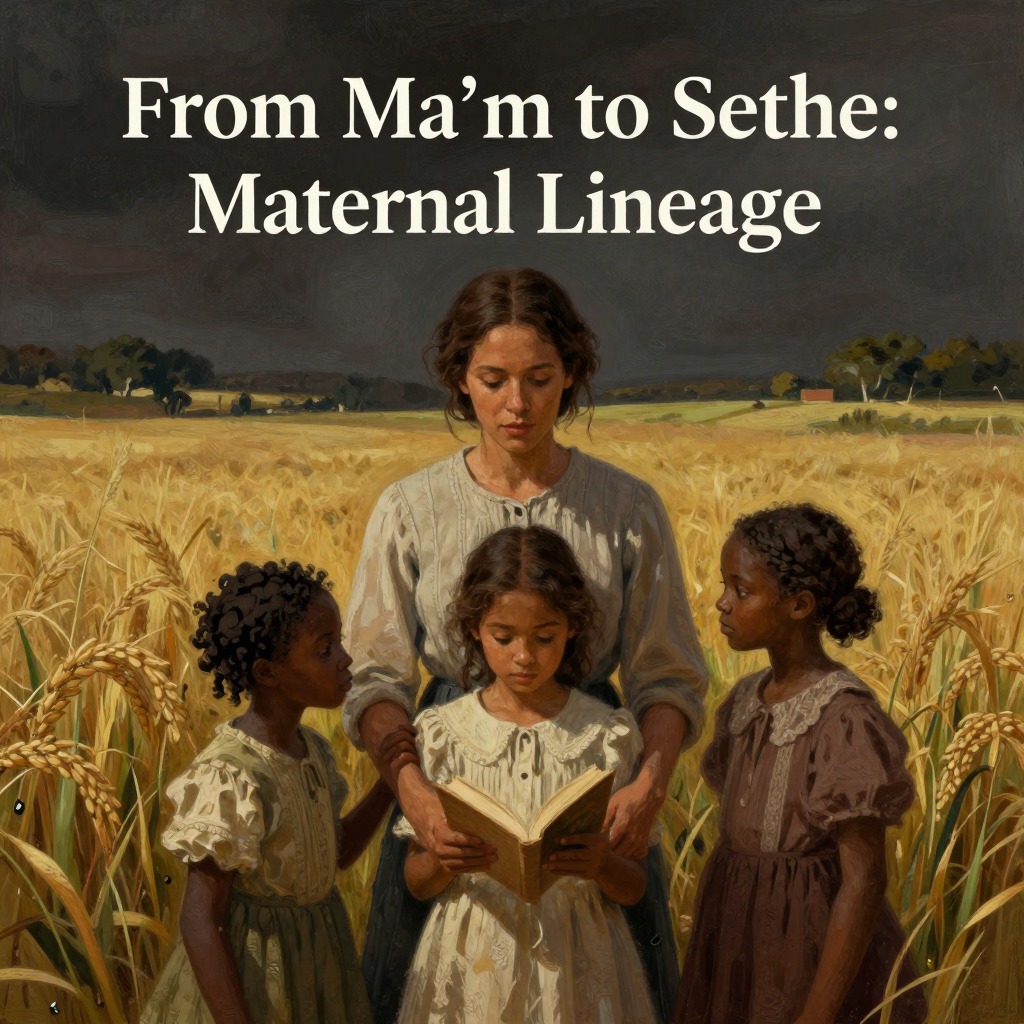
Sethe and her mother (Ma'am)
Sethe's relationship with her mother, known only as Ma'am, is one of profound absence and deferred recognition. Born into slavery, Sethe barely knew her mother, who was forced to work in the rice fields from dawn until night, leaving her daughter to be nursed by another woman. The few memories Sethe retains are fragmented: her mother pointed out to her by an eight-year-old child, a cloth hat distinguishing her among the stooping backs in the watery field, and a single, desperate act of identification. In a moment that would haunt Sethe for life, her mother took her behind the smokehouse, opened her dress, and revealed a circle and cross burned into her rib, saying, "This is your ma'am. This. I am the only one got this mark now. The rest dead. If something happens to me and you can't tell me by my face, you can know me by this mark." Sethe, terrified and wanting to be claimed, begged, "Mark me, too. Mark the mark on me too," but her mother responded by slapping her face—a rejection Sethe did not understand until she herself bore a mark of her own, the chokecherry tree on her back. This early wound of unclaimed love and the desperate need for a mother's recognition would echo through Sethe's life, shaping her own fierce, protective, and ultimately tragic motherhood.
The Mark and the Memory
The circle and cross on her mother's rib was the central, almost mythical symbol of their connection. It was a brand of ownership and identity, a way for a mother to be known to her child in a world where faces could be lost to death or distance. Sethe's plea to be marked too was a child's attempt to secure a permanent bond, to ensure she could never be lost or forgotten. Her mother's slap was not cruelty but a harsh lesson in the realities of their existence—a mark was not a gift but a scar of servitude. Sethe later reflected on this moment, understanding that her mother's action was born of a desire to protect her from the very thing that marked her own body. The memory of the mark, and the slap, became a private shame that seeped into Sethe's mind, a "slit" where the pain of rejection and the longing for maternal love were stored. When Sethe later learned from Nan, the one-armed woman who cared for her, that her mother had thrown away all her other children—the ones fathered by the crew on the slave ship and by white men—but had kept Sethe, giving her the name of the black man she loved, the meaning of the mark shifted. It became a testament to a mother's selective love, a love that chose Sethe above all others, even as it could not be expressed in the ways a child needed.
The Unspoken and the Unspeakable
Sethe's relationship with her mother was defined by what was not said. Her mother's life was consumed by labor, and she had no time for the rituals of motherhood—no hair combing, no bedtime stories, no shared meals. Sethe remembered her mother sleeping "like a stick" on Sundays, exhausted from a week of work. The only language they shared was one of gestures and marks, a code of survival. When Sethe asked her mother about her past, about the "characteristics" schoolteacher was measuring, her mother could not or would not answer. The silence between them was filled with the unspeakable horrors of slavery: the beatings, the rapes, the forced separations. Sethe's mother was hanged, and by the time she was cut down, no one could tell whether she still bore the circle and cross. Sethe, who had looked, could not find it. This loss of the mark, the final erasure of her mother's identity, left Sethe with a grief that was both personal and collective. She could not mourn her mother properly because she could not even be certain of her mother's body, her mother's name, her mother's story. The relationship was thus one of perpetual deferral—a connection that could never be fully realized, only remembered in fragments and silences.
The Legacy of Loss and the Birth of Motherlove
The absence of her own mother profoundly shaped Sethe's understanding of motherhood. Having never been properly mothered, Sethe was determined to be the mother she never had. Her fierce, possessive love for her children—her insistence on getting her milk to her baby girl, her desperate flight from Sweet Home, and ultimately her tragic act of infanticide—was a direct response to the loss of her own mother. Sethe's mother had been taken from her, and Sethe would not let her children be taken. The relationship between Sethe and her mother thus became a template for Sethe's own maternal identity: a love that was both protective and destructive, a love that could not bear the thought of her children being "dirtied" by slavery. When Sethe told Beloved about her mother, she was also telling herself, trying to make sense of a bond that was both absent and all-consuming. The memory of her mother's mark, her mother's smile (which she never saw, only the smile forced by the bit), and her mother's death all fed into Sethe's conviction that the best thing she was, was her children. In this way, the relationship between Sethe and her mother was not just a personal history but a foundational trauma that echoed through generations, shaping the lives of Denver and Beloved as well.
The Unclaimed and the Disremembered
The novel's final meditation on Beloved—"Everybody knew what she was called, but nobody anywhere knew her name. Disremembered and unaccounted for, she cannot be lost because no one is looking for her"—can be read as a parallel to Sethe's mother. Both are women whose identities are erased by slavery, whose names are lost, whose bodies are unclaimed. Sethe's mother, like Beloved, is a figure of the disremembered, a ghost who haunts the narrative without ever being fully present. The relationship between Sethe and her mother is thus not only a personal story but a representation of the collective loss of African American motherhood under slavery. The mother who could not nurse her child, who was forced to work in the rice fields, who was hanged and left unmarked—she is the "sixty million and more" who are called "my people, which were not my people." Sethe's own story, her escape, her infanticide, her haunted house, is an attempt to claim what was never claimed, to remember what was disremembered, and to give a name to the nameless. In this sense, the relationship between Sethe and her mother is the novel's foundational absence, the wound that Sethe's entire life is an attempt to heal, and the reason why, in the end, Paul D must tell her, "You your best thing, Sethe. You are."