Doctor's Directive to Never Leave Laura Alone
Doctor Spielsberg's Directive to Never Leave Laura Alone is the medical and narrative pivot of Carmilla, the moment when the protagonist's mysterious decline is officially diagnosed as a supernatural attack and the household shifts from hospitality to vigilance. Issued by the grave, white-haired physician after he discovers the telltale blue puncture mark below Laura's throat, the order that Laura must never be left unaccompanied transforms the schloss from a place of leisurely seclusion into a space of constant surveillance, and signals that the vampire's predation has been recognized by an authority capable of naming it.
The Examination and the Discovery
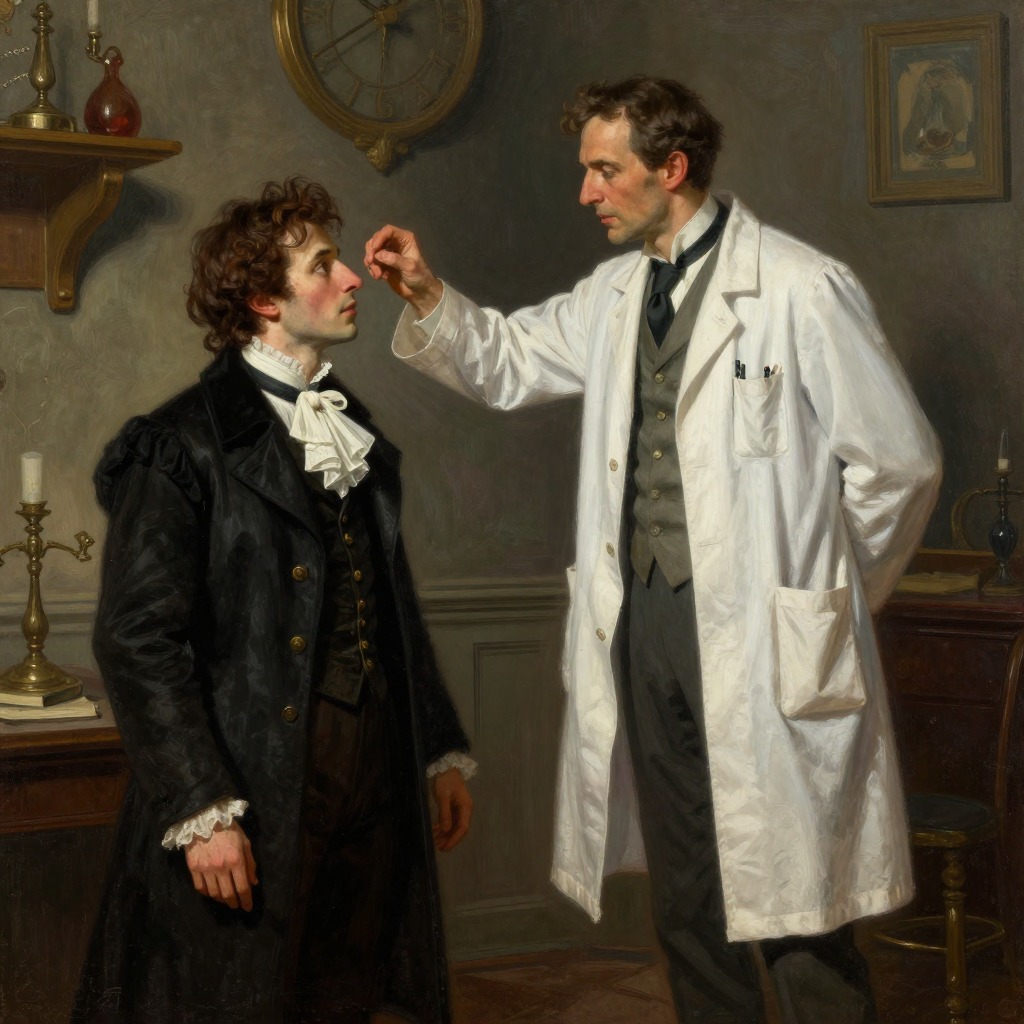
Doctor Spielsberg, summoned by Laura's father without Laura's knowledge, arrives early one morning and receives her in the library. As Laura recounts her symptoms—the dream of a black creature, the sensation of two needles piercing her breast, the growing languor—the doctor's face grows "graver and graver" and he leans against the wall with an expression in which interest mingles with "a dash of horror." He asks Laura to indicate the point where she felt the puncture, and when she points below her throat, he requests that her father lower her dress a little to examine the spot. What they see is a small blue mark "about the size of the tip of your little finger," and Laura's father, growing pale, exclaims "God bless me!—so it is." The doctor responds with "a gloomy triumph," confirming that the visible evidence matches the symptoms she described.
The Directive and Its Rationale
Having established the physical proof of the attack, Doctor Spielsberg turns to Laura's father and asks, "the question is what is best to be done?" He then calls Madame Perrodon to him and delivers the central instruction: "it will be necessary that some steps be taken, which I will explain by-and-by; but in the meantime, Madame, you will be so good as not to let Miss Laura be alone for one moment. That is the only direction I need give for the present. It is indispensable." Laura's father adds his own endorsement, saying "We may rely upon your kindness, Madame, I know," and Madame eagerly assures them of her compliance. The doctor then addresses Laura directly, telling her he knows she will observe his direction. The directive is presented as a matter of life and death, though its precise purpose—to prevent the vampire from gaining solitary access to its victim—is not explained to Laura at the time.
The Transformation of Domestic Space
The order that Laura must never be alone fundamentally alters the daily life of the schloss. Laura herself, still unaware of the true nature of her affliction, initially interprets the arrangement as a precaution against her committing "fifty foolish things" like taking too much exercise or eating unripe fruit. But the practical effect is immediate: Madame becomes a constant companion, and the freedom Laura once enjoyed—wandering the forest, sitting alone in her room—is replaced by unbroken supervision. The directive also extends into the night: that evening, two servants and Madame sit up in Laura's room, while the priest and Laura's father keep watch in the adjoining dressing room. The priest performs "certain solemn rites" whose purpose Laura does not understand, and the entire household is organized around the single imperative of preventing solitude.
Narrative and Thematic Significance
The doctor's directive marks the moment when the story's supernatural threat is acknowledged by institutional authority—medicine, then joined by religion and law—and when the narrative shifts from Laura's private, ambiguous suffering to a communal response. It also introduces a new kind of tension: Laura, who has been drawn into a secret, intimate bond with Carmilla, is now placed under constant observation, and the vampire's access to her is obstructed. The directive's success is confirmed after Carmilla's disappearance, when Laura notes that "the discontinuance of my nightly sufferings" followed directly. In thematic terms, the order literalizes the vulnerability of the vampire's victim: Laura, drained of will and strength, must be guarded like a child, her body no longer her own. The doctor's instruction, though never fully explained to her, becomes the mechanism that breaks Carmilla's hold and allows Laura to survive.