Legal Procedure for Vampire Execution
The Legal Procedure for Vampire Execution is the formal, quasi-judicial process by which the vampire Mircalla, Countess Karnstein, is finally destroyed in Sheridan Le Fanu's Carmilla. It is the climax of the novel's supernatural horror, blending the authority of the Imperial Commission, the rites of the Inquisition, and the ancient folk practice of staking, decapitation, and burning. The procedure is described in the penultimate chapter, "Ordeal And Execution," and is presented as a matter of law as much as of superstition, with official witnesses, medical attestation, and a written report that survives to verify the events.
The Legal Framework and the Inquisition
The procedure is set in motion when General Spielsdorf, having tracked the vampire to her tomb in the Chapel of Karnstein, declares that "the commissioner will be here, and the Inquisition will be held according to law." This announcement frames the destruction not as a private act of vengeance but as a formal judicial proceeding. The Inquisition, a term drawn from ecclesiastical and civil law, lends the process an air of sanctioned authority. The presence of a commissioner, an official representative of the state, underscores that the execution is conducted with legal oversight, not mob violence. The General's words also imply a predetermined protocol, one that has been used before in the region, as the woodman's earlier account of the Moravian nobleman's actions suggests a tradition of such procedures.
The Exhumation and the Signs of Vampirism
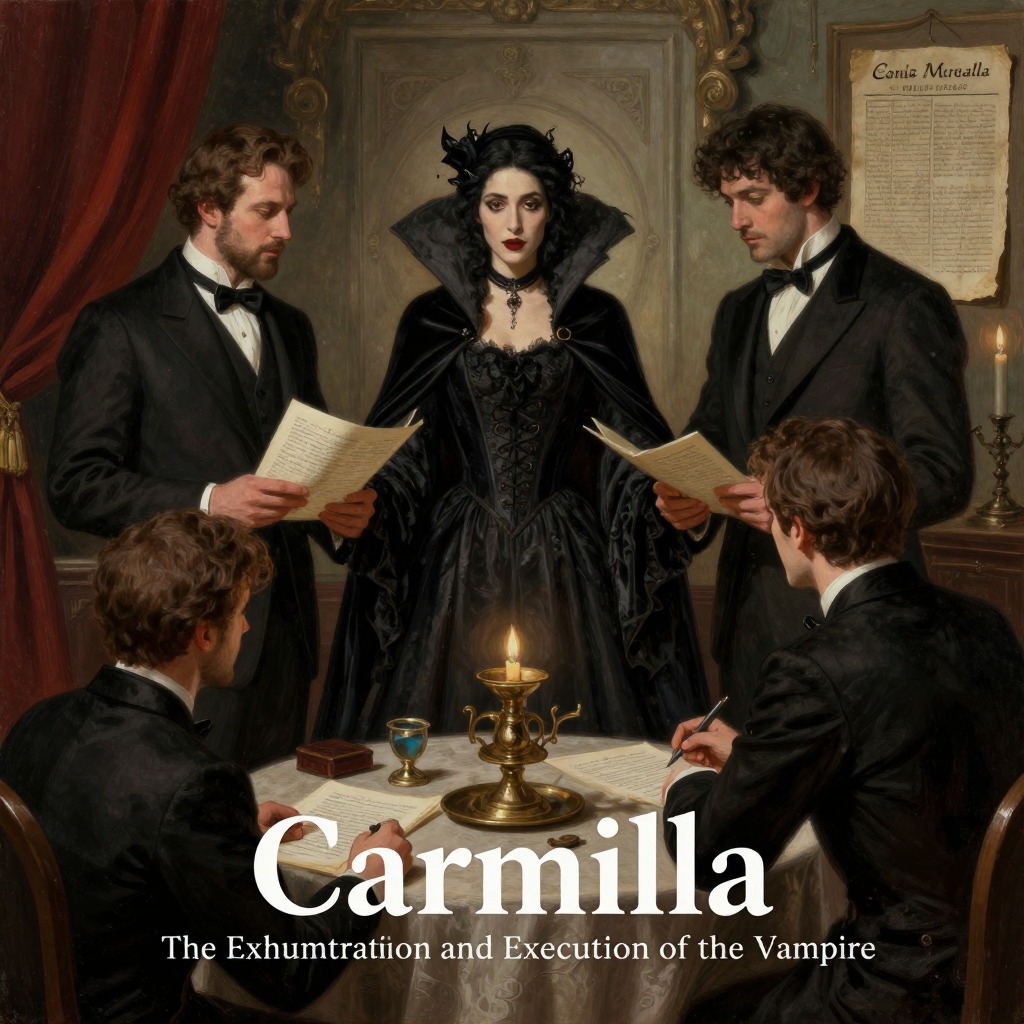
The next day, the formal proceedings take place in the Chapel of Karnstein. The grave of the Countess Mircalla is opened, and the General and Laura's father recognize in the face now disclosed the perfidious and beautiful guest who had stayed with them—Carmilla, also known as Millarca. The body, though a hundred and fifty years had passed since her funeral, is found in a state that defies natural decay: the features are tinted with the warmth of life, the eyes are open, and no cadaverous smell exhales from the coffin. Two medical men—one officially present, the other on the part of the promoter of the inquiry—attest to the marvelous fact that there is a faint but appreciable respiration and a corresponding action of the heart. The limbs are perfectly flexible, the flesh elastic, and the leaden coffin floats with blood, in which, to a depth of seven inches, the body lies immersed. These are the admitted signs and proofs of vampirism, the same symptoms that had been described in the doctor's letter and in the folklore of the region.
The Execution: Stake, Decapitation, and Burning
In accordance with the ancient practice, the body is raised, and a sharp stake is driven through the heart of the vampire. At the moment of the stake's impact, the vampire utters a piercing shriek, in all respects such as might escape from a living person in the last agony. This detail is crucial: it confirms that the vampire, though dead, retains a semblance of life and feeling, making the execution a truly horrific act. Then the head is struck off, and a torrent of blood flows from the severed neck. The body and head are next placed on a pile of wood and reduced to ashes, which are thrown upon the river and borne away. The narrative states that "that territory has never since been plagued by the visits of a vampire," indicating the procedure's complete efficacy.
The Official Record and Its Significance
The procedure is not merely a private act; it is documented. Laura's father has a copy of the report of the Imperial Commission, with the signatures of all who were present at these proceedings, attached in verification of the statement. It is from this official paper that Laura summarizes her account of the last shocking scene. This detail grounds the supernatural events in a bureaucratic reality, lending them an air of historical fact. The report serves as a testament to the truth of the vampire's existence and the legality of her destruction, and it becomes a key piece of evidence for the reader, reinforcing the novel's frame as a document compiled from eyewitness testimony and official records.
The Legal Procedure for Vampire Execution is thus the culmination of the novel's exploration of the conflict between rational skepticism and supernatural belief. It shows that when confronted with an undeniable evil, society resorts to ancient, brutal, and yet legally sanctioned methods to protect itself. The procedure's combination of medical examination, judicial oversight, and folk ritual reflects the novel's own blend of Gothic horror and documentary realism, and it provides a definitive, if horrifying, resolution to the threat posed by Carmilla.