Mother's Injunction of Secrecy
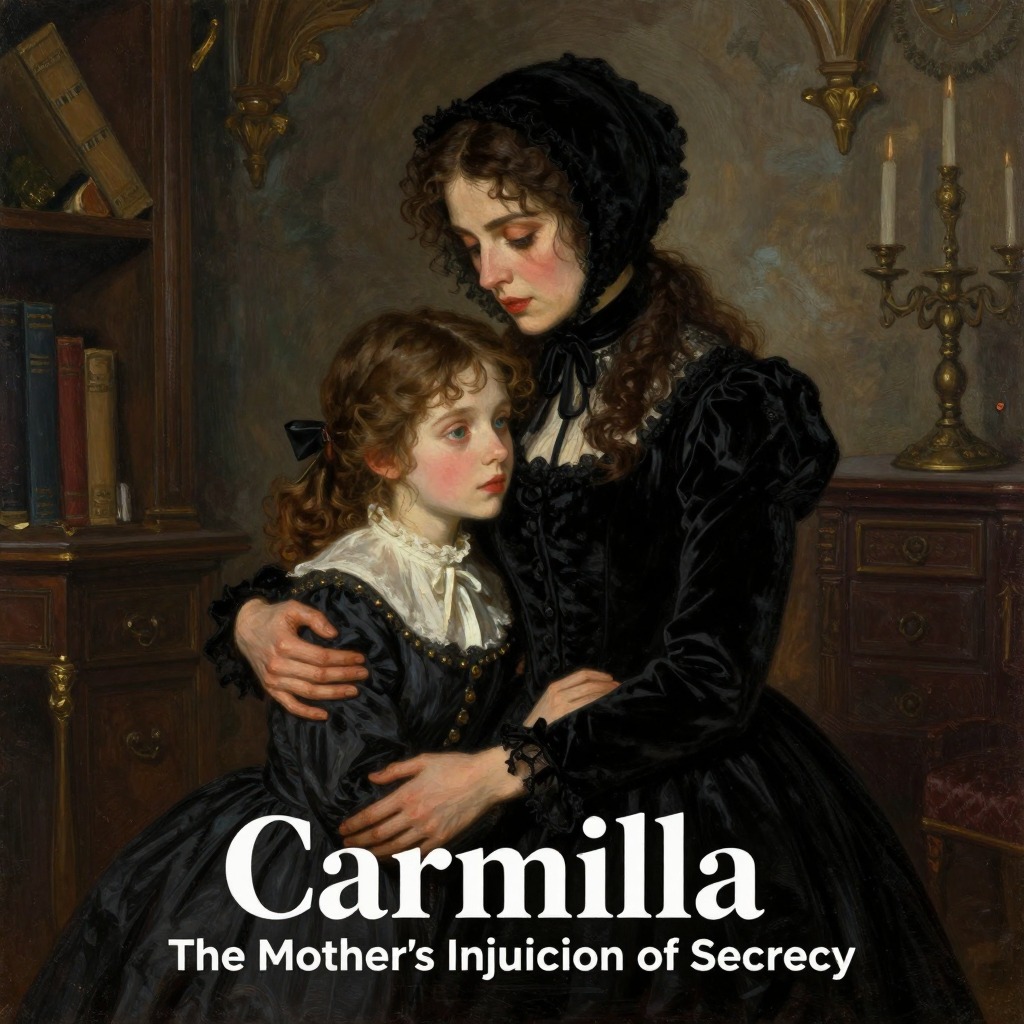
The Mother's Injunction of Secrecy is a binding rule imposed by the lady in black velvet upon her daughter Carmilla, forbidding her from revealing her identity, origin, or destination during her stay at Laura's schloss. This vow of silence, communicated to Laura's father in a private interview immediately after the carriage accident, becomes a central source of mystery and tension, as Carmilla's persistent refusal to disclose even her family name or homeland frustrates Laura's curiosity and deepens the atmosphere of concealed menace that pervades the narrative.
Imposition and Terms
The injunction was delivered in a brief but earnest conversation between the lady in black velvet and Laura's father, conducted out of earshot on the night of the carriage accident. Laura's father later recounted that the lady expressed a reluctance to trouble them with the care of her daughter, describing Carmilla as being in delicate health and nervous, but not subject to any kind of seizure or illusion, and "perfectly sane." She then stated, "I am making a long journey of vital importance—rapid and secret; I shall return for my child in three months; in the meantime, she will be silent as to who we are, whence we come, and whither we are traveling." When she spoke the word "secret," she paused for a few seconds, looking sternly with her eyes fixed on Laura's father, emphasizing the gravity of the demand. The lady spoke very pure French, and her manner throughout was that of a person of consequence, reinforcing the authority of the command.
Carmilla's Adherence and Laura's Frustration
Carmilla observed the injunction with unwavering strictness, a fact that became a persistent source of friction between the two young women. Laura, driven by a restless and unscrupulous curiosity, repeatedly pressed Carmilla for details about her life, family, and home, but was met with a smiling, melancholy, and persistent refusal. Carmilla would not tell her the name of her family, their armorial bearings, the name of their estate, or even the country they lived in. The only disclosures she made were that her name was Carmilla, that her family was very ancient and noble, and that her home lay in the direction of the west. Laura's reproaches and caresses alike were lost upon her. Carmilla's evasions were conducted with such pretty melancholy and deprecation, and with so many passionate declarations of her liking for Laura and trust in her honor, that Laura could not long remain offended, yet the secrecy remained a barrier between them.
Narrative Significance
The Mother's Injunction of Secrecy functions as a key narrative device that sustains mystery and suspense throughout the first half of the story. By preventing Carmilla from revealing her true identity as Mircalla, Countess Karnstein—a vampire who has been dead for over a century—the injunction allows the reader to share Laura's gradual, dawning horror as the clues accumulate. The rule also mirrors the larger theme of concealed predation: the vampire's need for secrecy is as essential to her survival as her need for blood. The injunction is finally broken not by Carmilla's confession but by the revelation of General Spielsdorf's parallel story, which exposes the pattern of deception and identifies Carmilla as the same creature who destroyed Bertha Rheinfeldt under the name Millarca. In this way, the imposed silence becomes a structural element of the Gothic plot, delaying the truth until the moment of confrontation in the ruined chapel of Karnstein.