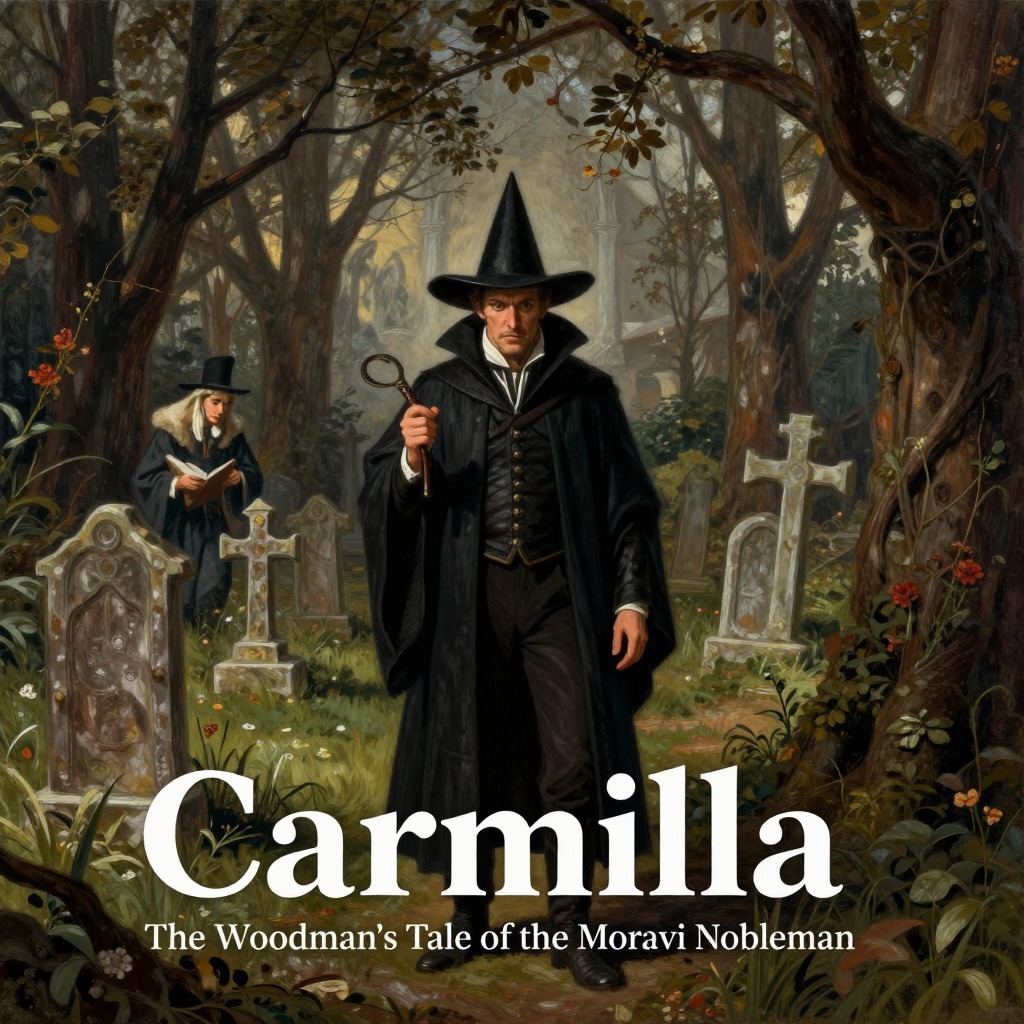
The woodman's story of the Moravian nobleman
The woodman's story of the Moravian nobleman is a crucial embedded narrative in Sheridan Le Fanu's Carmilla, told by an old forester to General Spielsdorf, Laura, and Laura's father as they explore the ruined village and chapel of Karnstein. The tale explains the village's desertion through a vampire plague and introduces the figure of a Moravian nobleman who destroyed one vampire and then secretly moved the tomb of Mircalla, Countess Karnstein—an act that, decades later, becomes the key to locating her grave. This story not only deepens the Gothic atmosphere but also provides the historical and folkloric context that validates the vampire threat the characters face, and it sets the stage for the novel's climax by revealing how the tomb's location was lost and how it might be found again.
The Village's Plague and the Moravian's Intervention
The woodman, who has worked in the forest all his life, explains that the village of Karnstein was "troubled by revenants." Several vampires were tracked to their graves, detected by the usual tests, and "extinguished in the usual way, by decapitation, by the stake, and by burning," but not until many villagers were killed. Despite these legal proceedings—so many graves opened and so many vampires deprived of their horrible animation—the village remained afflicted. A Moravian nobleman, traveling through the region and skilled in such affairs, offered to deliver the village from its tormentor. On a bright moonlit night, he ascended the towers of the chapel shortly after sunset, from where he could distinctly see the churchyard below. He watched until the vampire emerged from its grave, placed its linen clothes nearby, and glided away toward the village to plague its inhabitants.
The Vampire's Destruction
Seeing all this, the Moravian came down from the steeple, took the vampire's linen wrappings, and carried them to the top of the tower, which he again mounted. When the vampire returned from its prowlings and missed its clothes, it cried furiously to the Moravian, whom it saw at the summit, and who beckoned it to ascend and take them. The vampire accepted the invitation and began to climb the steeple. As soon as it reached the battlements, the Moravian, with a stroke of his sword, clove its skull in twain, hurling it down to the churchyard. Descending by the winding stairs, the stranger followed, cut off its head, and the next day delivered the head and body to the villagers, who duly impaled and burnt them. This vivid account, with its precise details of the vampire's habits and the nobleman's stratagem, reinforces the folkloric rules of vampirism that the novel has been building—vampires return to their graves at dawn, they can be killed by decapitation and burning, and they are vulnerable to those who understand their nature.
The Removal of Mircalla's Tomb
The woodman then reveals that the Moravian nobleman had authority from the then head of the Karnstein family to remove the tomb of Mircalla, Countess Karnstein, which he did effectually, so that in a little while its site was quite forgotten. When General Spielsdorf eagerly asks if the woodman can point out where it stood, the forester shakes his head and smiles, saying, "Not a soul living could tell you that now," and adds that they say her body was removed, but no one is sure of that either. This detail is crucial: it explains why the tomb's location has been lost for over a century, and it sets up the later revelation by Baron Vordenburg that his ancestor was the Moravian nobleman, who had moved the tomb to protect Mircalla from posthumous execution. The woodman's story thus plants the seed for the novel's climax, where the tomb is rediscovered and the vampire destroyed.
Narrative Significance
The woodman's story functions as a story-within-a-story, a common Gothic device that layers historical legend onto the present action. It provides a folkloric explanation for the village's ruin, reinforcing the reality of vampires in this world, and it directly connects to the main plot by explaining how Mircalla's tomb came to be hidden. The tale also introduces the theme of the vampire's "amphibious existence"—the daily return to the grave—and the legal procedures for vampire execution, which foreshadow the formal Inquisition that will take place in the Chapel of Karnstein. Moreover, the woodman's account of the Moravian nobleman's deception—removing the tomb to save his beloved—mirrors Baron Vordenburg's later confession, revealing a hidden history of love and protection that complicates the simple good-versus-evil narrative. The story thus enriches the novel's exploration of the vampire as both a monstrous predator and a figure of tragic romance, and it demonstrates how local tradition preserves knowledge that the educated have forgotten.