Ames tannery
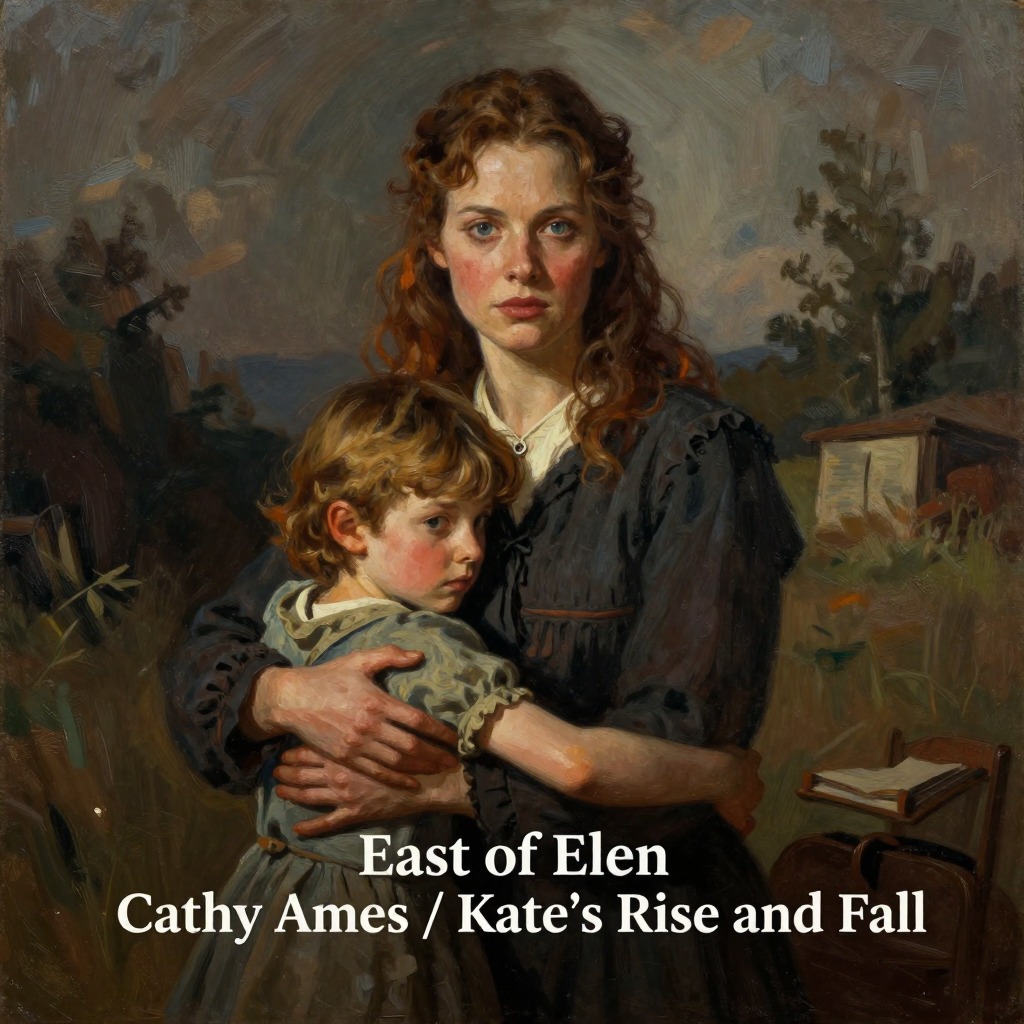
East of EdenThe Ames tannery was the family business of Cathy Ames, located in a small Massachusetts town. Her father, William Ames, operated it with hard work, making a comfortable but careful living. The tannery was a place of honest labor, but it became the stage for Cathy's earliest known acts of calculated cruelty and deception.
Identity and Setting
The tannery was a modest establishment, providing a "comfortable, careful living" for the Ames family through William's diligent efforts. It was situated on the edge of town, with a barn, carriage house, vegetable garden, and a fenced paddock for two horses behind the family home. This setting of ordinary, hardworking respectability stood in stark contrast to the dark events that would unfold there. William Ames was a "covered man," rarely sharing his thoughts, but he was uneasy about his daughter, sensing she was "not like other children." His wife, Mrs. Ames, was more easily manipulated, bound in a "cocoon of gauzy half-lies" planted by Cathy.
Key Events: The Carriage House Incident
The most significant event at the tannery was the discovery of Cathy, at age ten, in the carriage house with two fourteen-year-old boys. Mrs. Ames found Cathy lying on the floor, her skirts pulled up, her wrists tied with a heavy rope. The boys claimed Cathy had initiated the encounter and that they had each given her five cents, insisting they had not tied her hands. Mrs. Ames, however, refused to believe this, and the boys were whipped and sent to a house of correction. Cathy feigned shock and refused to speak, using the incident to solidify her parents' belief in her innocence. This event established Cathy's early understanding of how to weaponize sexuality and manipulate adult perceptions.
Cathy's Manipulation and the Tannery's Role
After the incident, Cathy used the tannery as a site for further manipulation. She feigned interest in her father's business, asking questions about tanning processes, loans, payments, billing, and payroll. She learned the combination to the safe, which she would later use. This interest was a calculated performance to allay suspicion and to gather information. Her father, impressed, told his foreman, "She might be running the business someday." The tannery, a symbol of honest work, became the training ground for Cathy's criminal apprenticeship.
The Fire and Its Aftermath
The climax of Cathy's involvement with the tannery was the fire that destroyed the Ames house and killed her parents. On the day of the fire, Cathy, then sixteen, had been sent to the bank to pick up the payroll money for the tannery. She instead collected chicken blood, hid it, and later that night, the house burned down. The fire was so intense that the volunteers could only wet down neighboring roofs. The coroner found the remains of two bodies, but no trace of Cathy. The tannery's foreman, Joel Robinson, later discovered the safe open and papers scattered, with a broken window indicating a thief. In the carriage house, a quantity of blood and a blood-splattered blue hair ribbon were found, leading the town to believe Cathy had been murdered. The tannery, the source of the family's livelihood, was thus the indirect cause of the tragedy, as Cathy had been sent there to collect the payroll, a task that provided her the opportunity to execute her plan. The tannery itself, however, was not destroyed, and its continued existence served as a grim reminder of the family's destruction. Later, Cathy would use the skills she observed at the tannery—understanding business, learning the safe combination—in her own criminal enterprises, including her management of a brothel in Salinas.