Astley's
EmmaAstley's Amphitheatre, a celebrated London venue for equestrian and theatrical entertainments, serves as the unlikely but decisive setting for the resolution of Harriet Smith's romantic fate. It is here, during a family outing arranged by John Knightley, that Robert Martin finds the opportunity to renew his addresses to Harriet, leading to her acceptance and the final, happy settlement of a match that Emma Woodhouse had once so strenuously opposed. The event at Astley's thus becomes the concrete mechanism by which the novel's long-running tension over Harriet's future is resolved, confirming the wisdom of Mr. Knightley's judgment and the natural pull of a steady, genuine affection over the allure of social ambition.
The Setting and the Occasion
Astley's was a popular London entertainment venue, famous for its dramatic spectacles involving horses, acrobatics, and theatrical performances. In the novel, it is the destination for a party that includes John Knightley and his wife Isabella, their two eldest boys Henry and John, and Harriet Smith, who is then staying with the family in Brunswick Square. Robert Martin, who had come to London on business and delivered some papers to John Knightley, is invited to join the party on the spur of the moment. The group attends a performance at Astley's, and the shared experience of the lively, crowded amphitheatre provides the social cover and the casual atmosphere that allow Robert Martin to speak privately with Harriet.
The Proposal and Its Circumstances
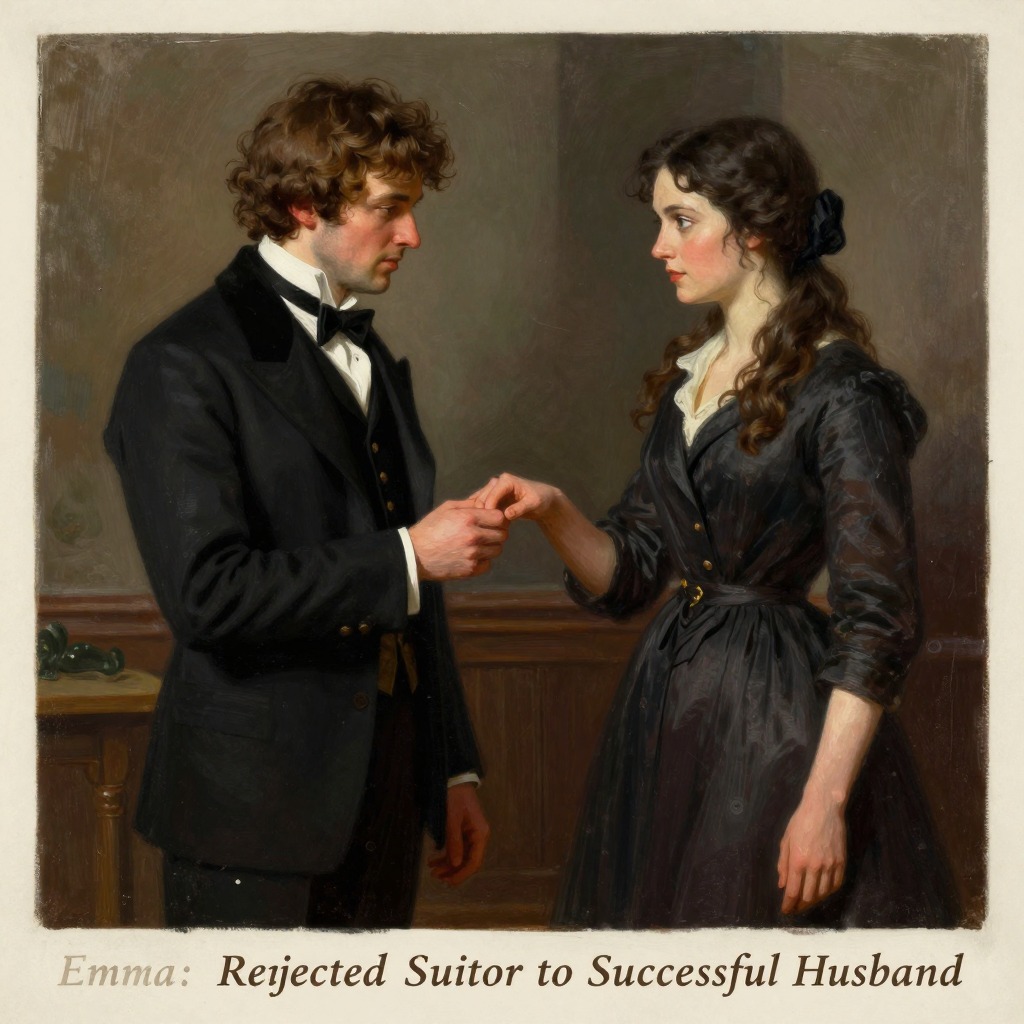
During the course of the evening at Astley's, Robert Martin finds an opportunity to speak to Harriet and proposes to her for the second time. Unlike his first, rejected proposal, this one is accepted. The circumstances of the outing are crucial: the party is a family affair, and the presence of the children and the bustle of the theatre create a natural, unforced setting for the couple to be together. Mr. Knightley later reports to Emma that Robert Martin described the evening with overflowing heart, mentioning that at one point, as they left the box, John Knightley took charge of his wife and little John, while Robert Martin followed with Harriet and Henry, and that in the crowd, Harriet became rather uneasy—a detail that suggests the intimacy and protectiveness of the moment. The proposal itself is not depicted directly, but its success is immediately confirmed when Robert Martin returns to Highbury and reports the news to Mr. Knightley.
Consequences and Significance
The acceptance at Astley's resolves the most persistent source of anxiety in Emma's life. It frees Emma from the guilt of having misled Harriet's affections and from the dread that Harriet might set her cap at Mr. Knightley. The match is, in every practical sense, a good one: Robert Martin is a respectable, intelligent, and prosperous farmer, and Harriet, who is revealed to be the daughter of a tradesman rather than a gentleman, is perfectly suited to the life he offers. The event at Astley's thus serves as the novel's final, decisive turn away from the dangers of romantic fantasy and toward the solid virtues of domestic happiness. It is the last of the three marriages that conclude the book, and its quiet, unpretentious origin at a public entertainment underscores the theme that genuine affection often thrives in the most ordinary circumstances, far from the elaborate schemes of a matchmaker.