The Book People (Granger's Group)
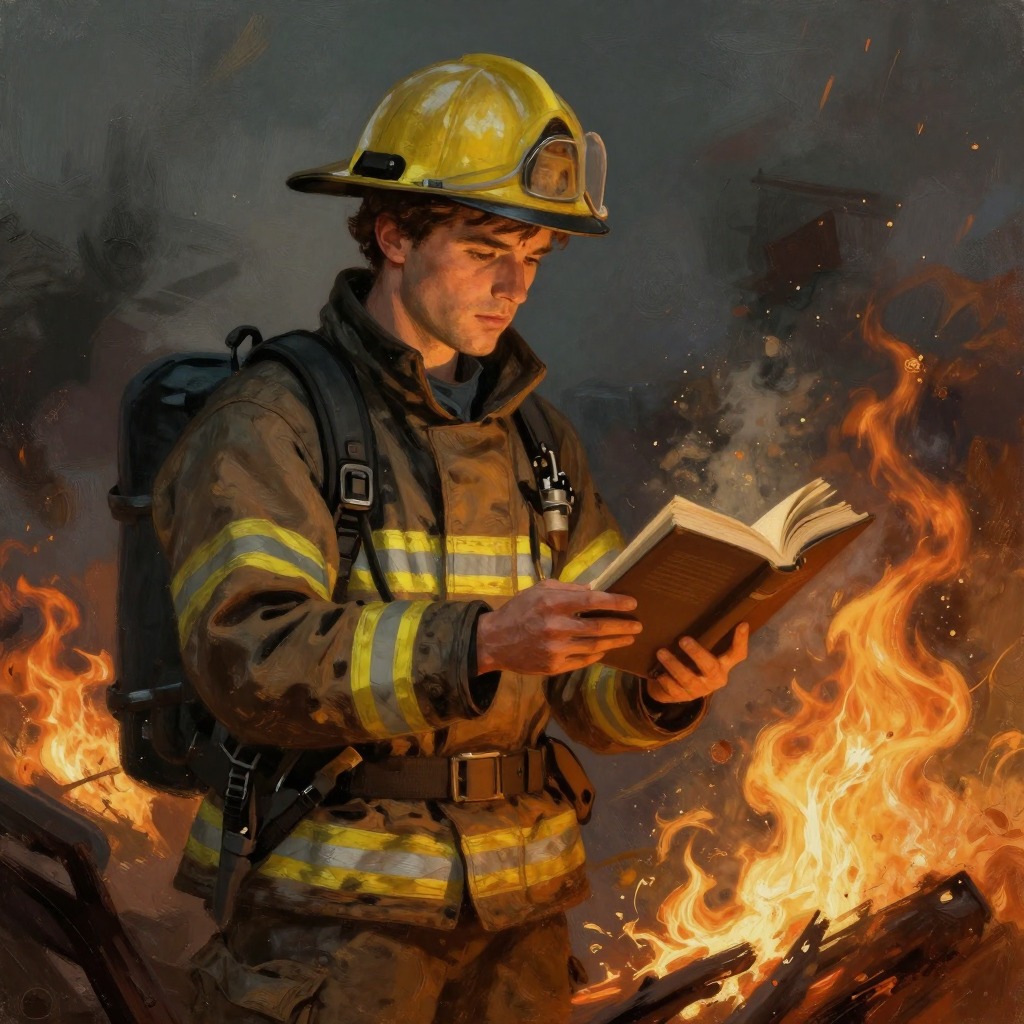
Fahrenheit 451The Book People (Granger's Group) are a decentralized network of wandering intellectuals who preserve the content of banned books by memorizing them, serving as living libraries in the aftermath of a society that has outlawed reading. They represent the ultimate form of resistance in Ray Bradbury's Fahrenheit 451: not the violent overthrow of the firemen, but the quiet, patient conservation of human knowledge in the minds of individuals who have become the books themselves.
Identity and Structure
The group is led by Granger, a former author of a book called The Fingers in the Glove; the Proper Relationship between the Individual and Society. Its members include Fred Clement, former occupant of the Thomas Hardy chair at Cambridge before it became an Atomic Engineering School; Dr. Simmons from U.C.L.A., a specialist in Ortega y Gasset; Professor West, who did quite a bit for ethics at Columbia University; and Reverend Padover, who lost his flock for his views. Each man has memorized a specific text or author: one is Plato's Republic, another is Marcus Aurelius, and others are Jonathan Swift, Charles Darwin, Schopenhauer, Einstein, Albert Schweitzer, Aristophanes, Mahatma Gandhi, Gautama Buddha, Confucius, Thomas Love Peacock, Thomas Jefferson, Mr. Lincoln, and the Gospels of Matthew, Mark, Luke, and John. The group is not a formal organization but a loose network that formed over twenty years as men met each other traveling on abandoned railroad tracks. They are "bums on the outside, libraries inside." Some members have undergone plastic surgery on their faces and fingerprints to avoid detection. The group's structure is flexible and fragmentary, with members living in small towns across the country—Chapter One of Thoreau's Walden in Green River, Chapter Two in Willow Farm, Maine, and the complete essays of Bertrand Russell in a town of only twenty-seven people in Maryland.
Aims and Methods
The group's primary aim is to keep knowledge intact and safe for a future when it might be needed again. They are not out to incite or anger anyone, recognizing that if they are destroyed, the knowledge is dead, perhaps for good. Their method is to read books and then burn them, afraid they would be found. Microfilming did not pay off because they were always traveling and did not want to bury the film and come back later. Better to keep it in the old heads, where no one can see it or suspect it. They are model citizens in their own special way, walking the old tracks and lying in the hills at night, and the city people let them be. They are stopped and searched occasionally, but there is nothing on their persons to incriminate them. The most important thing they had to pound into themselves was that they were not important, they must not be pedants, and they were not to feel superior to anyone else in the world. They are nothing more than dust-jackets for books, of no significance otherwise.
Major Actions and Development
The group's most significant action is their patient waiting for the war to begin and, as quickly, end. They know that the cities will not do well in the next few days. When Montag stumbles upon their campfire by the river, they welcome him without hesitation. Granger gives him a drink to change the chemical index of his perspiration so the Mechanical Hound cannot track him. They watch the televised chase on a portable battery TV set, knowing that the police are faking the hunt and will eventually catch an innocent man to provide a snap ending for their audience. When the bombs fall and destroy the city, the group survives, lying flat on the trembling earth. After the bombardment, they build a fire, cook bacon, and eat slowly, thoughtfully. Granger tells the story of the Phoenix, a bird that burns itself up and is born again from the ashes, but notes that humans have one thing the Phoenix never had: "We know the damn silly thing we just did." He declares that they will go build a mirror-factory first and put out nothing but mirrors for the next year so people can take a long look in them.
Significance
The Book People represent the novel's ultimate answer to the problem of censorship and cultural destruction. They are not revolutionaries but conservators, embodying the idea that knowledge can survive even the most thoroughgoing attempts to erase it. Their method—memorization and oral transmission—is ancient, predating the printing press, and it proves resilient against the firemen's technology. The group's existence demonstrates that the human mind is the most secure repository for what matters most. When Montag joins them, he becomes the Book of Ecclesiastes, and Granger tells him that if anything should happen to the man from Youngstown who also carries that book, Montag will be the sole copy. The group's final walk northward, with Montag leading, suggests a new beginning, a slow rebuilding of culture from the ashes of the old, one memory at a time.