
Main Story Flow
FirebloodMajor events ordered chronologically by story time.
increasing Bearing strength in each event
 decreasing
Bearing strength in each eventdecreasingFounding of Kenatos
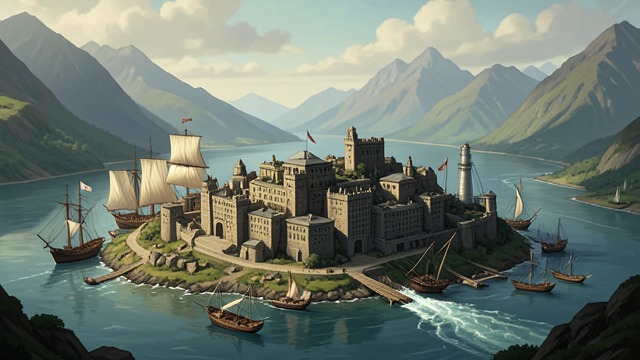
The Founding of Kenatos created an island-city intended to unite neighboring kingdoms through cooperation, shared laws, and common coinage. Its significance lies not only in its construction, but in the civic and commercial arrangements that made Kenatos a regional center while leaving the surrounding kingdoms politically independent.
Site and Construction
Kenatos was founded centuries earlier on an island in a lake. An advisor to the Arch-Rike proposed the site for its proximity to adjacent kingdoms and its defensible position. Construction began with shipyards on the southeastern shore, which took twenty years to build. Ships launched there carried the stone, timber, and animals needed for the city’s construction, making transport infrastructure an early part of the undertaking rather than an afterthought.
The city’s position connected it to the surrounding landscape and its resources. The snow-capped Mountains of Alkire fed the lake and the rivers that flowed from it; ore mined in the mountains traveled by wagon and riverboat to Kenatos. In the broader regional network, goods also moved downriver toward Havenrook, where they could be loaded onto barges or caravans. These routes reveal the material dependencies behind the ideal of cooperation: Kenatos’s place at the center relied on movement between kingdoms, mines, waterways, and roads.
Shared Government and Law
The founding joined political cooperation to common institutions. The kingdoms minted new coins and established laws they could all agree to follow. Kenatos did not claim authority over the kingdoms themselves; its laws were binding within the city. The Bhikhu administered the Arch-Rike’s justice there, giving the shared legal order an identified executor and a defined territorial limit.
This arrangement presents Kenatos as a negotiated civic center rather than an empire ruling its neighbors. Its founders’ authority depended on agreement among kingdoms, while the city’s own laws were treated as inviolate once within its boundaries. The account frames justice as a safeguard against sovereignty becoming organized theft, making law a central condition of legitimate rule rather than merely a tool of power.
Trade, Interdependence, and Legacy
Kenatos’s founding is remembered as an emblem of cooperation among races and kingdoms, and as evidence that wise rulers can work together for civilization’s benefit. The city’s shipyards, common currency, and legal framework gave that ideal concrete form. Its prosperity was also tied to regional commerce: mining and forging in the mountains, river and lake transport, and the circulation of goods through places such as Havenrook formed parts of an interconnected system.
That system could be disrupted. A large fire on the road toward Havenrook was understood to threaten the flow of goods, delay departing caravans, damage cargo, and shift the money won or lost at the Millpond. The contrast underscores the founding’s lasting premise: cooperation can sustain shared prosperity, but that prosperity remains vulnerable wherever transport and trade are interrupted. The founding account therefore links political collaboration to practical infrastructure, while presenting adaptation and cooperation as the qualities by which kingdoms endure.
The Last Plague
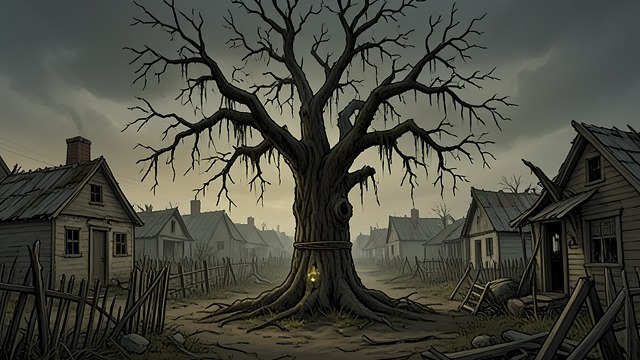
The Last Plague is a recurring catastrophe that has decimated populations across the kingdoms and left abandoned settlements in its wake. Its symptoms change from generation to generation, frustrating attempts to understand or cure it; the uncertainty also shapes the founding purpose of Kenatos, the choices people make during outbreaks, and the disputed explanations offered for the Plague’s origins and transmission.
Recurrence and Human Cost
The Plague returns across generations, but not in a stable form. Accounts describe outbreaks marked in different eras by sores around the mouth and joints, a red rash, white spores, yellow skin, or red flux. The changing signs make the disease difficult to cure, while its speed leaves communities with little time to respond: once it strikes, most of the affected population dies.
That devastation is visible well beyond any single outbreak. In Wayland, Annon passes forsaken farms whose fences have rotted and whose cottages have stood unclaimed since their inhabitants were killed by the Plague. Reeder, who lived through the previous outbreak, remembers whispers that Tyrus led an expedition into the Scourgelands and that the Plague began anew afterward. The story does not establish those whispers as fact, but their persistence shows how the catastrophe attaches suspicion to those who survive it.
The danger extends beyond the immediate loss of life. Some people flee stricken communities, and their movement helps carry the Plague to other cities and kingdoms. A response driven by the wish to escape can therefore widen the reach of the disaster, placing individual survival in tension with the safety of neighboring populations.
Kenatos and Competing Explanations
Kenatos was founded after the Plague had ravaged the kingdoms and diminished their populations. With some races said to have disappeared, the survivors joined in a common effort to preserve knowledge. No single kingdom was to rule the city; instead, its contributors sustained it with books, provisions, and wealth. The founding records preserved there do not say when the Plague began, leaving a central historical question unanswered even as Kenatos became a repository for the past.
The city’s early response also included a religious and political explanation. The Rikes were created when people believed that the Plague was attracted by the population’s thoughts, and they walked the city offering reassuring words intended to reduce panic and sustain confidence. A later account in the Archives identifies this belief as mistaken: the Plague is transmitted through bad air, not thought. The distinction matters because fear, faith, and political authority can shape public conduct even when their account of disease is wrong.
Other communities carry their own suspicions. Some in Havenrook blame the Cruithne’s experiments beneath the earth for causing the Plague, but the Archives dismiss this as an unfounded rumor. By contrast, the Cruithne’s settlement high in the mountains is described as a way to make their territory difficult for traders to reach and thereby reduce exposure. These accounts distinguish a practical strategy of distance from the unsupported claim that a people’s technical work caused the disease.
Memory, Survival, and the Scourgelands
The Plague’s history remains incomplete, and that absence makes testimony consequential. Reeder distrusts what he has heard about Tyrus’s earlier expedition, yet he has seen the small scars on Tyrus’s face and hands and recognizes him as someone acquainted with death. Tyrus’s own recollection is more direct: he entered the Scourgelands believing that he and his companions could destroy the Plague at its source, but the expedition was hunted and killed before reaching the maze’s inner core. He survives, but regards the deaths of those who trusted him as a failure he must carry.
That survival gives the expedition’s account an urgent purpose. Tyrus believes that one of them must escape to warn the Arch-Rike about the next coming Plague, and hopes that a future Paracelsus might read what he has learned and notice what he missed. His mission thus turns the limits of his first attempt into a reason to preserve testimony. The Plague is not only a recurring killer but also a problem whose obscured beginnings and inaccessible source demand continued observation.
The novel resists a simple promise that the Plague can be understood or mastered. An archivist’s maxim holds that some things must be endured rather than comprehended; elsewhere, records preserve symptoms, disputed causes, and the consequences of flight without resolving every uncertainty. The resulting picture is of a disaster that repeatedly forces communities to adapt while leaving them with incomplete knowledge—and with the responsibility to distinguish careful observation from rumor.
Tyrus’s Scourgelands Expedition
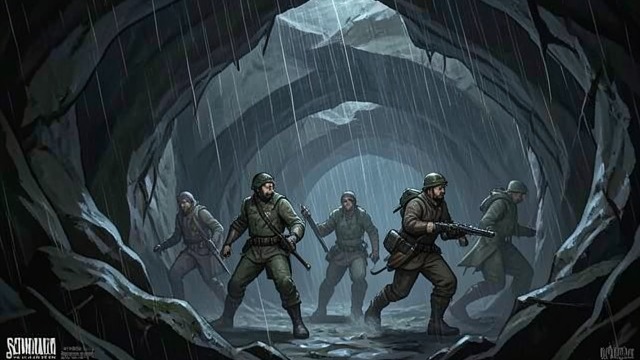
Tyrus’s Scourgelands Expedition begins as a campaign to break the cycle of the Plague by reaching its source and destroying it. Instead, the expedition is lost in a hostile maze before it reaches the inner region, and its companions are killed one by one. Tyrus and the pregnant Merinda Druidecht are the survivors; their escape depends on rain rather than on the plan Tyrus believed would carry them through. The disaster exposes both the limits of his confidence and the cost of entering a land whose dangers the party did not understand.
Purpose and Stakes
The expedition is driven by Tyrus’s ambition to end the Plague, which returns across generations and repeatedly devastates populations and kingdoms. He persuades himself and his companions that they can destroy the source and halt a cycle of death and stagnation. The undertaking is therefore more than a journey into dangerous territory: it is an attempt to prevent future mass suffering by confronting the cause of a recurring catastrophe.
The stakes are sharpened by the expedition’s failure to make meaningful progress. The party does not reach the maze’s inner core or see the enemy that governs the territory. That enemy, however, detects the intruders and responds with overwhelming fury. The expedition is thus turned back before its stated objective comes within reach, while the danger it sought to end remains unexplained and undefeated.
The Expedition’s Collapse
Within the maze, the landscape frustrates escape. Tyrus repeatedly loses his bearings and finds himself moving toward the interior rather than away from it. The party is hunted and killed one by one, and the companions’ losses leave Tyrus with Merinda as the danger closes around them. Their predicament is not presented as a battle won by superior skill: the expedition is broken before the group can confront the force at its center.
The woodland’s dangers also make the party’s situation difficult to interpret. Tyrus and Merinda face attackers while the rain arrives, and the pursuit continues even as the storm breaks. The rain eventually conceals their trail long enough for them to slip out of the maze. It is an accidental reprieve, not a result Tyrus had anticipated or engineered; the weather makes the difference between escape and death after his strategy has failed.
Merinda’s Revelation and Sacrifice
As the two survivors face the threat, Merinda discloses that she and Aboujaoude were secretly married in Kenatos by the Arch-Rike. She is carrying his child. Aboujaoude sacrificed himself so that she could escape, and Merinda asks Tyrus to save her body for the child’s sake. She frames the child’s survival as consequential beyond the family: their blood, she says, is sacred and will save many during the Plague that is coming.
Merinda also reveals that the expedition has helped cause that coming Plague by entering the wilderness. This disclosure reverses the mission’s moral logic. Tyrus had brought his companions north to destroy the source of widespread death; now the survivors must reckon with the possibility that their own intrusion has contributed to another outbreak. The mission’s danger is no longer only what the Scourgelands may do to the party, but what the party’s presence may have set in motion.
When the attackers return, Merinda uses her fireblood to defend Tyrus and herself. She burns the first wave, then protects Tyrus again when another attacker brings him down. Tyrus recognizes that she has unleashed the power to an extent he had never seen before. Her intervention helps them survive the immediate assault, but the escape that follows does not undo the cost of her exertion: she becomes mentally unwell, singing a lullaby and intermittently giggling as Tyrus leads her through the maze.
Escape and Consequences
The storm ultimately gives the pair a chance to leave. As the rain falls, Tyrus keeps his eyes on the ground and pulls Merinda along, resisting the beings’ attempts to command his attention. The weather masks their tracks long enough for both to pass beyond the maze of oak trees that killed the twelve who entered with him. Their survival is therefore partial and precarious: they escape the immediate pursuit, but they do not return with a victory over the Plague or an account of the enemy’s true nature.
Merinda’s appeal makes their next task specific. Tyrus must try to preserve her body and protect the child, even as her mind is giving way after using her power. She gives him the names Annon for a boy and Hettie for a girl, with Hettie recalling her mother. The expedition’s aftermath consequently points away from its original objective and toward the survival of the unborn child, whose future Merinda believes may matter to the wider struggle against the Plague.
Legacy and Narrative Significance
The expedition’s defeat is set against Kenatos’s purpose as a refuge for knowledge. The surviving peoples founded the city after earlier Plague devastations, contributing books, provisions, and wealth in the hope of preserving what repeated catastrophe might erase. Yet the records do not say when the Plague began. The expedition reaches into that gap in knowledge, but the available account offers no confirmed origin or cure; instead, it shows the attempt ending in loss and uncertain responsibility.
Accounts of the Plague emphasize why the mission matters and why certainty remains elusive. Its symptoms vary between outbreaks—sores, rashes, white spores, yellow skin, or red flux—and it can ravage a community quickly, killing most of its people. Those who flee may carry it to other cities and kingdoms, while changing symptoms frustrate efforts to cure it. In Kenatos, the Rikes once sought to limit panic through public assurances, but the Archives’ account rejects the claim that thought attracts the disease and identifies bad air as its means of transmission. Against this background, Merinda’s warning that the expedition has caused the coming Plague remains an urgent disclosure, not a demonstrated explanation of the disease’s full origins.
The failure also gives the journey a pointed contrast between intention and outcome. Tyrus set out to interrupt a cycle of death, but the expedition suffers its own decimation and returns without reaching the enemy. The accidental protection of rain, rather than mastery of the terrain, saves the two survivors. The Scourgelands Expedition therefore stands as a turning point in which the search for a cure produces a crisis of responsibility: Tyrus must carry forward Merinda’s plea, while the source of the Plague and the fate of the wider population remain unresolved.
Hettie’s Abduction and Rescue
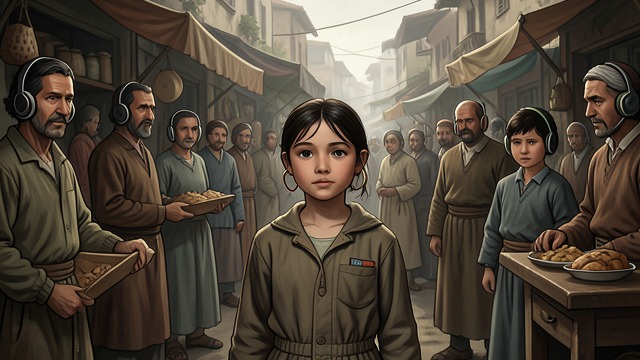
Hettie’s abduction and rescue are a long struggle to reclaim a life treated as property: taken as a baby, marked with a hoop, and subjected to periodic sale, she must find a way to purchase lasting freedom without becoming indebted to those who help her. The revelation that she is Annon’s twin makes her captivity a family wound as well as a social injustice, while her pursuit of Drosta’s treasure turns rescue into a test of whether generosity can remain free of leverage.
The custom that turns childhood into a debt
Tyrus explains that the Romani travel between lands and move goods, but also covet children, whose value rises in a world repeatedly afflicted by Plague. A stolen child is marked with a single hoop in the ear and, at eight, sold for a ten-year term. At eighteen the child is taken back and sold again; for girls, the second sale brings a hoop in the other ear. The cycle may recur, with the price decreasing as the person grows older and another ring added at each sale. What is presented as custom is thus a mechanism of repeated control: a child’s body is marked, a term of ownership is renewed, and age determines the price.
For girls, Tyrus says, a term may include marriage, which lasts only as long as the husband pays again. If he refuses, the woman may be sold to another man. The arrangement is not simply a one-time kidnapping followed by a fixed period of service. It makes continued security conditional on payment and leaves the person exposed to transfer when the term ends. Tyrus describes this system to Annon because he believes Annon must understand the circumstances of the sister he has never known.
The revelation of Hettie’s identity
Tyrus tells Annon that Hettie was stolen as a baby and is almost eighteen, the same age as Annon: they are twins, though they look nothing alike. Her second hoop and sale are due. Annon is astonished that Tyrus did not reclaim her earlier. Tyrus explains that when she was nearly eight he hired a Finder, but the Romani demanded a king’s ransom. He refused to pay, reasoning that she was sheltered, fed, and cared for. The Finder later returned and bought her with his own money, without being asked to do so. Hettie then lived with him in the woods near the lowlands of Alkire for ten years and learned to work as a Finder herself; she eventually found Tyrus and came to the city.
Tyrus says Hettie is staying at a nearby Bhikhu temple, which he sometimes supports with ducats. She can buy her freedom permanently in a single payment and stop wearing the earring, but the sum will be high. Because Tyrus is famous, his direct involvement would raise the price; he insists that he will not bid for her himself, arguing that the price will be more reasonable if he does not. Annon sees the contradiction in this distance: Tyrus is involved, even if he avoids the transaction, and the Romani may still try to extort him. The rescue therefore begins inside a system where even a family’s attempt to help can affect the price demanded for a person.
Hettie’s terms for freedom
When Annon meets Hettie, she asks what Tyrus has told him. He recounts the essential facts: she was kidnapped, is due for another earring, trained as a Finder in Alkire, and must avoid Tyrus bidding for her. He also says that Tyrus has told him of an abandoned treasure in the mountains of Alkire and given him key words to open it, which he was instructed not to reveal until the party reached the site. Annon and Hettie are to seek Erasmus in Havenrook, who knows where the treasure is but not how to retrieve it.
Hettie makes clear that the treasure matters because she wants release from a lifetime of debt. She asks how much Annon expects to receive if he accompanies her, offering him a portion so that their understanding is settled in advance. Annon takes her hand and refuses any share, saying that neither a Druidecht nor, as he understands it, a Bhikhu needs money; he believes Tyrus chose them because they would help freely. Hettie remains wary. She does not yet know how large the treasure is and does not want to owe both Annon and the Bhikhu. Her insistence on agreeing beforehand shows that freedom, for her, includes the right to understand the price of assistance and refuse an obligation that might outlast the rescue.
Annon answers that he will take nothing, distinguishing himself from Tyrus and pointing instead to what he can contribute: his knowledge of the woodlands and abilities that may keep them from danger. If the road becomes hard, he adds, they both have fire. Hettie recognizes his sincerity, while the contrast between his voluntary help and her life of imposed debt remains sharp. His offer does not erase her history or persuade her to abandon caution; it gives her a companion who will not convert the treasure into a claim on her.
Care, coercion, and the meaning of being free
The Bhikhu’s involvement carries a parallel sense of obligation. Master Shivu explains that Tyrus shares his wealth with the temple to settle a debt he believes he owes, though, as Master Shivu sees it, what was given was given freely and what was lost was lost freely. He tells Paedrin that Hettie is Tyrus’s niece and must be kept safe on her journey. The temple’s care is therefore not presented as a ransom or purchase: it is a freely given service, even as Tyrus understands it through the language of debt.
On the road, Paedrin tells Hettie that she is free and need not obey traditions invented to enslave others. He suggests that she could simply leave and go somewhere such as Kenatos, where the Romani could not take her. Hettie replies that traditions can bind more tightly than ropes. When Paedrin asks what punishment she was taught to expect, she recalls no specific penalty: only that it would be extreme, vaguely described and imposed in unspecified ways. She had been a child when she learned to fear it. Her hesitation makes visible a form of control that does not require a guard to be present. Paedrin can name a route away; Hettie has to reckon with a threat planted before she was old enough to judge it.
The story sets this inherited fear beside the language used to justify other systems of forced service. Drosta tells Annon that spirits are captured and bound to power Kenatos’s lamps, whose light produces neither smoke nor heat; he calls the spirits slaves and condemns the practice. The Arch-Rike, by contrast, insists that the spirits serve and will be freed when their commitments are fulfilled, defending their forced labor as necessary to preserve civilization against the Plague. That dispute echoes Hettie’s situation: a system may call itself service, tradition, or a term of commitment, while the person subjected to it has little meaningful ability to refuse or leave. Hettie’s account of vague childhood threats gives that contrast a human measure.
Rescue as an unfinished release
Hettie’s abduction is not undone merely because she is reunited with her family or travels with people who wish her well. Tyrus’s refusal to bid for her keeps the price from rising through his fame, while Annon’s refusal to accept treasure and the Bhikhu’s protection offer alternatives to purchased loyalty. Yet Hettie still needs the money to secure permanent release, and she remains alert to the possibility that help can become another debt. Her path toward freedom therefore depends not only on escaping the next sale but also on retaining agency over what she owes and to whom.
The narrative places Hettie’s personal rescue within a wider argument about power. Annon is taught that Druidecht knowledge is passed from one person to another without books or written words, and he uses that knowledge to help people live alongside the woods without harming sacred trees. Drosta’s account of spirit captivity and the Arch-Rike’s defense of it extend the question from one woman’s treatment to the city’s claims of necessity and preservation. Against these competing justifications, Hettie’s story insists on the concrete stakes of coercion: a marked ear, a sale due at eighteen, an unspoken threat, and the difficult work of making assistance serve freedom rather than replace one form of control with another.
Annon and Hettie’s Reunion
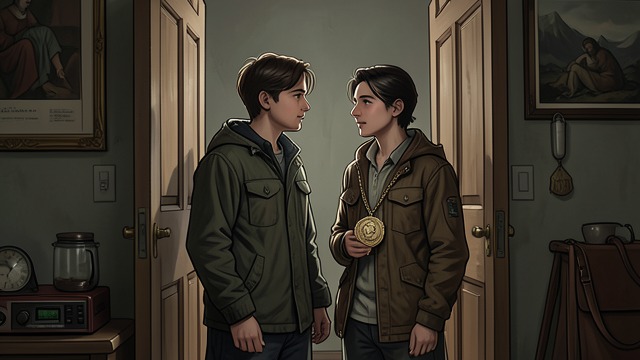
Annon and Hettie’s Reunion turns a secret of birth into a relationship both twins can recognize and choose. Their first meeting in Kenatos confirms that they are siblings through their striking resemblance and shared fireblood, but the reunion is more than a disclosure: Hettie tests Annon’s claim, accepts his help, and refuses to let that help become another debt. The terms they set—trust, kinship, and assistance freely given—resonate beyond their first night together, as the wider story repeatedly connects bonds to duties that cannot simply be priced or dismissed.
The Meeting and Recognition
Hettie opens her door expecting to dislike the person accompanying Master Shivu. She has reason to expect suspicion: many people hate the Romani, and she tries to conceal that part of her identity, while knowing her uncle may disclose it. Instead, she sees a young man her own age whose face resembles her reflection. He is slightly taller, has reddish hair like hers when it is not dyed, and wears the Druidecht talisman. The resemblance makes kinship visible before the story behind it has been explained.
Annon names himself as her brother and says he has come to help. Hettie is so shocked that she cannot speak at first. He tells her they are twins, pointing to their likeness, and explains that he was raised in Wayland by Reeder, learned of his sister only recently, and was summoned to Kenatos by Tyrus two days earlier. Tyrus has told him of Hettie’s circumstances and offered a way to help free her. The recognition therefore arrives with both a family revelation and an immediate purpose: Annon has come not only to disclose their relationship but to act on it.
Hettie does not accept his claim merely because he says it is true. She asks him to demonstrate a secret associated with the fireblood, a persecuted ability in these lands. Annon silently understands what she is asking and kindles blue flames across his fingers. Hettie raises her own glowing hand, and when their palms touch she feels the magic in his blood. She has learned the Vaettir words at the proper age; among the Romani, possessing fireblood has increased her value rather than brought the same persecution. The shared power gives their recognition a physical confirmation, while also revealing how the same inheritance means different things in the communities that raised them.
Kinship Against the Terms of Debt
The reunion takes place against Hettie’s account of her life as a debt. She tells Annon that she wants to be free of it forever and asks how much of the treasure he expects if he joins her. Her question is practical as well as personal: she wants to know the terms of the help before accepting it, and fears becoming indebted to both Annon and the Bhikhu. Her caution reflects the conditions under which she has lived, where freedom has a price and assistance can seem like another claim on her future.
Annon answers that he will accept neither a ducat nor a pent. A Druidecht, he says, has little need of money, as do the Bhikhu, and he believes Tyrus chose them to help because they would do so freely. Hettie warns that he cannot know how large the treasure will be and offers him a portion willingly. But Annon repeats that he wants none of it: his knowledge of the woodlands and ability to guard against certain dangers are what he brings, and if the road becomes difficult, both twins have their fireblood. Their exchange establishes the difference between a paid bargain and assistance offered without a claim to repayment. Hettie’s insistence on clear terms does not disappear; rather, her acceptance must coexist with her determination not to trade one form of dependence for another.
The financial stakes are real. Tyrus has explained that Hettie can buy her freedom with a single payment and stop wearing the earring, but that the required sum will be outrageous; he also says he cannot be visibly involved in the deal without raising the price. At the temple, Master Shivu describes Tyrus’s wealth as support given to settle a debt he believes he owes, although Shivu insists there is no true debt: what was given was freely given, and what was lost was freely lost. He tells Paedrin to safeguard Tyrus’s niece and see her safely on her journey. Against that background, the twins’ disagreement about treasure becomes part of a larger question: whether help must create an account between giver and recipient, or whether it can remain freely given.
A Relationship Chosen Through Trust
The fireblood test does not erase Hettie’s doubts about her uncle. The arrival of a twin she never knew was possible intensifies her question of how Tyrus could have kept such a secret. Yet she separates that anger from her judgment of Annon. When he asks whether she believes him, she answers through her people’s saying that a loud voice can make even the truth sound foolish; she does not need a black ring to know when a man lies. His demonstration gives her the proof she requested, and her welcome into the room changes the encounter from a test of identity into a conversation between siblings.
Annon’s refusal of payment persuades Hettie not simply because it is generous, but because it fits the integrity she perceives in him. She thinks him unwise not to ask for a share, yet cannot doubt his commitment. The contrast unsettles her: she has not been raised to expect help on those terms. She leans forward and hugs him, still disbelieving that the unexpected source of aid is a twin brother. Annon pats her back tentatively, embarrassed by the display of friendship. The gesture is modest, but it marks a decisive change: a stranger who arrived bearing proof and an offer becomes someone Hettie can embrace and ask about his life.
They stay awake through the night talking by the light of a candle Master Shivu had brought, coaxing its remaining wax to keep it burning. Hettie asks about Annon’s upbringing in Wayland, and the conversation gives their new kinship time to take shape rather than leaving it at the instant of revelation. In the scene’s structure, recognition is not only a fact announced by Tyrus or verified by magic. It becomes mutual through questions, explanation, trust, and the slow intimacy of time spent together.
Bonds, Vows, and Responsibilities
Later events place the twins’ reunion within a wider network of relationships defined by promises and duties. Nizeera, a great cat, tells Annon that she trusts him because he is Druidecht and of the fireblood, and that she is bound to obey him. Annon inwardly rejects the idea that anyone serves him; Nizeera insists that her oath was not given lightly. His instinctive reluctance to treat another being’s obligation as his entitlement echoes the ethic he expresses to Hettie when he refuses a share of her treasure. In both cases, the story distinguishes a bond’s existence from a person’s willingness to exploit it.
Other customs make clear that such bonds may carry obligations beyond ordinary kinship. A Dryad explains that tasting a tree’s fruit grants eternal life and that she took it as part of her binding when she became a Dryad at sixteen. Tyrus later describes a Dryad’s choice of a mortal mate as a custom marked by an ankle bracelet worn until the man dies, and identifies the Dryad in the tower as his wife and the mother of his daughter. These later disclosures do not alter the twins’ recognition, but they broaden the story’s interest in how communities make relationships legible through vows, ritual, and shared responsibilities.
The story also returns to kinship in a different register when Annon grieves for Reeder. A girl remains with him and offers a consoling account of death as separation from sight rather than the end of a bond. This moment underlines the emotional pattern first opened by the reunion: relationships matter not only as facts of descent, but through the care people give one another and the memories they carry. Hettie and Annon’s first night together begins with the discovery that they are twins; its lasting significance lies in the decision to treat that discovery as a basis for freely offered help, shared danger, and a connection neither of them had known they were missing.
The Quest for Drosta’s Treasure
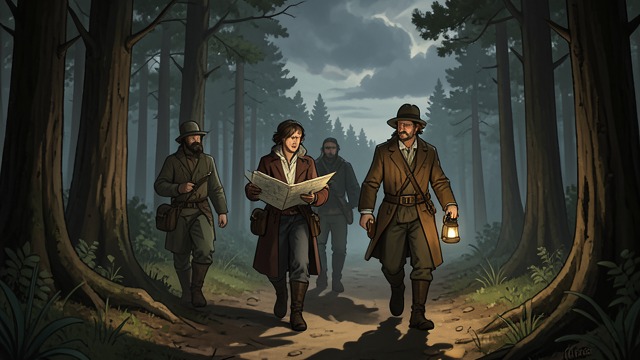
The Quest for Drosta’s Treasure is the expedition that brings Annon and Hettie together as newly discovered siblings and sends them from Kenatos toward Havenrook in pursuit of a hidden prize. Presented by Tyrus Paracelsus as a possible way for Hettie to buy her freedom, the quest turns on a sharp reversal: the treasure is not wealth, and the man who knows its location warns that it has been placed there for safekeeping. Along the way, the promised solution to Hettie’s captivity becomes a test of what freedom and obligation mean to her companions.
The Proposal and Its Stakes
Tyrus explains that Hettie was taken as a child and has lived for ten years with a Finder in the mountains of Alkire. She has become a Finder herself and has come to Kenatos, where she stays at a Bhikhu temple. Tyrus says that she can purchase permanent freedom from the customs that bind her, but that the price will be high. Because his own involvement would raise the price, he will not bid for her himself. His proposed alternative is Drosta’s treasure, said to have been left in the mountains by an earlier Paracelsus, a Cruithne named Drosta.
Tyrus does not claim to know the treasure’s precise location. Instead, he knows a man who does, and he possesses the key words that will open the door. That man lives in Havenrook, and Tyrus identifies him as Erasmus. He has already told Hettie about him and urged her to seek the treasure. He also asks the Bhikhu master to send someone to protect her during the journey, arranging for Reeder to find Annon before Hettie leaves.
Hettie’s immediate deadline gives the expedition its urgency. She believes that she has a fortnight to win her freedom and fears that, when she turns eighteen, she will be sold again. The prospect of buying release does not feel like an abstract matter of money: she describes her whole life as a debt and wants to end that debt permanently. Her concern is not simply whether the group can find the prize, but whether accepting help will create another obligation she cannot escape.
An Escort, Not a Bargain
Master Shivu assigns Paedrin to escort Tyrus’s niece. Paedrin is only seventeen, younger than the usual age for leaving the monastery, but Master Shivu considers the journey exceptional. Paedrin has long wanted to see the world beyond Kenatos, is Vaettir-born, and is the most accomplished Bhikhu student Master Shivu has trained in many years. He is warned that Havenrook and the road through the woods are dangerous, and that Kenatos’s laws, customs, and mixture of people will not prepare him for everything he encounters. Master Shivu stresses that the assignment is a favor to Tyrus, not a pursuit of reward.
Hettie is wary of her new escort. In the temple chamber where she waits, she judges Paedrin quick to speak and take offense, qualities she sees as a risk both to himself and to her goal. Her assessment makes clear that this journey is not a harmonious party setting out with a shared understanding. Hettie has to pursue her own practical objective while accounting for companions whose instincts and principles may complicate it.
Annon, for his part, rejects any share of the treasure. When Hettie offers him a portion in advance so that their agreement is clear, he answers that neither he nor the Bhikhu need money and insists that they are helping freely. He points instead to the skills he brings: as a Druidecht, he knows the woodlands and can help them avoid some dangers; if the road becomes difficult, he and Hettie both have fire. Hettie remains cautious, saying that she cannot be indebted to both Annon and the Bhikhu. Her offer and his refusal establish a conflict of principles within the party: she wants assistance to have explicit terms, while Annon treats freely given help as something that should not be converted into a claim on her.
That disagreement echoes Tyrus’s conversation with Annon about debt. Master Shivu says Tyrus shares his wealth with the temple because he believes he owes it a debt, although the aid he once received was given freely. To Master Shivu, there is no true debt in that exchange; Tyrus’s belief that he owes one does not change the character of the original gift. The expedition therefore carries two different accounts of obligation: Hettie’s lived fear of being bound, and the Bhikhu understanding that help freely given need not be repaid.
The Road to Havenrook
The party’s destination is Havenrook, described by Master Shivu as the seat of Romani power. The approach through the mountains of Alkire emphasizes how different the route is from Kenatos. The mountains feed rivers that run toward the lake on which Kenatos stands, while ore mined there is hauled down to the city by wagon and riverboat. Cruithne forge-fires create patches of artificial fog in the mountain landscape. This movement of resources connects the remote mining country to the city, even as the travelers leave Kenatos’s familiar protections behind.
At the road to Havenrook, Annon notices the signs of a heavily used trade route and of nature under pressure. The road is broad enough for three or four carts abreast; its ruts have been worn to dust by hooves, wagon wheels, and people until even weeds cannot grow there. The travelers pass signs advertising cargo or passage, damaged trees, discarded rubbish, abandoned wagons, and missing wheels. The surrounding spirits have withdrawn from the savaged woods, leaving Annon feeling exposed and depriving him of a source of help he would ordinarily expect in the wild.
Havenrook’s trade network makes the expedition vulnerable to consequences beyond its immediate companions. After a fire on the road, Erasmus estimates that the route has been blocked, stopping goods and delaying caravans prepared to depart. He understands that the interruption will bring financial losses and gains at the Millpond, and warns that the people affected may kill the travelers. The road is not just a landscape crossed on the way to a private prize: its traffic carries goods, livelihoods, and danger, so a disruption quickly draws attention to the group.
Erasmus and the Reversal
Once the travelers reach Erasmus, the expedition’s premise begins to change. He tells them that Kiranrao has searched for Drosta’s treasure for years and that a bounty has been offered to anyone who can lead him to it. Kiranrao, however, does not know that Erasmus knows the location. The disclosure makes the treasure a contested secret, not simply an abandoned fortune waiting for Hettie’s party to collect it.
Erasmus then challenges the assumption that the prize can buy Hettie’s freedom. When she asks why Kiranrao would want still more wealth, Erasmus replies that the treasure has nothing to do with wealth: there are things no amount of coin can purchase, and Drosta’s treasure is not coin. Annon and Hettie realize that Tyrus led them to believe otherwise. Erasmus adds that he cannot believe their uncle would want the treasure in Kiranrao’s hands and says it was placed there to safeguard it.
The revelation changes the meaning of the journey without erasing its original stakes. Hettie set out hoping to exchange the treasure for release from a life she experiences as debt; Annon joined her without claiming a portion; and Paedrin was sent to protect her as an act of service rather than for payment. But the prize they have been promised may not function as money at all, and its concealment appears to serve a purpose that conflicts with handing it to Kiranrao. The quest thus turns from a straightforward recovery-and-ransom plan into a struggle over who understands the treasure, what it is meant to protect, and whether freedom can be secured through an exchange arranged by others.
Havenrook Road Ambush
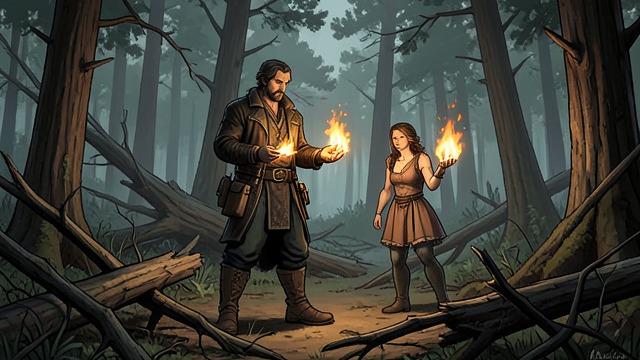
The Havenrook Road Ambush is a roadside attack that turns Annon’s knowledge of the forest into a means of survival, then tests the limits of that response. A self-styled collector uses the language of protection to mask a planned robbery; Annon answers with fire, and Hettie nearly loses control of the same power. Their escape leaves Paedrin confronting both the damage he thinks he has witnessed and the unfamiliar principles by which Annon judges it.
Causes and Setting
The travelers approach Havenrook through a landscape already marked by human disregard. Annon is a Druidecht, one of the few who know how to distinguish sacred trees from those safe to cut. He has used that knowledge to guide Dame Nestra’s woodcutter husband toward a trade that harms the forest less, though the couple do not know the hidden world his teaching helps protect. For Annon, such care is practical as well as spiritual: the woods are shared with beings beyond ordinary sight.
The road presents the opposite picture. Its verge is littered with broken crates, frayed ropes, smashed barrels, and abandoned wagons stripped of their wheels. Trees have been cut or damaged, and Annon senses no spirits in the air. The forest’s absence of life recalls Kenatos to him, a city that also feels devoid of sentient presence. In these woods, he feels unprotected: the companions cannot count on the warnings or safe passage that forest creatures might otherwise grant.
Annon had already proposed using the roadside mess as cover if a wagon train approached. The road’s bends and blind corners make that observation newly significant when the travelers turn one and find a man sitting on a broken wagon. The clutter is not just a sign of neglect; it offers a place for an ambush to form and conceal itself.
The Collector’s Trap
The man introduces himself as a collector of tithes, borrowing the Rikes’ language for the payment he demands. His ostensible offer is protection on the road, priced at three ducats for the three travelers. His manner and weapons belie the claim: he has several knives within reach, and Paedrin detects numerous people concealed in the woods. The collector’s demand is therefore not a reasonable fee but the opening of a trap.
Annon quiets Paedrin with a hand gesture before laying out what he believes the demand means. The travelers are isolated, appear easy to rob, and are being asked to disclose where they keep their purses, sparing the attackers the search after killing them. Annon reads the offer as a routine practice, not an improvised negotiation. He does not accept its pretense of protection; he identifies the violence it conceals and acts before the hidden group can strike.
Fire and Its Limit
Annon speaks the fire-taming incantation, then sends flames into the deadwood and discarded wagon debris beside the road. The dry remains burn, and the blaze spreads across the refuse. Hettie follows his lead, setting other piles alight, while the attackers flee. The action turns the rubbish that concealed the ambush into a barrier and forces the would-be robbers to abandon their position.
For Annon, the power is not a simple weapon. He feels the attraction of releasing more fire, but understands that this desire misleads him: continued use could give way to self-loathing and guilt as the fire begins to govern him. He struggles to master the impulse until the flames on his hands die down. The episode makes the danger internal as well as external; surviving the attackers depends on stopping the power before its exhilaration becomes loss of control.
Hettie does not stop as readily. She continues sending fire toward the fleeing men, and Annon sees that she is no longer attending to him. He grabs her shoulder and calls her name, but she remains unfocused. He strikes her, and the pain brings her back; the flames sputter out, and she nearly collapses before he catches her. The intervention prevents her attack from continuing, but it also reveals how close she came to being carried away by the fire.
Paedrin reacts with shock. He first sees only that Annon and Hettie have set the forest burning and accuses Annon of betraying his role as its protector. Annon explains that fire can renew a forest: some trees release their seeds only after a firestorm, and oaks need fire to grow properly and avoid being crowded out by weaker trees. He also distinguishes the deadwood-strewn, neglected roadside from a healthy forest, arguing that green wood does not burn readily. Paedrin remains troubled by the attackers’ fate, but Annon’s account establishes that the fire is not, in his understanding, simply destruction.
Flight and Disclosure
The companions leave the road with the flames behind them. Paedrin has crippled the collector, and the smoke may be visible as far away as Havenrook; the fire is also likely to halt traffic until it is put out. Annon accepts those consequences and does not turn back. The immediate escape does not erase the cost of the encounter: the attack has transformed a lawless stretch of road into a conspicuous emergency, while the companions have to make sense of what they did to get away.
After they have put distance between themselves and the ambush, Paedrin confronts Annon about the fire and repeats that he thought a Druidecht protected the woods. Annon asks him to trust that he would not knowingly harm a forest. Their disagreement is not only about what happened but about how to interpret it: Paedrin sees a dangerous blaze, while Annon sees fire as an ecological force whose effects depend on where and how it is used.
When Paedrin asks how Annon and Hettie can summon fire, Annon chooses reciprocal trust and explains that the ability is something they were born with. Though they may look Aeduan, he says, their blood carries a power called fireblood. He has not used it this way before and would ordinarily have avoided doing so; in some kingdoms, their people are persecuted, and he intends to use the power only as a last resort. His account makes the ambush a disclosure as well as a fight: necessity has exposed an ability he treats as both dangerous and politically perilous.
Hettie thanks Annon for stopping her and acknowledges that she nearly lost herself in the flames. She then reveals that the men concealed in the rubbish were Romani, not Preachán. Her hatred is evident, but the episode does not explain its cause, and the revelation does not change what Annon had identified about the ambush: its leader presented himself as a collector, while a larger group waited out of sight. For Annon, Hettie’s near-loss of control remains an immediate concern, and he asks how often she has used the power.
Consequences and Significance
The ambush changes the travelers’ understanding of one another. Paedrin has seen Annon and Hettie wield a power he does not know, and Annon responds by entrusting him with its name and origin. Hettie, meanwhile, has both been restrained by her brother and acknowledged the danger she faced. Their escape depends on fire, but the scene refuses to treat power as a clean victory: it leaves smoke, a disrupted road, an argument about stewardship, and a warning about how easily the users themselves may be overwhelmed.
The encounter also sets Annon’s Druidecht knowledge against the road’s damaged condition. Where the unseen inhabitants have withdrawn and the abandoned debris enables human violence, Annon relies on judgment shaped by the living forest and its cycles. His defense is therefore neither passive reverence nor an assertion that every fire is harmless. He distinguishes between a regenerative burn and uncontrolled devastation, and his effort to restrain both himself and Hettie makes that distinction consequential. The road ambush becomes a test of whether such knowledge can protect travelers without reproducing the harm it seeks to resist.
The Millpond Confrontation with Kiranrao
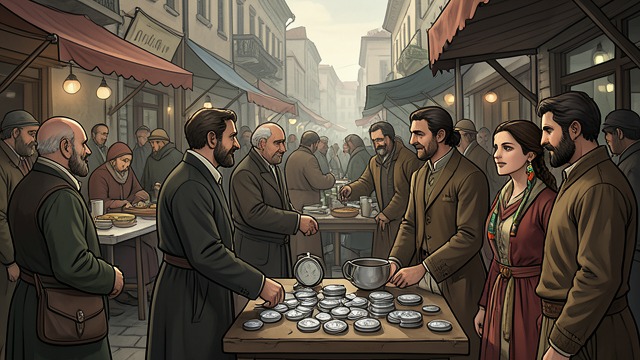
The Millpond Confrontation with Kiranrao brings Annon, Hettie, and Paedrin into direct contact with Kiranrao at Havenrook’s crowded trading house. Kiranrao’s summons makes Hettie’s constrained position visible, while Paedrin’s refusal to be intimidated turns a commercial encounter into a test of power, conscience, and the possibility of saying no. Beneath the immediate clash lies the danger facing the group: their presence has drawn Kiranrao’s attention just as Annon is trying to find Erasmus.
Setting and Arrival
The confrontation takes place in the Millpond, a vast gallery crowded with tables and noisy bargaining. Preachán traders shout and gesture over small silver tokens; goods and wagers pass from table to table. One group trades pears, another bargains over a girl marked by a single Romani earring, while other tables host bets on a caravan’s safe arrival or the outcome of dice. The scene places the characters inside a marketplace where commodities, people, and uncertain outcomes are all subject to negotiation.
The group has reached Havenrook after travelling through country scarred by roads, traffic, and abandoned cargo. The road toward the city is wide enough for several carts abreast, but its ruts have been worn to dust by constant passage, and the woods beside it bear signs of deliberate damage. Annon, a Druidecht, notices that the spirits have withdrawn from the abused landscape. The trade route’s material bustle thus contrasts with the absence of the natural presence on which he relies.
The arrival at the Millpond also follows the journey across the lake to Kenatos and through the surrounding region. Kenatos is an island city connected to its neighbours by trade and cooperation; Havenrook’s road, meanwhile, carries goods and caravans whose movement supports the Millpond’s commerce. When the road is later reported blocked by fire, Erasmus recognizes that the interruption will halt goods and delay caravans, showing how quickly local conflict can ripple through the trading network.
Kiranrao’s Summons
Inside the gallery, Hettie notices Kiranrao watching her from across the room. He sits among Romani companions and Preachán amid the commotion, wearing a jeweled doublet and a black ring associated with a Rike of Kenatos. His relaxed posture does not conceal how quickly he has observed the newcomers. When he raises a hand to touch the gold hoop in his ear, Hettie understands the gesture as a summons and tells Annon that she must obey.
Annon tries to stop her, but Hettie insists that he does not understand Kiranrao’s reach. She describes him as someone who can buy anyone or anything and says that no one defies him. She asks Annon to find Erasmus quickly, then goes to Kiranrao’s group. The episode establishes that her apparent compliance is not simply a freely chosen response: the fear surrounding Kiranrao’s power shapes what choices seem available to her.
Kiranrao says that he knew every Romani in Havenrook until Hettie appeared. He wants a Finder and asks whether she is available for hire. When she declines to take another engagement while her current work remains unfinished, he offers to pay more than her existing prospective employer. He also takes an earring from his pocket; Hettie pales, then says she cannot accept a new job at that time. The object and her reaction make the offer more than ordinary recruitment: Kiranrao’s wealth and the earring connect his proposal to the pressures governing Hettie’s life.
Hettie maintains that abandoning a customer would damage her reputation and says that she may seek him out if she later needs work. Kiranrao accepts the refusal for the moment, putting the earring away. The exchange therefore stops short of a new agreement, but it does not erase the imbalance between them. Hettie’s careful explanation and Kiranrao’s reminder that she knows where to find him leave his influence present after the immediate encounter has ended.
Paedrin’s Challenge
Paedrin is present behind Hettie when she turns away from Kiranrao. Her expression carries surprise and tightly controlled emotion; she clips Paedrin’s arm with her shoulder as she passes. He watches her go, then turns back to Kiranrao and remarks that he admires the man’s sword, which seems to appear and disappear beneath his cloak. Kiranrao recognizes Paedrin’s sharp eye but says he has no use for a Bhikhu in his business, since too much conscience is bad for it.
Paedrin answers that Bhikhu do not work for hire and that some people cannot be bought. The exchange sets Kiranrao’s commercial power against Paedrin’s declared ethical independence. Kiranrao calls him a fool; Paedrin replies that he is the best Bhikhu in the temple apart from Master Shivu. He then notices Kiranrao’s ring and appears to listen to it before leaving without waiting to be dismissed.
Kiranrao tells Paedrin not to turn his back on him. Paedrin pauses without turning around and challenges him to use the sword if he expects it to humble him. Kiranrao does not attack; instead, he says that the Bhikhu temple needs to learn humility. The threat broadens the encounter beyond a personal disagreement, suggesting that Kiranrao’s authority can extend to institutions as well as individuals.
Paedrin’s defiance is not merely bravado. He believes that the men at Kiranrao’s table are not a threat to him, and he uses their attention strategically. He draws Hettie close and tells her that he wants the group to be noticed rather than Annon, whom he believes has found Erasmus. He also says not to look toward the far corner where Erasmus is. Hettie pushes Paedrin away, but his maneuver buys time for Annon’s search and redirects the room’s attention.
The Search for Erasmus and the Confrontation’s Aftermath
While Paedrin and Hettie remain in a heated exchange with Kiranrao’s company, Annon keeps his attention on finding Erasmus. Annon later sees the two together across the room and asks when he can speak with Erasmus. The person assisting him warns that Kiranrao has already noticed him and advises remaining beneath Kiranrao’s notice. Erasmus has left before their arrival, and the Millpond is becoming rowdy enough that a fight may break out. Annon plans to gather his friends and meet the contact outside, withholding a warning that could expose Hettie’s abilities and choosing instead to extend a measure of trust.
The danger soon reaches beyond the tavern. At Erasmus’s home, a fire on the road is identified as a likely cause of disruption: goods will stop moving, caravans will be delayed, and cargo may be ruined. Erasmus assumes the group deliberately caused the fires and warns that people in Havenrook may kill them for far less. This later assessment gives the Millpond encounter a practical consequence: in a town where commerce and reputation carry immediate force, attracting attention can put the group at risk even when Paedrin’s display is intended to protect Annon.
Significance
The confrontation stages two forms of power in the same crowded room. Kiranrao commands wealth, status, and the capacity to summon Hettie; Paedrin answers with a moral boundary, insisting that neither employment nor fear can make every person purchasable. Hettie’s refusal is real but circumscribed: she declines the new engagement, yet her reaction to the earring and her insistence that she must obey show why the encounter cannot be reduced to a simple negotiation between equals.
The Millpond’s tables make that tension visible. Pears, wagers, a marked girl, and prospective work all appear within the same commercial din, where value is assigned and exchanged. Against that setting, Paedrin’s declaration that some people cannot be bought becomes both a direct rebuke and a statement of principle. His choice to attract Kiranrao’s notice also carries a cost: it shields Annon’s search for a short time but exposes the group to the hostility that follows when powerful interests are challenged.
The Mob Attack on Erasmus’s Home
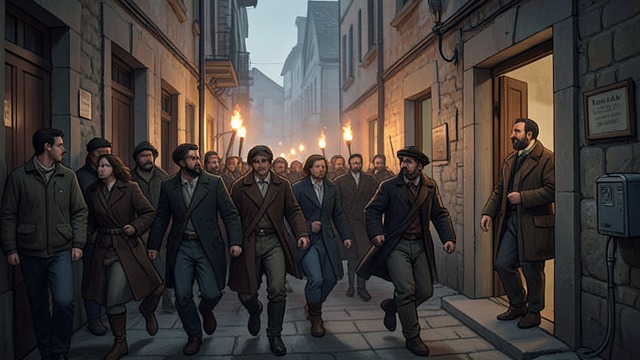
The Mob Attack on Erasmus’s Home brings the consequences of the road fire to Erasmus’s doorstep: a crowd gathers in Havenrook, and the attempt to get Annon, Hettie, and Paedrin away becomes a stand against a much larger force. Paedrin’s intervention buys the others time, while his refusal to kill his principal opponent preserves the Bhikhu ethic at the very moment that revenge becomes a likely consequence.
Causes and Immediate Danger
Erasmus traces the danger back to a large fire on the road. From the smoke plume’s size and direction, he reasons that the road has been blocked, interrupting caravan traffic and threatening commercial losses. The interruption, he warns, will cost some people money and make others money at the Millpond; in Havenrook, such stakes can turn quickly into mortal danger. He believes Annon’s group deliberately caused the fire and predicts that people in town will pursue them.
When torches appear in the street, Erasmus realizes the pursuers have already found their way to his dwelling. He orders his guests to leave by the back, tells them to return to Kenatos, and says that he and his household will delay the crowd. His harsh judgment of their trust in Annon’s uncle accompanies a practical warning: the pursuers are close, and escape is still possible only if the group acts at once.
The Escape and Paedrin’s Stand
Dwyer takes up a cudgel and offers to buy the fugitives time, directing them toward the woods and warning that darkness will conceal them only briefly if the pursuers hire a Finder. Erasmus prepares to help, even pausing to pull on wool socks and sturdy boots. The threatened household is also a store of accumulated work: as Paedrin listens to the mob outside, he thinks of the books of poetry and translations inside, the product of years of labor and now in danger of being lost.
Paedrin initially lets Annon and Hettie go ahead, then circles around the dwelling as torchlight grows brighter at the front. The crowd’s anger rises; a stone breaks the front window, and someone tries to set the house alight. Paedrin recognizes that the bolted door cannot hold such a mob. He climbs to the roof and, once the crowd’s attention is drawn to him, jumps down onto the man carrying the flaming bottle. He then uses his staff to drive back the attackers, choosing to disable them rather than kill them.
The Armed Opponent
A bearded man Paedrin recognizes from Kiranrao’s table emerges from the crowd, and the others make way for him. Unlike the drunken attackers, he moves with control and carries a dagger whose hilt contains a glowing stone. The weapon’s light goes out when Paedrin takes it from him, and the dagger suddenly feels heavy. The encounter makes the threat more than a matter of numbers: this opponent is armed with an enchanted weapon and intent on fighting Paedrin directly.
Paedrin manages to turn the man’s attack aside and disarm him. He is hurt in the struggle, but does not let that show as they face one another. The man reaches for another blade, and Paedrin disables him sufficiently to keep him from pursuing the fleeing party. Their confrontation leaves both the immediate escape and Paedrin’s own conduct hanging on a choice: he has the power to kill a dangerous enemy, but does not use it.
Bhikhu Restraint and Aftermath
Paedrin considers killing the man because he expects him to seek revenge and believes the man would not spare him in the reverse situation. He nevertheless holds to the Bhikhu principle that even a miserable life is too sacred to take. His opponent’s hatred does not cancel that obligation; Paedrin understands restraint as the standard he must meet, not a response dependent on the other man’s character. He acknowledges the opponent with a subtle nod while leaving him unable to follow.
No one steps forward to replace the defeated man. Paedrin retrieves his staff and walks away from Havenrook carrying the now-heavy dagger. He knows that if he returns, he will die. Thus the defense succeeds in creating an opening for escape, but not in restoring safety: the attackers have been driven back, the household and its books remain in danger, and Paedrin leaves with a clear expectation of future retaliation. The episode sets the crowd’s collective violence against the individual discipline of a Bhikhu, while making that discipline costly rather than effortless.
The Briarling’s Liberation
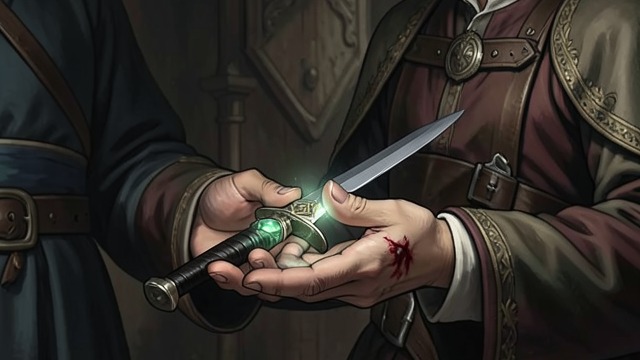
The Briarling’s Liberation marks a decisive turn in Annon’s understanding of spirit imprisonment: a dagger that appears to contain a glowing stone proves to be a prison, and freeing its captive heals Paedrin. Annon’s knowledge of Druidecht and his command of fire make the release possible, but the encounter’s consequence reaches beyond the wounded companion. It reveals the spirit’s captivity as one instance of a larger practice that Annon fears may extend to many beings.
The Dagger and Its Hidden Prison
The event begins when Paedrin tosses Annon a dagger he had claimed in Havenrook. Annon notices its unusual weight and the glow from the object set in its hilt. On closer inspection, the apparent stone is a round glass orb, no larger than a child’s toy, attached to the blade by an intricate mesh of metal. The familiar feeling it stirs in Annon is not yet a full explanation, but the construction of the hilt makes the object’s concealed nature available for investigation.
Annon pauses Hettie as she prepares supplies to stitch Paedrin’s wound. He examines the dagger instead, holding its handle in his palm and concentrating on its metalwork. The order of attention matters: before treating the injury, he tests the object that caused it. What seemed to be a weapon with an unusual ornament becomes something more troubling—a vessel built to hold a spirit.
Fire as a Means of Release
Annon speaks the fire-taming words, then deliberately feeds the flame with his anger. He directs it at the metal weave, allowing the fire to soften the metal without burning his hands. As he focuses on the band around the orb, smoke rises and the metal gives way. The orb drops free, cracks on the ground, and releases a burst of light.
The light is not merely an effect of the breaking glass. Annon hears a spirit’s voice, and the freed being identifies itself as one of the Briarlings. It says it has been trapped for three centuries and thanks Annon for its release. Annon can see the spirit as a small, thorn-covered creature; the others have seen only light. That difference establishes that the liberation depends not only on physical intervention but also on Annon’s particular ability to recognize the being hidden inside the object.
Paedrin’s Healing and the Spirit’s Departure
The Briarling acknowledges that its power had wounded Paedrin and offers to heal him. It flies to him and enters the wound; the cut closes before the group’s eyes. The healing is therefore a direct consequence of the release, not an act Annon performs himself. The spirit chooses to repair the harm associated with its captivity and then announces that it can at last go to Mirrowen. Its light disappears into the woods.
Afterward, Annon looks at the warped metal in his hand and explains that he did not heal Paedrin: he freed a spirit from a prison, and the spirit chose to heal the person it had wounded. Paedrin had understood the glow as light, while Annon recognized the captive within it. The altered dagger makes the distinction concrete. Its value as a weapon has been undone, exposing the imprisonment that its elaborate construction had concealed.
A Wider System of Captivity
The release expands Annon’s concern from this single Briarling to the possibility of many captive spirits. He remembers visiting his uncle a few days earlier and seeing dozens of orbs on the uncle’s desk. The memory fills him with anger as he considers what beings might be trapped in them: not only Briarlings, but different species of spirits, unable to speak and imprisoned. The dagger encounter does not establish what each orb contains, but it gives Annon a reason to fear that the scene at the desk concealed further captivity.
This fear connects the event to Annon’s broader Druidecht understanding of the woods. He has learned to recognize spirits as inhabitants of an unseen world called Mirrowen, and he understands his role as an intermediary between them and the mortal world. He has also relied on that knowledge to guide people through the forest and distinguish sacred trees from those that can be cut. In this episode, such knowledge becomes a practical means of resistance: he identifies a captive that others perceive only as an object or a light, then uses fire to break its confinement.
Anger, Judgment, and the Meaning of Release
Annon’s anger is both the fuel for his intervention and a risk he must regulate. He channels it carefully enough to soften the metal without harming himself, but the pleasure of wielding the power becomes noticeable to him. After the Briarling’s departure, his thoughts turn to the orbs at his uncle’s desk and his fingers begin to glow. Hettie grips his arm and warns him; Annon tries to master himself. The event thus leaves him with two linked responsibilities: to oppose the imprisonment of spirits and to govern the anger through which he acts.
The Briarling’s Liberation also reframes the dagger’s earlier violence. The captive spirit’s power had injured Paedrin, yet once freed it chooses to heal him. Annon’s response does not treat the creature as a weapon to be controlled or a source of harm to be destroyed. He identifies the prison, opens it, and allows the spirit to decide what follows. Its departure for Mirrowen closes this encounter, while the remembered orbs leave its larger implications unresolved.
Kenatos的建立
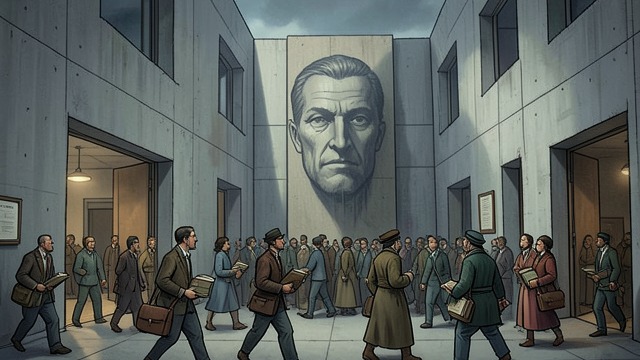
Kenatos’s founding transformed the aftermath of the Plague into a collective project: peoples and kingdoms joined to preserve knowledge, crafts, and ways of life that catastrophe had put at risk. Conceived as a refuge belonging to no single kingdom, the city’s survival depended on shared resources, cooperation, and the defense of a common purpose.
Origins and Purpose
The Plague’s beginning was not recorded, but its reach was immense: every kingdom was ravaged, populations were decimated, and some races disappeared. Survivors joined in the cause of preserving knowledge, establishing Kenatos as what the account calls the last bastion of knowledge. Rather than placing the city under one kingdom’s rule, its founders made its continued existence a shared responsibility: each contributed books, provisions, and wealth.
The founding account also describes an invitation to all races and peoples to send representatives who could live together and preserve their traditions and knowledge. The undertaking answered not only the loss of written and practical learning, but also the disappearance of crafts and cultural inheritance. Kenatos was therefore founded as both a repository and a place of collective life, where the survival of distinct traditions was tied to cooperation among their custodians.
Site and Construction
The city was established centuries earlier on an island in a lake. An advisor to the Arch-Rike proposed the location because it lay near the adjacent kingdoms and could be defended. Its position joined practical accessibility to protection: the island could serve as a meeting point for the surrounding peoples while resisting attack.
Construction required a large logistical effort. Shipyards were built along the southeastern shore over twenty years, and ships ferried the stone, timber, and animals needed to begin building the city. The account’s emphasis on this long preparation presents Kenatos not as a sudden refuge but as a coordinated undertaking, dependent on transport and contributions from beyond the island.
The city remained connected to a wider network of movement and resources. Its fires produced a persistent haze above the island, while gulls circled over the lake. Farther away, the Mountains of Alkire supplied ore that was carried to Kenatos by wagon and riverboat; their snowpack also fed the rivers flowing toward the lake. These links place the city within a regional system of exchange rather than apart from it.
Defense and Shared Survival
The Boeotians refused the invitation to join Kenatos and vowed to destroy it. For centuries they attacked the island by boat, and some attempted to build an earthen bridge to reach the city. Each assault was repelled. Attempts to negotiate also failed: the ambassadors sent to the Boeotians were killed, while the Druidecht alone were said to be able to pass safely through Boeotian territory.
The account credits the city’s survival to the other peoples banding together to protect it in its infancy. This defense gave practical force to the founding principle of shared responsibility. Kenatos endured not because its founding promise removed conflict, but because communities with different origins sustained a common defense against a persistent threat.
Legacy and Significance
Kenatos became an enduring emblem of cooperation among races and kingdoms, and a monument to the possibility that rulers could work together for civilization’s benefit. Its founding establishes preservation as a collective undertaking: books, provisions, wealth, cultural representatives, and military protection all mattered to the same goal.
The narrative also frames adaptability, rather than strength or intelligence alone, as essential to survival. Kenatos embodies that claim in its institutional design: no single kingdom rules it, and its existence depends on contributions and collaboration across political boundaries. Its history thus makes the city both a refuge from the Plague’s devastation and a continuing test of whether its peoples can maintain the cooperation on which that refuge was built.
阿布贾乌德一行深入Scourgelands的远征
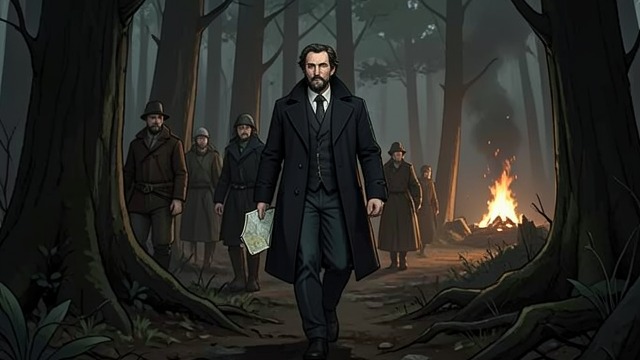
The expedition led by Tyrus into the Scourgelands is remembered as a failed attempt to investigate the Plague’s source and find a way to stop it. Its immediate cost was the death of Aboujaoude and the loss of the other companions who entered the region with Tyrus; its longer consequence was to turn Tyrus’s unfinished inquiry into a dangerous challenge to the Arch-Rike’s authority and a defining inheritance for Aboujaoude’s children, Annon and Hettie.
Purpose and Stakes
Tyrus believed the changing Plague that had devastated different peoples came from the Scourgelands. He understood its shifting forms not as separate afflictions but as disguises of one continuing Plague, and believed that the answer to stopping it lay hidden in the region. His pursuit was also historical: he suspected an ancient betrayal, perhaps involving a promise made by a Paracelsus, whose forgotten circumstances might explain the crisis. He had spent his life assembling clues, but the expedition was an attempt to find what the surviving record could not provide.
The stakes were not limited to knowledge. Tyrus later told Annon that the Arch-Rike would do anything to prevent him from ending the Plague, because its end would cost the Arch-Rike power and authority. Tyrus therefore treated his research as both a rescue project and a political conflict. The expedition’s failure did not settle either question; it left him convinced that the truth remained in the Scourgelands while making further pursuit more perilous.
Loss and Tyrus’s Return
The expedition ended with the deaths of its members, as Tyrus later recalled: everyone who had gone with him into the Scourgelands had died. Among them was Aboujaoude, a Bhikhu whom Tyrus had regarded as exceptionally gifted. When Tyrus encountered Merinda alive, he asked where Aboujaoude was, unable at first to complete the thought that his companion might be dead. Merinda answered plainly that he was. Her survival beside Tyrus made the expedition’s losses personal and immediate, rather than merely a failed tally of a company.
Tyrus saw himself as responsible to the dead. He remembered that the companions had trusted him and that he had failed them; he judged himself foolish and unprepared for the dangerous beings within the Scourgelands. Yet he believed one survivor had to carry back a warning: another Plague was coming, and the Arch-Rike needed to know. His determination to live was thus bound to testimony and future action, even as guilt threatened to overwhelm him.
The Expedition’s Political Aftermath
Tyrus’s account to Annon places the expedition within a longer struggle. He said that the Arch-Rike had opposed his effort before, and that on the previous attempt everyone who accompanied him had died. He nevertheless remained certain that the Scourgelands held the means to end the Plague. In his view, the Arch-Rike’s resistance was not a disagreement over method alone: it protected the authority that would be diminished if the Plague were stopped.
By the time he spoke to Annon, Tyrus described himself as an outlaw in Kenatos and believed that his proximity placed others in danger. The expedition had therefore left him with a divided obligation: continue the work he thought could save lives, while trying to spare his nephew and Hettie from the consequences of joining him. His farewell was an attempt to separate them from that danger, not a conclusion to his pursuit.
Aboujaoude’s Family and the Inheritance of the Quest
The expedition’s most consequential revelation about Aboujaoude came later, when Tyrus answered Paedrin’s question about the Bhikhu’s death. Aboujaoude had died in the Scourgelands before Paedrin was born, while supporting Tyrus’s cause and knowing his motives. Tyrus then disclosed that Annon and Hettie were Aboujaoude’s twins. The expedition thus connected the lost company to the present group not only through its surviving witness but through the parentage of the two young people who had become involved in Tyrus’s plans.
That disclosure changed the meaning of the expedition’s sacrifice. Aboujaoude was not simply a renowned Bhikhu who had died on a dangerous journey; he had deliberately given his life for a cause whose full history his children had not known. Annon’s immediate questions about his father and his own upbringing show how the revelation opened a personal mystery alongside Tyrus’s larger search for the Plague’s origin. The expedition remains both a failed mission and the event from which its unfinished responsibility passes to a new generation.
Shatalin寺院的覆灭
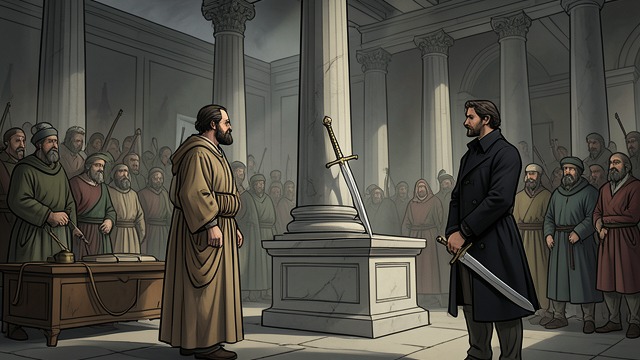
The fall of the original Shatalin temple began when Cruw Reon, an exceptionally swift and ambitious Bhikhu student, drew the Sword of Winds in pursuit of power over other kingdoms. The act blinded him forever, and his refusal to relinquish the weapon brought the temple down; the knowledge that might have addressed his blindness survived, but was separated from the sword.
The Hidden Temple
Master Shivu reveals the temple’s history while speaking with his imprisoned pupil, Paedrin. The Bhikhu temple familiar to Paedrin in Kenatos is only a shadow of the original: a replica, and an inferior one. The first Shatalin temple was concealed in the mountains, and only Vaettir studied there or could reach its heights. Shivu says that he entered it as a boy and later left with a small band seeking to escape its fate.
That disclosure revises Paedrin’s understanding of the Bhikhu tradition. He had assumed the original temple stood in the woods of Silvandom. Shivu’s account instead places its origin in an inaccessible mountain sanctuary and makes the present temple a remnant of a lost institution.
Cruw Reon and the Sword
Among the students at Shatalin was Cruw Reon, who had bested the masters and moved faster than anyone else. Shivu describes his power as extending beyond Bhikhu skill to his words and speech: his influence helped corrupt the temple through pride. The disaster sharpened when Cruw sought the Sword of Winds, a weapon traditionally approached only by the most virtuous and used only to defend the temple from attack.
Cruw’s purpose overturned that restriction. He took the sword from its casing and drew it from its sheath, intending to conquer other kingdoms and rise to the heights of power. The weapon’s sacred defensive role thus became an instrument of personal ambition. Paedrin listens, holding his breath as he looks into Shivu’s eyes.
The Fall and Its Unresolved Legacy
When Cruw drew the sword, he went blind and remained blind forever. He would not give up the weapon, and so could not learn how to cure his blindness. Shivu identifies the lost temple with that moment: Shatalin fell that day, as Cruw’s grasp on the sword made recovery impossible.
The answer to Cruw’s blindness had been written in the Book of Shatalin and smuggled away by Shivu’s own master. Shivu now possesses the book and knows the secret, but the book and sword cannot be brought together: the book is held in the archives and cannot leave Kenatos, while the sword will never leave the temple. The survival of the knowledge therefore does not undo the catastrophe. Shivu looks back on the unprevented rise of Cruw’s madness as a turning point whose consequences still reach the present, lamenting that so many lives might have followed a different course if someone had acted earlier.
A History Used as Warning
Shivu’s account is not merely an origin story for the ruined temple. As he grips Paedrin’s hands through the bars, he compares the young Bhikhu’s pride and ambition to Cruw’s and invokes the temple’s fall to justify what he intends to do. He tells Paedrin that preventing another tragedy requires his death and the restoration of Bhikhu tradition and honor, then declares that Paedrin is no longer his pupil or bound to the Bhikhu.
The parallel turns a history of institutional collapse into a present threat. Shivu treats Cruw’s ambition as a warning against power unconstrained by virtue, but applies that warning to Paedrin with a severity that makes preservation itself coercive. The lost temple’s legacy thus persists not only in the separated book and sword, but in the choices made in its name.
Iddawc的锻造与封灵
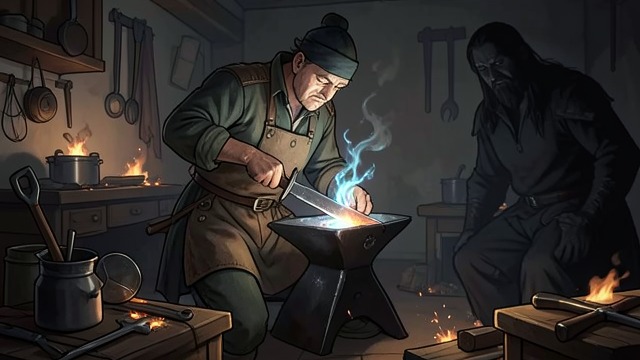
Iddawc’s forging and binding began as an attempt to make a spirit into a source of power and ended with the creation of a weapon that could not be unmade. Drosta Paracelsus later explained that he had fashioned the blade and helped the spirit within it transform, making his own vanity and the pursuit of power the roots of an enduring danger.
Discovery and Forging
The Cruithne discovered the being that would become Iddawc deep in the mines. They did not understand its capabilities until many had been killed; a Druidecht warned them, but Drosta admits that he was foolish to see the spirit as something valuable to trap. He devised a plan, and the Arch-Rike approved the price. Drosta does not disclose what that price was, saying only that it would be unseemly.
The plan did not simply imprison the spirit. As Drosta later acknowledged, he and his people helped it transform. The blade he made became a spirit weapon, with a spirit hosted inside it and named Iddawc. Drosta calls the result an evil thing brought into existence through vanity and pride: an effort to create a weapon that could conquer death.
Power and Limits
Iddawc serves only one master at a time. It seeks a powerful person and subverts that person; when its master dies, it looks for another. Its blade can sever a life with a single cut, and Drosta describes it as possessing power over death. The weapon’s hunger is therefore not a fixed allegiance but a continuing threat: possession gives it a route to influence, while a master’s death only begins the search again.
The weapon cannot be destroyed. Drosta says it will persist until its term of service ends, a span far beyond his lifetime or even a dozen lifetimes. It was bound for ten generations, and only the second generation had begun. Because destruction was impossible, hiding and safeguarding it were the remaining ways to keep it from claiming further victims.
Commission and Concealment
The Arch-Rike commissioned Iddawc for the Quiet Kishion, his most feared protector, but the weapon was never used in that role. Tyrus of Kenatos arranged for it to be stolen and hidden from the world, specifically to prevent it from claiming more victims. The theft did not resolve the danger: Iddawc remained intact, capable of seeking a master, and in need of continued protection.
Drosta’s account to Annon takes place as the group is approaching a gateway to Mirrowen. He identifies the blade Annon carries as the Iddawc he made, then explains its history and insists that Annon understand both its nature and the risk of treating it as an ordinary weapon. The revelation turns the blade from an unexplained possession into the surviving consequence of a failed attempt at spirit-binding.
Responsibility and Significance
Drosta presents Iddawc’s creation as both a personal failure and an institutional one. The Arch-Rike authorized the price, and the Cruithne’s craft contributed to the creation of the Paracelsus Order; Drosta nevertheless names his own pride as the decisive mistake. His later work to repair the harm done to the spirits of Mirrowen gives his confession a clear consequence: he has become an adversary of the practice he helped establish.
Iddawc embodies the contradiction at the heart of the attempt to master death. Its makers sought power over mortality, but produced a weapon that kills, seeks successive masters, and cannot be destroyed for generations. The only remedy Drosta can offer is restraint: recognize the spirit within the blade, do not mistake its power for safe service, and keep it hidden.
Iddawc从Arch-Rike宫殿被盗
Iddawc’s theft from the Arch-Rike’s palace removes a weapon designed to wield power over death from the ruler who commissioned it, setting off a struggle over who should control it and why. The blade’s purpose is contested from the start: Tyrus arranged its theft to keep it hidden and prevent further deaths, while the Arch-Rike later presents it as a safeguard for preserving knowledge against the Plague.
Commission and Theft
The Arch-Rike commissioned Iddawc as a weapon for his most feared protector, the Quiet Kishion, but it was never delivered for that purpose. Tyrus arranged to have the blade stolen and hidden from the world, seeking to prevent it from claiming more victims. The theft therefore precedes the later search to recover the artifact, while leaving its location and control open to others’ competing aims.
The weapon’s history makes the act more than a simple removal of property. Iddawc was made to kill and to hold power over death, yet Tyrus’s intervention turns concealment into a means of limiting its use. Its continued existence remains dangerous: as its maker Drosta explains, the blade seeks a powerful master, and when one dies it seeks another. It cannot be destroyed; it must be hidden and safeguarded.
Competing Claims to the Blade
At Drosta’s lair, Kiranrao offers a self-serving account of Tyrus’s role. He says Tyrus used his services to steal the dagger from the Arch-Rike, knowing that Kiranrao would want it, and hid it in the mountains. Kiranrao treats the expedition to Havenrook as a personal insult and declares the dagger his, even though the others found it. His account presents the theft as part of a contest over possession and leverage, not simply an effort to keep the weapon out of circulation.
The Arch-Rike gives Paedrin a different account when explaining why Tyrus is considered a traitor. He says the artifact had been commissioned and paid for but never delivered, and accuses Tyrus of being behind its theft. The Arch-Rike describes the blade as a means to preserve the memories and experiences of those it kills, storing them in its hilt for the bearer to use. Because he expects the Plague to return, he regards this power as essential to Kenatos’s project of preserving knowledge. The opposing accounts make the same theft signify either dangerous interference with the city’s survival or a necessary effort to keep a lethal weapon hidden.
A Contest over Knowledge and Power
The arguments surrounding Iddawc connect its theft to a wider tension between control and freedom. Paedrin tells Annon and Hettie that the Uddhava begins with observation: being watched changes how people act, and understanding an action requires asking what motivated it. Kiranrao’s attempt to steer the group’s understanding of Tyrus illustrates why motive matters, while the Arch-Rike’s account places the weapon within an argument about the city’s authority and future.
The Arch-Rike uses a black garnet ring imbued with a spirit to prevent falsehoods from being spoken by its wearer or in its presence. He offers the ring to Paedrin before declaring Tyrus a traitor and explaining the blade’s supposed value. The ring lends formal weight to the ruler’s claims, but it does not erase the conflict between his preservationist rationale and Tyrus’s stated aim of hiding Iddawc to prevent further victims. Around the stolen blade, the struggle is not only over who possesses a weapon, but over which danger—death, the Plague, or the concentration of power—must be confronted first.
Paracelsus塔爆炸
The Paracelsus Tower explosion was Tyrus Paracelsus’s attempt to turn his own volatile-spirit technology against an assassin sent by the Arch-Rike. It destroyed his tower but did not kill his pursuer, leaving Tyrus a hunted man and making the blast both a failed act of defense and a concealed consequence of Annon’s arrival in Kenatos.
Causes and Background
Before Tyrus explained what had happened, Kiranrao treated the explosion as evidence that Tyrus was alive and in danger. He told Annon and Hettie that news of the blast had spread through Kenatos, noted the reward for information about Tyrus’s whereabouts, and reasoned that Tyrus had sent them to retrieve a blade. Annon and Hettie had not known the tower had exploded; the news cast their mission in a new light.
Annon considered the possibility that Tyrus had deliberately sent them away because he knew danger was coming. Paedrin proposed checking the report with the boatmen rather than crossing the lake into the city, while Hettie struggled with the possibility that Tyrus had manipulated them to spare them. The later explanation confirmed the danger behind their speculation, though it did not erase Hettie’s discomfort at having been kept in the dark.
The Blast and Tyrus’s Escape
Tyrus explained that he had been developing a way to release power in a blast for the Arch-Rike. The volatile spirits involved were bound for a particular purpose: helping the masons of Stonehollow crack boulders. Tyrus believed the Arch-Rike intended to adapt the technology to destroy castle walls, giving the explosion’s mechanism a wider military significance beyond the immediate attempt on his life.
When the Arch-Rike sent a man to kill him, Tyrus used a device he had made to travel far away and triggered the room to explode in the hope of killing his attacker. The attempt failed: the man survived, while the Paracelsus Tower was destroyed. Tyrus remained in hiding and under pursuit. The sequence links escape and retaliation in a single maneuver, but its outcome is sharply divided: Tyrus got away, yet the tower and the hoped-for protection of the blast were lost.
Revelation and Consequences
Annon asked whether his arrival in the city had caused the crisis. Tyrus answered that it had, but stressed that Annon had done so unwittingly. He had tried to protect both Annon and Hettie as well as he could, and sending them away from Kenatos was part of that effort. The explosion therefore changes the meaning of their earlier journey: what had seemed like a mission shaped by incomplete instructions was also, in Tyrus’s account, a way to remove them from immediate danger.
The explanation also sharpens the conflict between Tyrus and the Arch-Rike. The tower’s destructive technology originated in a project for the Arch-Rike, but Tyrus turned it against an agent sent to kill him; the same kind of power he had developed for construction work might, he warned, be used against castle walls. The blast thus marks not simply the destruction of Tyrus’s home, but the point at which his work, his flight, and the Arch-Rike’s pursuit converge.
前往Drosta藏身处并取得Iddawc
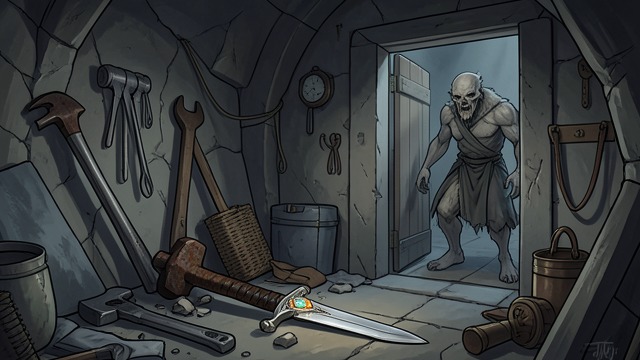
The expedition to Drosta’s lair leads Annon, Paedrin, Hettie, and Erasmus from a debris-strewn clearing into a hidden chamber guarded by a Goule. Annon’s command opens the trap and allows him to recover a silver dagger with a luminous white stone in its guard; the retrieval exposes the danger of the weapon and the need for the group to act together.
The lair and its hidden entrance
Erasmus leads the party along a difficult trail at the base of a ravine. The path winds among low, heavy trees before reaching the clearing that contains Drosta’s lair. The signs of earlier efforts to reach its center are unmistakable: abandoned campfires, hacked-down trees, scattered fragments of stone and branches, and a waist-high domed boulder surrounded by broken hammers, pickaxes, shovels, and crowbars. The ground has been pocked by digging, but a layer of solid rock has defeated the tools and those who used them.
The failed excavation gives the clearing the character of a sealed threshold. Annon picks up a rust-pitted hammer whose handle is still firm and whose head does not wobble. To him, it stands for the labor of many men and for the failure of their attempts. Access does not come through further force: Tyrus taught Annon that a keyword would open the entrance, making remembered knowledge—not the abandoned tools—the key to the lair.
Annon opens the way
Annon speaks the Vaettir words, “Vickensatham. Restimos. Alloray morir.” The language surprises Paedrin, though the words are haltingly spoken and correct. They mean, “Awaken from your sleep. Rise from the dust. Open the gateway to death.” In response, the domed rock shudders, separates from the earth, and rises into the air, uncovering a large circular opening.
Paedrin descends through the opening by controlling his breath: he begins to float, steps over the edge, and lets himself drift down gradually. The chamber below is a natural cave, roughly three times his height, with a tiled stone floor and shadows extending beyond the shaft’s light. Although he expects to find a Paracelsus study, there are no tables, flasks, cauldrons, or old books. The space instead presents a different problem: the room’s wall orbs illuminate it, and touching the floor brings a creature into motion.
The Goule and the group’s response
When the chamber’s threat advances, Erasmus identifies the crucial response: the party must cover the lights on the walls. Paedrin acts on this instruction, shielding the nearest orb with his hands. As the room darkens, the creature slows and turns away from him, moving instead toward Annon and Hettie. The encounter makes the lighting part of the danger, and solving it requires the party to respond to what the room does rather than simply attack its guardian.
The Goule’s pressure also bears on the group’s ability to cooperate. Paedrin feels jealousy at Annon’s words, while Hettie asserts that the treasure belongs to her because Annon had said he wanted no share. Annon asks his companions to trust him: he can hear the creature speaking to each of them and trying to set them against one another, but he says it does not control him. He warns that failure to work together will allow the trap to kill them and directs Erasmus to the final orb. Once Erasmus covers it, plunging the chamber into darkness, the creature stops.
The dagger and the end of the trap
In the darkness, Erasmus struggles with the weight of the task and urges Annon to act. Annon addresses the guardian by name and gives it a direct command: “Goule. Obey me. Open the trap door.” The creature returns to its alcove and drags away the lid. Light appears from within, and Annon, wearing sturdy gloves, reaches carefully into the pit.
He brings out a silver dagger whose blade guard holds a glowing white stone. Annon looks at it with both awe and fear, then deliberately takes a sheath from the pit and slides the weapon inside. As the blade is sheathed, the three glass orbs crack; glowing reddish mist leaks from them and gradually dissipates, taking the light with it. At the same moment, the force affecting Paedrin ends. The thoughts and images that had overwhelmed him disappear, and he can breathe in relief.
Significance of the recovery
The expedition’s decisive turn is not simply finding the hidden chamber or taking the dagger, but discovering the sequence that makes retrieval possible: Annon recalls the opening words taught by Tyrus, the party learns to suppress the orbs’ light, and Annon commands the Goule to open the trap. Each step relies on knowledge or cooperation rather than the brute force represented by the worn tools above.
The weapon’s influence gives the recovery a cost beyond the physical danger of the chamber. Paedrin experiences thoughts and images of disturbing intensity that he cannot control, and their disappearance follows the dagger’s placement in its sheath and the orbs’ failure. The scene therefore ends with the object recovered but not rendered harmless: the party has escaped the immediate trap, while the dagger’s capacity to affect those around it is already clear.
Fear Liath袭击Kiranrao一行
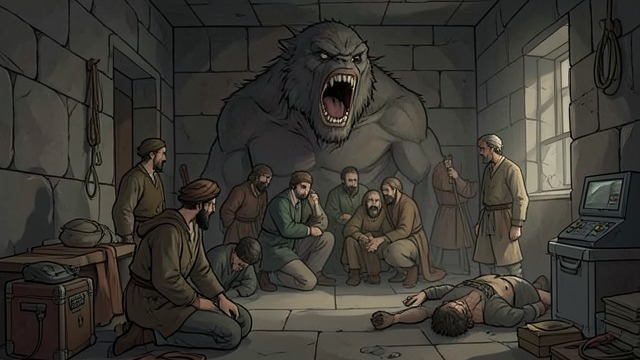
The Fear Liath’s attack on Kiranrao’s party transforms a pursuit into a night of entrapment, death, and uncertainty. Its roar announces a threat the companions cannot see; Annon seals them inside a stone chamber to keep the creature from reaching them, and dawn brings relief without resolution. The survivors find the Preachán dead, but Kiranrao is missing, making his fate the attack’s lasting question.
The Threat Arrives
The assault begins while Kiranrao is above the chamber and his companions are below. A man approaches him, and Kiranrao reacts sharply to news that someone has not returned from fetching water. Then a roar interrupts them. Paedrin experiences it as a sound that robs him of reason and confidence, its force reaching the place in his mind where fear takes hold. Annon has already given the creature a name: the Fear Liath.
After the first roar, a pause leaves the danger unseen. The silence breaks as trees and branches give way to something immense. A second roar sounds closer; confusion rises above, weapons are drawn, and the attack becomes audible in cries and the sounds of companions falling. The scene’s progression—from an unexplained sound to signs of destruction, without a clear view of the attacker—makes uncertainty part of the danger. The party has little time to understand what is happening before it must act.
Annon Seals the Chamber
Annon steps into the opening’s ring of light and speaks in the Vaettir tongue. A great stone slams shut overhead, sealing the chamber and cutting off the screams from above. The act protects those below from whatever is attacking the camp, but leaves them shut in darkness, separated from the fate of the people outside.
They endure the night inside. The chamber’s faint lights have gone out, and even the Goule that had been moving under enchantment is now motionless. Annon knows he can make light with his fingers, but cannot keep it going all night. The Fear Liath remains an ever-present source of dread even without entering the sealed space. Survival here means waiting in the dark, with the danger outside and no certainty about who is still alive.
Dawn and the Missing Kiranrao
When the chamber’s atmosphere changes, Annon wonders whether dawn has come or whether the Fear Liath has returned to the waterfall. Exhausted by the effort of resisting the strain on his mind, he repeats the words and raises the stone. Silvery-blue daylight appears above the opening, and the companions share a collective sigh of hope: they have survived the night.
Paedrin floats effortlessly to the opening and emerges first. The camp is strewn with signs of death, including the Preachán bodies. Though his arm is injured, he uses the remaining rope and the floating stone to help the others climb out. Hettie searches the ground among the dead, looking for bodies and other traces of what happened. The party does not find Kiranrao among the corpses. His absence, rather than a confirmed death, leaves the consequences of the attack unsettled.
Consequences and Narrative Significance
The attack breaks the party’s apparent security and leaves its survivors with a starkly incomplete account of what happened: the Preachán are dead, but Kiranrao’s body is nowhere to be found. Annon’s intervention gets the group through the night, while Paedrin’s actions make it possible for the others to emerge at dawn. Their escape from the chamber is a limited reprieve, not proof that the Fear Liath has been defeated.
The episode builds horror through the gap between what the characters hear and what they can know. The Fear Liath is first defined by its name and by Paedrin’s involuntary fear; the assault then reaches the party through sound and signs of destruction before the survivors can inspect its aftermath. Dawn restores light but not certainty. The absent Kiranrao carries that uncertainty forward: survival is established for those who emerge, while his fate remains unknown.
The group enters Mirrowen through the tree-root gateway
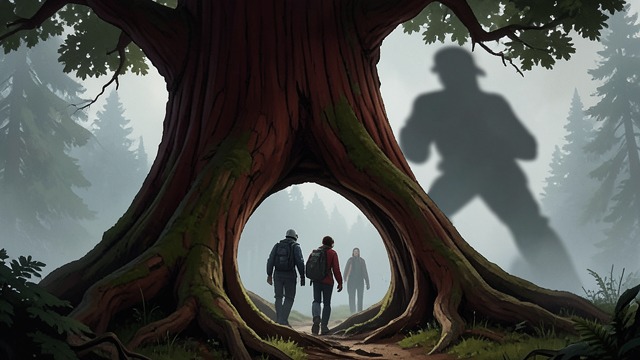
The group enters Mirrowen through the tree-root gateway as the Fear Liath closes in, turning a refuge in a hollow redwood stump into a passage between worlds. The crossing is both an escape and a revelation: the Cruithne explains the gateway’s cost to mortals, discloses his identity as Drosta Paracelsus, and names Iddawc as the spirit weapon he made; the travelers then lose consciousness and awaken in a different landscape.
Flight to the Gateway
The group reaches the gateway while moving through thick white fog with the Cruithne, whose immense footsteps announce their position. He pushes through small trees rather than going around them, snapping trunks in his path. Redwoods rise above the mist, their lower branches swallowed from view. Annon nearly turns an ankle on a root, and Hettie catches him before he falls. He keeps wanting to look behind them, but Paedrin gestures sharply for him to watch the Cruithne ahead. A shuffling sound grows louder and takes on a bark-like quality, while the Fear Liath’s approach remains a pressure at their backs.
The Cruithne leads them to a lightning-struck redwood that has fallen and shattered. Its exposed roots jut like thorny fingers, and fire has hollowed the trunk into a small cave. The entrance is too low for an adult to stand upright, but the Cruithne bends and goes inside without hesitation. Hettie follows, with Annon behind her. Erasmus joins them and rubs his hands for warmth, his breath visible in the cold; Paedrin stays outside, staring first into the stump’s dark opening and then into the fog as the pursuing bulk draws nearer.
The shelter initially looks to Paedrin like no more than a tree stump. The Cruithne calls it a gate to Mirrowen, but Paedrin objects that he is speaking in riddles. Annon urges him to trust them and come in. The entrance’s meaning is disclosed at the instant when ordinary shelter is no longer enough: the group is not merely hiding inside a hollow tree but crossing through it.
The Passage and Drosta’s Disclosure
Once the group is inside, the Cruithne says the Fear Liath can no longer see them and that this angers it. Asked why the creature cannot find them, he declines to explain the mechanism. Instead, he makes the urgency of the moment plain: he has won their trust in as few words as possible, and they have little time to listen. He warns that they will fall asleep within moments, wake at sunrise somewhere different, and suffer the effects of the passage as mortals. His instructions are practical as well as ominous: remember as much as they can.
Before sleep takes them, the Cruithne gives his name: Drosta Paracelsus. He identifies himself as the maker of the blade the group has found, called Iddawc, and asks Annon to show it. When Annon uncovers the weapon from his cloak, Drosta’s expression darkens. He explains that Iddawc is alive: it is a spirit weapon with a spirit hosted inside it, and the spirit’s name is also Iddawc. Knowing this, he says, is the means by which the weapon can be controlled. He describes it as unique in both this world and Mirrowen, and says the Cruithne discovered it deep in the mines. Many died before its capabilities were understood.
Drosta’s account connects the weapon’s existence to a failure of judgment. A Druidecht warned the others, but Drosta admits that he was foolish: he saw value in trapping such a being, devised a plan, and obtained the Arch-Rike’s approval for the price. He refuses to name that price, calling its disclosure unseemly. The plan did not simply capture the spirit; it helped the spirit transform. Drosta names vanity and pride as his own part in the wrongdoing. The weapon he fashioned is thus not only an object of power but evidence of a decision whose consequences have outlasted its maker’s intentions.
Sleep, Arrival, and Recognition
Drosta’s warning is fulfilled almost at once. As he speaks, Annon’s thoughts thicken and grow foggy, and an exhaustion unlike anything he has known overtakes him. Erasmus is already asleep, his jaw hanging open; Hettie struggles to stay awake as her chin bobs. The narrative then renders Annon’s sleep as a shroud of warm blackness, layered with indistinct voices and the faint sound of branches stirred by wind. Rainfall or perhaps a brook seems to patter nearby, but the impressions remain hazy and tangled rather than resolving into a clear account of the passage.
A hand clutching and jerking Annon’s shoulder breaks that suspended interval. Sunlight streams through thin yew trees and nearly blinds him. The air and vegetation mark a distinct change of place: instead of the heady scent of pine and thin mountain air, he wakes among the grasses, weeds, and brush of a lowland setting. The alteration confirms that the hollow stump has carried the group elsewhere, although Annon first has to recover from sleep before he can understand where he is.
The voice that wakes him belongs to his uncle, Tyrus. Annon recognizes it, turns in sudden desperation, and sees Tyrus kneeling over him. Recognition does not bring uncomplicated relief: disbelief gives way to shock and then the first surge of anger. The gateway therefore delivers more than a change of landscape. At the far side of the passage, Annon’s reunion with Tyrus opens on an unresolved emotional conflict.
Narrative Function and Stakes
The passage is structured as a threshold crossing whose explanation arrives before the travelers experience it. The fallen redwood’s exposed roots first resemble a monstrous obstruction; once the Cruithne calls the stump a gate, its hollow interior becomes an exit from immediate danger. The pursuit by the Fear Liath gives the group almost no time to debate or demand a full account. Drosta explicitly chooses brief, forceful truth over persuasion, and the travelers enter the gateway with only a partial understanding of what it will do.
That limited explanation binds three consequences into one transition: the Fear Liath loses sight of the group, the travelers undergo a mortal passage expressed as sudden sleep, and Annon wakes in a different environment beside Tyrus. At the same time, Drosta’s disclosure reframes Iddawc. The weapon is not merely a blade the travelers have found, but a living spirit-bearing creation tied to Drosta’s pride and to a costly plan approved by the Arch-Rike. The scene thus makes passage across a boundary inseparable from knowledge: the group escapes the immediate pursuit, but arrives carrying a deeper understanding of the danger and history embedded in the weapon.
The Quiet Kishion attacks and captures Paedrin
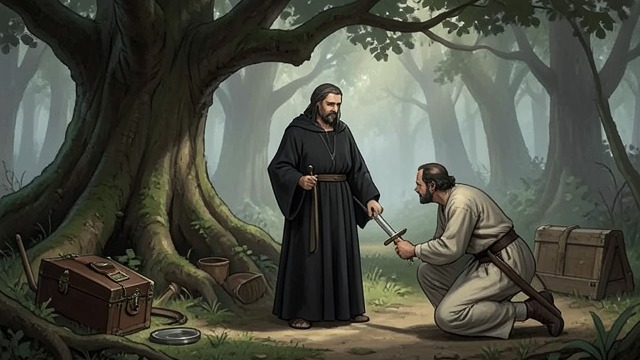
The Quiet Kishion attacks and captures Paedrin in a grove, breaking the group’s fragile safety and carrying Paedrin away to Kenatos. The encounter brings Annon’s knowledge of the woods into conflict with the city’s most feared enforcer: Annon can negotiate safe passage with the forest’s creatures, but Druidecht offers no protection against an opponent who survives his fire and takes Paedrin by force.
Background and Stakes
Annon has learned to live by Druidecht, a body of knowledge transmitted orally from one practitioner to another. It teaches him to distinguish sacred trees from those that may be cut and to recognize the spirits inhabiting Mirrowen, the unseen realm within the ordinary world. His knowledge is practical as well as hidden: he has shown a woodcutter which trees are safe to fell, and he understands that forest creatures can recognize travelers and grant them safe passage.
That relationship matters on the journey with Paedrin. Annon assures him that the woods’ creatures know they are present and will warn them of danger. Paedrin cannot understand what agreement Annon could have made, having been with him throughout their passage, but Annon asks him to trust Druidecht. The assurance establishes a limited kind of protection, grounded in Annon’s understanding of the forest; it does not make the travelers invulnerable to human pursuit.
The contrast becomes sharper on the road toward Havenrook. There, the trees have been cut and scarred, abandoned wagons and refuse line the route, and Annon senses no spirits in the air. He feels exposed, as though he were in Kenatos, a place similarly devoid of sentient life. His anger at this damaged landscape is tied to his belief that human actions have driven the spirits away. In the grove, by contrast, his confidence in the creatures’ awareness gives way before the Quiet Kishion’s arrival.
The threat has been foreshadowed by an account of the Kishion, the Arch-Rike’s personal bodyguards, who administer Kenatos’s justice in cases involving grave crimes. Chosen from the Bhikhu and Finders and trained in survival, diplomacy, and poison, they are few in number and loyal to the Arch-Rike. The most feared among them is the Quiet Kishion, rarely seen and reputed, though only by speculation, to be impossible to kill. When Erasmus recognizes the intruder as a Kishion, the group’s danger becomes immediate.
The Attack in the Grove
Annon tries to hold the intruder back, but Paedrin steps in front of him and Hettie. Paedrin addresses the Kishion as a brother and begins to propose that they talk. The attempt at conversation does not interrupt the attack: the Kishion closes with him, and the two engage in a fight. Paedrin is already at a disadvantage because one arm is bound against his side; the Kishion disables him and knocks him unconscious.
Annon and Hettie then face the attacker. Annon channels his rage and fear into blue fire, directing a powerful burst at the Kishion. The flames do not stop him: he emerges from them and strikes Annon, leaving him unable to intervene effectively. Hettie attacks with her daggers, but the Kishion disarms and restrains her. The group’s defenders are overcome in succession, and Annon is left to answer the pursuer’s demand for his uncle’s whereabouts while Hettie remains in danger.
The scene reverses the assurance Annon had given Paedrin. The forest may have recognized the travelers and granted them passage, but that agreement cannot prevent the Kishion from reaching them or control what happens once he does. Likewise, Annon’s magic, formidable against other threats, proves insufficient against an adversary who walks through the fire. The sequence narrows from a group’s passage through the woods to a choice made by Annon under direct pressure.
Annon’s Answer and Paedrin’s Capture
The Kishion asks where Annon’s uncle has gone. Annon knows that the man is hunting his uncle and understands that the pursuer may have a black ring of Seithrall. He also recalls that his uncle had given him information to disclose in the event that he was taken. Under that pressure, Annon names Silvandom and pleads for Hettie’s life.
The answer does not save Paedrin. After hearing Annon, the Kishion turns back to the unconscious Paedrin, takes hold of his shirt, and says that they are going to Kenatos. A flash of light and a burst of thunder follow; when the group can see again, both men are gone. Paedrin has been removed from the grove, while Annon and Hettie remain behind with Erasmus.
The outcome separates the travelers and carries Paedrin directly into the city from which the Kishion has come. Annon’s answer appears to redirect the hunt for his uncle, but the immediate, confirmed result is Paedrin’s capture. The contrast between those outcomes preserves the uncertainty surrounding the information Annon has disclosed while establishing the practical consequence of the confrontation: Paedrin is now in the Kishion’s custody.
Aftermath and Narrative Significance
Hettie is left with bruising on her neck and an injured wrist. She recognizes the significance of the encounter, remarking that even the Romani fear the Kishion. Annon checks where she is hurt, shifting at once from confrontation to care for the person who remains beside him. Erasmus, who had recognized the attacker and watched the struggle, has not intervened.
For Annon, the capture exposes the limits of the protection on which he relies. Druidecht lets him read the forest, learn from its inhabitants, and explain practices such as using fire to renew woodland growth; it does not guarantee victory over a trained agent of Kenatos. The grove’s creatures may grant passage, but the Kishion imposes the city’s authority through direct force and sudden transport.
The event also makes Paedrin’s relation to Kenatos newly urgent. He entered the confrontation as Annon’s companion and as a fellow Bhikhu, addressing the Kishion as a brother in an attempt to stop violence. He leaves the scene unconscious and in the Kishion’s custody. That shift—from attempted negotiation to sudden removal—turns the journey’s danger into a concrete separation and sets the consequences of the Kishion’s intervention in motion.
The Arch-Rike forces Paedrin to become a Kishion
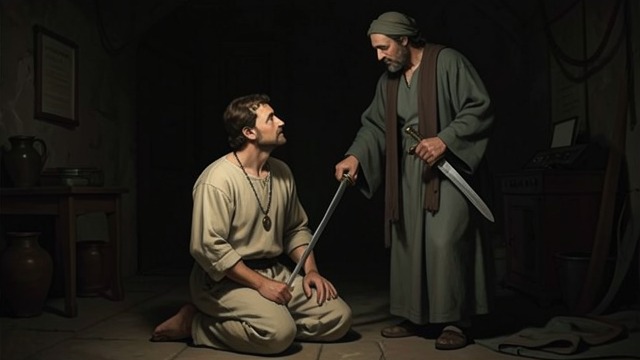
The Arch-Rike forces Paedrin to become a Kishion by converting a prisoner’s ring into an instrument of control. Paedrin is made to surrender the black gemstone, which the Arch-Rike sets into a necklace that governs his servants; under its compulsion, Paedrin answers, “Yes, my lord.” The episode turns the Arch-Rike’s claim that Paedrin will serve Kenatos into a concrete loss of agency, identity, and future.
Accusation and Imposed Service
The encounter begins with the Arch-Rike identifying Paedrin as a Bhikhu from the temple and apologizing for having mistaken him for someone who could lie under the influence of the ring. He blames Tyrus for ensnaring Paedrin in a treasonous plot and says a trial will soon take place, with Paedrin’s life likely to be forfeited. His apology does not protect Paedrin: it establishes the Arch-Rike’s account of the case while leaving the prisoner facing punishment for a mission he says his master assigned.
The Arch-Rike presents the coming transformation as service to Kenatos. He maintains that Paedrin will continue to serve, but first must die and be remade as a Kishion. In the Arch-Rike’s description, Kishions are dead to the ordinary course of life: they do not marry or have children and have neither a past nor a future. Paedrin is to accept responsibility for the theft of Iddawc and be hanged, yet, because he is a Vaettir who survives so long as he has breath, he will live through the hanging and be reborn into the role. The proposed punishment thus disguises the destruction of Paedrin’s former life as an appointment to continued service.
The Ring and the Necklace
Paedrin resists the Arch-Rike’s account of service, insisting that imprisonment is not fitting for someone trained to serve Kenatos and rejecting the prospect of being made a Kishion. The Arch-Rike offers a stark alternative: obedience or confinement in darkness for the rest of his life. He then orders Paedrin to twist the gemstone in the ring.
Paedrin cannot prevent himself from obeying. The black stone detaches from the ring, and the Arch-Rike orders him to hand it over. Though Paedrin tries to stop his arms, the compulsion carries them through the bars to the Arch-Rike, who fastens the stone to a jeweled necklace inset with matching black stones. The decisive change is material and immediate: a gem formerly set in a ring is transferred to the Arch-Rike’s necklace, shifting control from an object Paedrin wears to an object the ruler possesses.
Submission and Loss of Agency
The Arch-Rike explains that the necklace gives him control over all the Kishions. He declares that they will forget their names, remember being born in darkness, and speak and act as he wishes. Paedrin’s reply, “Yes, my lord,” is therefore not evidence of consent. It follows the forced removal of the stone and the Arch-Rike’s explicit claim of control; Paedrin’s submission marks the success of the binding.
The scene makes the transformation a conflict over who can define Paedrin. The Arch-Rike names him a future servant and prescribes the memory he is to retain, while the transferred gemstone supplies the means to enforce that account. Paedrin’s former identity and attachments are placed at risk alongside his freedom: before the binding takes hold, he thinks of his master and Hettie, as well as the man who had injured him. The Arch-Rike’s promised Kishion existence would cut across that remembered life by denying its past and foreclosing its ordinary future.
Political Conflict and Consequences
The Arch-Rike frames his actions within a larger disagreement with Tyrus over the spirits who serve Kenatos. He insists that the spirits are serving rather than enslaved, that they will be freed after fulfilling their commitment, and that their service helps preserve people against a coming onslaught. He accuses Tyrus of trying to free them prematurely and thereby aiding enemies. This political defense sits uneasily beside the scene’s direct demonstration of control: the Arch-Rike describes service as protective and temporary while compelling Paedrin to surrender the stone that resists falsehood and to become an obedient instrument of his rule.
The binding also has an immediate consequence beyond Paedrin’s own fate. Asked what Hettie was seeking at the Paracelsus Tower, he is compelled to disclose that Tyrus sent her for spirit magic he had left behind: a leather bag containing three uncut gems. The imposed obedience thus turns Paedrin into a source of information for the Arch-Rike, even as he recognizes that he cannot stop himself from speaking. The scene establishes that the necklace controls not only the Kishion’s actions but also what he says, extending the transformation from identity into practical service to the Arch-Rike’s political aims.
Significance of the Transformation
The episode’s central reversal is that an instrument associated with truth becomes part of a system of domination. The Arch-Rike first offers Paedrin the ring because its spirit prevents falsehood; after removing its black gemstone, he uses that same transfer to bind Paedrin and make him answer to a new lord. Truthfulness does not secure justice or freedom here. Instead, Paedrin’s compelled disclosure confirms how completely his agency has been taken.
The Arch-Rike’s language of duty, preservation, and service cannot erase the coercion that the scene shows. Paedrin refuses, is threatened with lifelong confinement, loses control of his own movements, and finally gives the required answer under magical compulsion. His forced acceptance marks a decisive change in his position: he is no longer merely a prisoner accused of assisting Tyrus, but a person the Arch-Rike intends to remake and command as a Kishion.
Kiranrao rescues Paedrin and escapes Kenatos
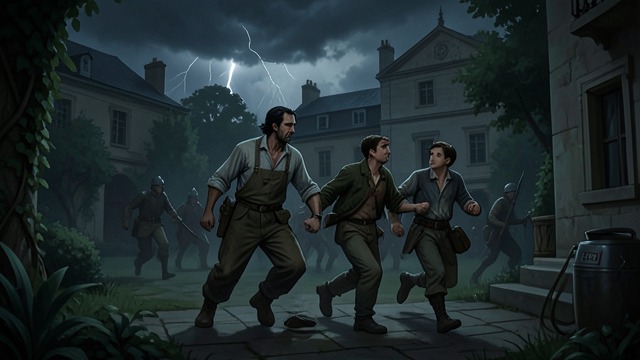
Kiranrao rescues Paedrin from the Arch-Rike’s custody and helps him escape Kenatos, but the rescue does not restore Paedrin’s freedom completely. The iron Kishion ring remains on his hand, making the escape both a break from immediate imprisonment and a continuation of the magical bond imposed on him. Hettie’s presence, Kiranrao’s diversion, and Paedrin’s fight against the pursuing soldiers carry the group from the palace grounds toward flight, with danger still close behind.
Causes and Stakes
The rescue follows the Arch-Rike’s decision to make Paedrin serve Kenatos as a Kishion. The Arch-Rike claims that the Plague threatens every surrounding people and that Kenatos must preserve knowledge to save civilization. He also presents the spirits compelled to serve the city as willing participants who will be freed when their terms end. Paedrin sees the matter differently: he recognizes that the Arch-Rike believes his own justification, but rejects the idea that this makes imprisonment appropriate. The dispute over service and enslavement frames Paedrin’s escape as more than a flight from a cell; it is a refusal of the authority that has claimed his body and allegiance.
Paedrin is not, in the Arch-Rike’s account, the last Bhikhu, but the Arch-Rike still treats him as a pawn in a contest with Tyrus. He says that Tyrus wants to free the serving spirits and thereby weaken Kenatos, while he himself intends to preserve knowledge and people against the coming Plague. This political argument does not make Paedrin’s captivity voluntary. The Arch-Rike’s own conclusion is that Paedrin must die before he can continue serving the city, exposing the violence beneath his language of preservation.
Kiranrao Reaches Paedrin
Kiranrao appears at Paedrin’s cell, bringing the possibility of escape into the prison itself. The encounter is followed by Hettie waiting in the rugged ground behind the palace. She knows that Kiranrao has been discovered and watches the approaching search party: soldiers, black hounds, and a Rike of Seithrall. Two men land behind her. She turns with her bow, but Kiranrao catches its stock before she can loose an arrow; he and Paedrin have arrived in a crouch, using the brush for cover.
The rescue is also a negotiation over the stones Hettie carries. Kiranrao tells her that Paedrin now wears a Kishion ring and is effectively bound to the Arch-Rike. He asks for the stones as payment for his service, intending to trade them for the blade. Hettie objects that Paedrin is of no use to them without his own will, but she gives Kiranrao the pouch. The exchange makes the limits of the rescue explicit: Kiranrao has extracted Paedrin from the cell, yet Paedrin’s condition remains unresolved, and the group’s practical aims do not fully align.
Diversion and Pursuit
Kiranrao chooses to draw the search party away. He tells Paedrin to go with Hettie, then breaks from the brush at a run, making noise so that the guards and dogs will follow him. The soldiers shout and pursue, releasing the hounds and sounding a horn. His diversion creates a route for the others, but it also leaves Hettie and Paedrin to make their way down the steep slope while the alarm is already raised.
Hettie listens for footsteps above them before starting down. She uses exposed roots as handholds, keeping low on the difficult descent. A black hound suddenly rushes from the woods with soldiers behind it. Hettie warns Paedrin not to let them sound the horn. Paedrin launches past the hound and the advancing patrol, moving through the air with the Vaettir’s ability to hover and control their descent through breath. He lands in a crouch and charges the soldiers before they can close in.
Hettie shoots the pursuing hound in the flank, slowing it without killing it. As she reaches the bottom of the slope, Paedrin is already among the soldiers. When one raises the horn, Paedrin blocks Hettie’s shot, vaults up, knocks the man down, and crushes the horn beneath his heel. In moments, six men are dispatched. The horn’s destruction prevents that soldier from raising the alarm in the immediate confrontation, while the pursuit itself shows that the escape remains exposed to the palace’s forces.
Consequences and Significance
The escape rests on complementary actions rather than a single act of strength: Kiranrao attracts the searchers, Hettie guides Paedrin down the slope and helps stop the hound, and Paedrin uses his movement and fighting skill to disable the patrol and destroy its horn. Their cooperation gets them past the men at the hillside, but the scene does not establish that the Kishion ring has been removed or that Paedrin has regained control of himself. Kiranrao’s insistence on the stones in exchange for his help underlines that rescue and freedom are not yet the same thing.
The episode gives physical form to the conflict over what Kenatos calls service. The Arch-Rike speaks of preserving civilization through compelled labor; Kiranrao and Hettie act to get Paedrin out of his reach, even though the ring continues to mark that reach. The escape therefore brings a decisive change in Paedrin’s immediate circumstances—from the cell to the open ground beyond the palace—without resolving the larger struggle over his allegiance and will.
Tyrus reveals Annon and Hettie’s parentage
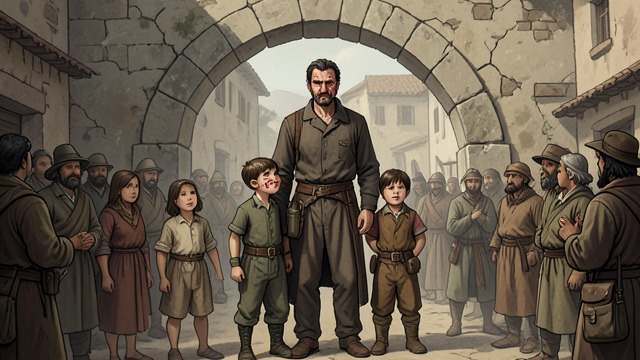
Tyrus reveals that Annon and Hettie are the children of Aboujaoude, a Bhikhu who gave his life in the Scourgelands for Tyrus’s cause. The revelation links the twins’ unknown past to the expedition’s losses and Tyrus’s unfinished work, while forcing Annon to confront why his own childhood took a different course from that of a Bhikhu’s orphaned student.
The Disclosure and Its Context
Paedrin raises the question of Aboujaoude’s death while discussing his service to Tyrus. Aboujaoude was known as a famous Bhikhu, though he had died before Paedrin was born. Tyrus confirms that he died in the Scourgelands, then explains that Paedrin has been protecting Aboujaoude’s twins: Hettie and Annon.
Tyrus adds that Aboujaoude believed in his cause, knew his motives, and nevertheless gave his life for it. The disclosure therefore does more than identify the twins’ father. It presents their parentage as part of a history of deliberate allegiance and sacrifice, and makes their connection to Tyrus older than their own service to him.
Annon’s Response and Unanswered Questions
Annon is stunned by the news. His father was a Bhikhu, and that fact immediately unsettles his understanding of his upbringing: he wonders why he was not raised in a temple orphanage like Paedrin, but instead was sent to the woods in Wayland. The revelation supplies his parentage but not the explanation for that separation.
That unanswered question gives the disclosure its personal force. Annon has grown up as a Druidecht, learning to read the forest and its spirits, while the newly revealed identity of his father points toward a different institutional and familial history. Tyrus’s account joins these histories without resolving why Annon was placed in the woods.
Family, Oaths, and Tyrus’s Cause
The revelation also clarifies the relationship between the twins and the man whose mission they encounter. Aboujaoude’s commitment to Tyrus’s cause binds family history to the Scourgelands expedition, while Tyrus’s statement makes clear that he regards Aboujaoude’s sacrifice as meaningful rather than incidental. The twins inherit knowledge of that connection, even though the circumstances of their childhood remain unexplained in this disclosure.
Elsewhere, Tyrus calls on Annon to help continue the work he and Annon’s mother began, saying that he needs a Druidecht and cannot succeed without him. He also recruits Khiara, explaining that the earlier Scourgelands expedition lacked a Shaliah and that a healer could have helped more of the wounded survive. Together, these appeals show how Tyrus’s renewed undertaking depends on people with different skills and ties to the earlier expedition; the family revelation places Annon within that larger history of loss and unfinished purpose.
Tayles’s First Expedition into the Scourgelands
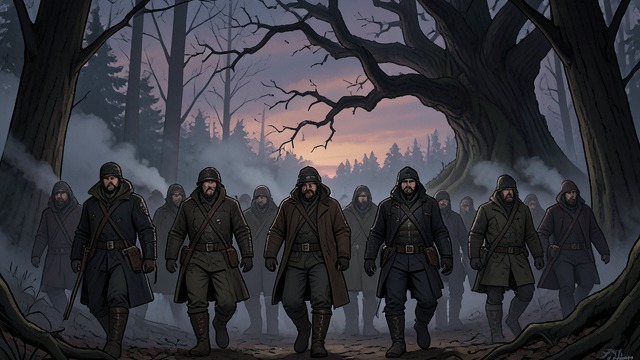
Tayles’s First Expedition into the Scourgelands was Tyrus Paracelsus’s attempt to turn the preservation of knowledge into an assault on the Plague itself. The party entered with the Arch-Rike’s blessing, but was destroyed by the Scourgelands’ defenses; its failure left Tyrus alive with evidence of a concealed betrayal and a determination to return to the work through Annon and a Dryad who could uncover what human records had lost.
Purpose and historical setting
The expedition arose from a crisis no archive could date precisely. Possidius Adeodat’s account says Kenatos possessed records reaching back to its founding, yet none established when the Plague began. The epidemic had ravaged every kingdom, decimated populations, and erased some races. In response, the survivors united around preserving knowledge, founding Kenatos as a shared stronghold rather than a city ruled by any one kingdom. Books, provisions, and wealth were contributed to its survival.
Tyrus understood his own undertaking in the same collective terms. He had chosen the work of banishing the Plague as a young man and had lived to see its devastation twice. Studying records and interviewing people who had crossed into the Scourgelands, he sought stubborn facts rather than stories. His mission was not simply an exploration of dangerous territory: he hoped to identify what lay behind the catastrophe and prevent further suffering.
The assembled party and its defeat
Tyrus gathered people he considered exceptionally capable: brilliant minds, fierce warriors, and a Bhikhu whom he later identified as Annon’s father, described as the most gifted of his generation. He sought the Arch-Rike’s blessing, received it, and led the party north into the Scourgelands, determined to overcome whatever stood in their way. The expedition was destroyed. Tyrus later said plainly that the party had been lost and that he himself should have died with them.
The danger was not an abstract threat. Possidius’s records describe the Plague as changing its symptoms across generations: sores, rashes, white spores, yellow skin, or red flux. It could devastate a community quickly, leaving most of its people dead; flight could carry it onward to other cities and kingdoms. Because its symptoms changed, finding a cure was especially difficult. In this context, the expedition’s ambition to reach the source of the danger came with stakes extending far beyond its members.
Merinda’s sacrifice and the escape
Tyrus survived because Merinda saved his life. During the attack by the creatures guarding the Scourgelands against intruders, she was gravely wounded and released the magic in her blood to protect the party. The use of that power cost her her sanity. Tyrus promised to bring her safely home and give her unborn child a chance to live. The expedition’s aftermath therefore became inseparable from the survival of Annon, whom Tyrus later left with the Druidecht in Wayland.
The party found a way out through knowledge Merinda revealed about the Dryads, who guard the Scourgelands. Tyrus came to regard this as the missing piece: the Dryads there were not merely obstacles but guardians connected to the explanation of what had gone wrong. His later account joined their hostility to a hidden injury or betrayal, which he believed was preserved in the trees even after it had disappeared from human memory.
The suspected betrayal in Kenatos
After escaping, Tyrus reasoned that the party had been trapped before it had even substantially crossed the woods’ outer defenses. The defenders had attacked and assembled too quickly for him to understand at the time. In retrospect, he concluded that the Arch-Rike’s approval had been part of the betrayal: the expedition had been sent toward its deaths, he believed, because the authorities wanted the truth about the Scourgelands to remain hidden. He suspected that the Rikes of Kenatos wished to perpetuate the injustice associated with the Dryads.
Tyrus returned to Kenatos rather than risk provoking the Arch-Rike’s suspicions by remaining absent. He reported failure and said that he had needed time to recover, a statement he considered true but incomplete. He concealed that Merinda was pregnant, protecting Annon from the Arch-Rike’s knowledge. Tyrus described his return as a choice to enter his gilded prison again, this time carrying a secret about the expedition and its survivors.
The unfinished mission and its legacy
The expedition’s defeat did not end Tyrus’s effort; it changed how he pursued it. He concluded that the truth about the Scourgelands had to be read from the trees by another Dryad. A Dryad bound to a tree in the Paracelsus Towers agreed to go, and Tyrus explained that she was his wife by Dryad custom: she had chosen him, and an ankle bracelet marked her bond to him for the remainder of his life. He denied forcing her and framed her participation as voluntary. Her ability to enter the Scourgelands and bind herself to its trees offered a way to investigate the wrong the failed expedition had revealed but could not resolve.
Years later, Tyrus told Annon that he needed a Druidecht to finish what the first party had begun, specifically because Merinda had saved his life and he wanted to honor her memory. He also recruited Khiara, explaining that the earlier party had been wounded and killed in numbers that might have been reduced by a Shaliah’s healing and support. The first expedition thus remained both a military failure and the origin of a continuing inquiry: the Plague’s changing devastation demanded answers, while the expedition’s defeat suggested that the truth had been deliberately guarded.
Tyrus takes Annon away from his mother
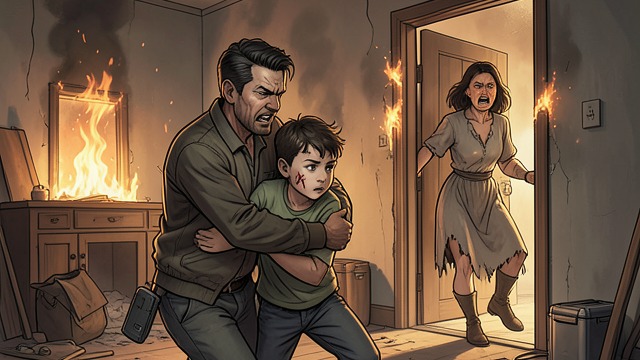
Tyrus takes Annon away from his mother in an early-childhood crisis that Annon can remember only after a Dryad helps him reach memories bound to powerful emotion. The fragment shows the child’s love for his mother and terror at her violence, then Tyrus shielding him and carrying him from their burning home. The separation saves Annon, but it leaves him with a lasting wound that joins his origins to his mother’s fireblood, Tyrus’s expedition into the Scourgelands, and the loss that shapes both men’s later choices.
Recovered Memory and the Separation
The event is not first presented as a continuous scene from Annon’s childhood. During a later encounter, the Dryad explains that memory and emotion strengthen one another: love, loyalty, and gratitude can make a recollection vivid, while painful memories may carry wisdom. As Annon searches within himself, images of his earliest life surface in broken sequence. He recognizes a woman as his mother, though he was too young at the time to understand her words. What he can recall clearly is the emotional contradiction: he loves her, yet she frightens him.
The recollection then shifts to Tyrus. Both adults bear marks from the earlier crisis, and Annon remembers Tyrus lifting him against his chest and shielding him. Flames surround the child’s memory; Tyrus takes him from the stone hut and out into a storm. He covers Annon with his cloak, mounts a horse with the baby in his arm, and holds him as they leave. The child struggles and cries before exhaustion carries him to sleep. The remembered departure is therefore both rescue and rupture: Tyrus brings Annon out of immediate danger, but the child is separated from his mother without understanding why.
The Crisis Behind Tyrus’s Choice
Tyrus later supplies the history that Annon’s fragment cannot explain. He had led an expedition into the Scourgelands in pursuit of a way to banish the Plague. The company was destroyed by the creatures guarding the region, and Annon’s mother—then carrying Annon—was gravely wounded. She unleashed the magic in her blood to save the survivors, but the power cost her control of her mind. Tyrus says that he should have died and that she saved his life; he promised to bring her safely home and give her unborn child a chance to live.
The memory of Tyrus taking the infant away belongs within this larger chain of desperate decisions. Annon’s mother had revealed the Dryad secret that made escape possible, while her use of fireblood left her vulnerable to the madness that followed. The recovered childhood scene does not itself explain every step between the Scourgelands and the burning hut. Tyrus’s account, however, establishes the promise that governs his actions: to protect the child and honor the woman who had saved him.
The Mother’s Fate and the Cost of Rescue
When Tyrus returned to the stone hut later, he learned that Annon’s mother had died. In her madness, she unleashed the full force of the flames. The fire did not burn her, but a collapsing wooden beam killed her. The villagers, unnerved by her unburned skin, realized that she had fireblood; when Tyrus returned, they tried to kill him. This later account gives the remembered escape its consequence: Tyrus succeeded in carrying Annon away, but he could not save the child’s mother.
For Annon, the recovered images make the loss more than a fact told by another person. He remembers the mother’s face, his love for her, and his fear; he also remembers Tyrus as the figure who protected him when he could not protect himself. The memory does not resolve that contradiction or erase the separation. It lets Annon encounter both sides of his earliest bond at once: the mother he loved and the danger he could not comprehend, and the protector who took him away.
Family, Memory, and the Continuing Quest
The event becomes part of Annon’s understanding of his family and of Tyrus’s motives. Tyrus explains that the expedition failed because its leaders did not understand what had happened to the Dryads of the Scourgelands; he believes an old betrayal lies behind their hostility and wants to discover the truth and mend the wrong. His return to that unfinished purpose is tied to his debt to Annon’s mother, whose memory he says he seeks to honor. He asks Annon to join the effort because a Druidecht is needed to help uncover what the trees remember.
The recovered scene also reframes Tyrus’s repeated insistence that Annon tame his anger. Annon connects that warning to the revelation that his mother’s uncontrolled fireblood ended in her death. In this way, the separation is not only the origin of Annon’s loss: it makes the discipline Tyrus teaches personally consequential, and binds Annon’s inherited power to the history of the mother he can now remember. The event leaves the child alive, the mother dead, and the truth of their final separation available to Annon only years later, through memory restored by the very emotional force that made it painful.
Hettie is taken by a Romani midwife at birth
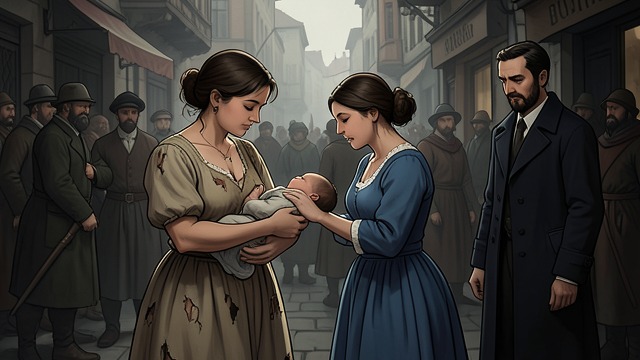
Hettie is taken by a Romani midwife at birth, an act that separates her from her twin brother Annon and becomes one of the defining losses in Tyrus’s past. The midwife did not know there were twins; Tyrus faced a choice between saving Annon and trying to save Hettie, and chose the infant whose life he could preserve. Years later, the truth recasts Hettie’s identity and gives new meaning to the freedom Tyrus offers her.
The Birth and Separation
Tyrus explains that Hettie was taken almost at birth by a Romani midwife who did not realize that Merinda had delivered twins. At the time, he lacked the knowledge needed to save both children. He believed he could preserve Annon’s life only by accepting that Hettie would be lost to the Romani, a choice he later describes as terrible. His account makes the separation neither an intentional abandonment nor a simple failure to find her: it began in the constrained circumstances of the birth, then continued because he had chosen to save one child at the other’s expense.
The story Tyrus gave local people—that Merinda was his sister—also concealed the twins’ parentage. Hettie grew up believing Tyrus was her uncle, while Annon had no recollection of her. Tyrus later connected the Romani’s kidnapping of Hettie with their attempt to blackmail him. The original taking therefore endured beyond the birth itself: it divided the siblings, obscured their family relationship, and became entangled with pressure on Tyrus.
The Truth Revealed
Tyrus eventually tells Annon directly that Hettie was stolen as a baby and that the two of them are twins. He acknowledges that he could not save her then and says he regrets the loss. Annon’s question about why he has no memory of his sister receives a painful answer: there was no shared childhood for him to remember. The revelation changes the meaning of their reunion by identifying their bond as one severed before either child could know it.
Tyrus also tells Hettie that he is not her uncle and that she is not his blood relative, while naming her as Annon’s twin. He frames his past choice as something he failed to correct at the time, but insists that he can act now. The disclosure links private family history to a wider threat: he warns that the Romani will be hunted and destroyed when the next Plague comes, and asks Hettie to help with his quest. He offers her the possibility of living in Silvandom, where Romani are forbidden, as the freedom he had promised her.
Freedom, Debt, and Its Afterlife
Before the full family truth is revealed, Hettie describes her life as a debt and seeks to buy her freedom permanently, including release from the obligation marked by her earring. She asks how much of the treasure Annon expects in return for helping her. Annon refuses payment, saying he is helping freely rather than repeating Tyrus’s example. Hettie remains wary of becoming indebted to him and insists that they agree on the matter, because she does not want to owe both Annon and the Bhikhu. Their exchange shows how the consequences of Hettie’s removal reach into adult relationships: even assistance can feel like another bond from which she must secure release.
Tyrus’s own explanation of the abduction underscores the difference between money and freedom. When Annon asks whether he lacked the ducats to recover Hettie, Tyrus answers that the obstacle was not money but freedom. In an earlier account, he says he once hired a Finder to locate her when she was nearly eight, but refused the enormous ransom demanded. The Finder later paid for Hettie independently and cared for her in the woods near the lowlands of Alkire; Hettie eventually became a Finder herself. Tyrus describes her later arrival in the city and her prospect of purchasing freedom, but his decision not to bid himself reflects the risk that his involvement would drive up the price.
Narrative Significance
The abduction’s consequences unfold across two revelations: first, Hettie’s history as a child taken and held under a system from which she seeks release; later, her identity as Annon’s twin and Tyrus’s lost daughter. The delayed recognition turns a personal separation into a cause that links the siblings’ reunion, Tyrus’s remorse, and Hettie’s pursuit of independence. Its lasting force lies not only in what was taken at the birth, but in the years of concealed kinship and imposed debt that followed.
The battle to protect the Silvandom oak
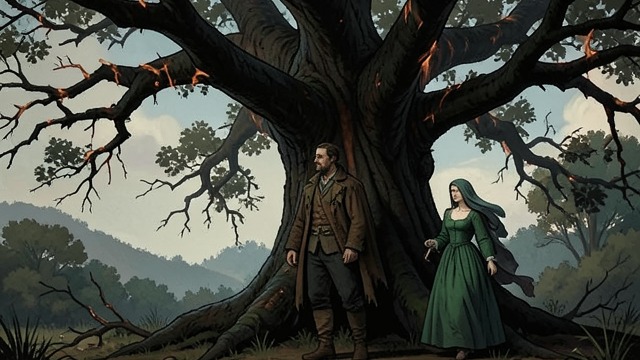
The battle to protect the Silvandom oak is a defense of both an ancient tree and the spirits of Mirrowen, whose lives are endangered by Boeotian axes and smoke. It becomes a turning point for Annon: fighting to uphold his Druidecht vows, he loses Reeder, nearly dies, and receives aid from the spirits and the Bhikhu. The battle also leads to a rare boon from the Dryad Neodesha, whose trust gives Annon a power that comes with a demand for restraint.
Causes and Background
Annon’s defense of the oak grows from the Druidecht understanding that woods are inhabited by unseen beings, not merely resources for human use. Earlier, he had explained to Paedrin that creatures knew of their passage through the forest and had granted them safe conduct. That relationship rests on knowledge and reciprocal recognition, rather than on visible barriers or a human claim to control the woods.
Annon has also seen what happens when that relationship is ignored. On the approach to Havenrook, the trees are scarred for firewood, rubbish and abandoned wagons choke the roadside, and the spirits have fled. The desolation leaves Annon feeling exposed and angry: here, as in Kenatos, there is no sentient life in the woods for him to call upon. The contrast establishes the stakes of the oak’s defense. The battle is not an isolated clash but a direct confrontation with the destruction of a living forest and the disappearance of the beings who inhabit it.
Annon’s knowledge shapes his understanding of both danger and care. When Paedrin objects to the fire Annon sets during an earlier attack, Annon insists that fire can renew a forest: some trees release their seeds during a firestorm, and oaks need fire to grow without being crowded out. That principle does not make every use of fire harmless. In the battle for the oak, the Boeotians’ smoke is specifically shown killing spirits, making their use of burning sticks a weapon against Mirrowen as well as a means of approaching the tree.
The Spirits’ Alarm and the Attack
As Annon and Reeder travel through the forest, a frantic spirit appears before them, its urgency drawing them after it. They follow its trail through changing woodland until they hear the unmistakable sound of an axe striking bark. Reeder recognizes the attackers as Boeotians, and Annon sees a group gathered around an ancient oak: one man swings an axe while others carry weapons and burning sticks.
The smoke has an immediate effect on the spirits. They dart through the clearing and strike back with magic, but the vapors kill them when they come into contact with the haze. A plea for help comes from the endangered spirits, and Reeder charges toward the scene. The Boeotians are attacking the tree while the beings who might otherwise defend it are being driven off or killed by the smoke.
Reeder is struck down before Annon can stop the attack. The loss of his mentor transforms the conflict for Annon from a defense of the tree into a personal struggle against the men who have killed the person closest to a father he has known. The leader of the Boeotians turns back to the oak, and Annon answers with the fire spell, “Pyricanthas. Sericanthas. Thas.” The flames engulf the attacker, and Annon rushes into the grove, sending fire against the other Boeotians.
The fight is not Annon’s alone. Nizeera, the large cat accompanying him, joins the defense, attacking the men who carry spears and axes. Annon continues to use fire against the attackers, while spirits aid him after he is wounded. Their help restores his strength, but it cannot end the assault: more Boeotians arrive, carrying the same weapons and smoking sticks. Annon is left facing a much larger force, and his resolve gives way to the recognition that he may not survive.
The Bhikhu Arrive
When the Boeotians close in, Annon’s fear is sharpened by the thought that he will never see Hettie again. He has already tried to fulfill his Druidecht vows to preserve and defend, but the arriving attackers overwhelm his capacity to protect the tree alone. The spirits’ aid has bought time, not safety.
The balance changes when the Bhikhu begin to fall from the sky. More than a dozen Vaettir-born fighters, like Paedrin, crash through the smoke and join the battle with swords, staves, whips, and javelins. Their arrival gives Annon a small but real measure of hope. The scene shifts from a solitary defense, with Annon exposed to the attackers’ force, to a collective fight in which the Bhikhu can meet the Boeotians directly.
Annon nevertheless collapses beside the damaged oak. As he slips toward death, he experiences himself looking down at his own body, then feels the spirits gather and thrust him back into it. The spirits’ intervention revives him, and a Bhikhu calls for Khiara. Khiara touches Annon’s face and infuses him with strength; she cannot, however, save Reeder. She tells Annon that his companion’s spirit has already passed beyond the world and cannot be called back. Annon’s recovery therefore does not undo the battle’s central loss.
Reeder’s Death and the Dryad’s Boon
Annon grieves for Reeder, whose memories return to him as he tries to contain his sobs. Reeder’s body is to be taken to Canton Vaud so the Vaettir can pay their respects before returning him to the soil. Annon is told that he may go with them, but the battle has left another obligation unfinished: the Dryad whose tree was saved must offer a boon.
He is therefore instructed to stay by the oak rather than accompany Reeder’s body. The Bhikhu will drive the Boeotians away and establish a defense around that part of the forest, but Annon must remain until the Dryad appears and gives her gift. The boon is described as rare, and its nature is not known in advance. Its arrival turns the battle’s outcome beyond survival and military defense: the saved tree’s guardian must decide what to offer the person who defended it.
The Dryad Neodesha explains that she has given Annon her name, and that the name gives him power over her: he could use it to free her from the tree or compel her to leave against her will. But the power is reciprocal and conditional. If Annon looks at her, he will forget her name and the encounter; as long as he does not look, he holds power over her, while looking gives her power over him. The gift makes trust inseparable from restraint. Annon refuses to look at Neodesha and instead asks her to answer truthfully about his uncle, Tyrus of Kenatos.
Neodesha also tells Annon that she will kiss him. She says that a Dryad’s kiss brings wisdom and will help him remember what he has forgotten; it will also prevent her from stealing his memories when he looks at her. She explains that she does not offer this to most mortals, but trusts Annon because he faced certain death to save her tree. The boon thus joins memory and knowledge to the same question of trust that governed the battle: Annon has acted to defend a being who could not defend herself, and Neodesha responds with an exceptional gift while making the danger of possessing power over another explicit.
Consequences and Significance
The battle does not restore what has been lost. Reeder is dead, the oak has been damaged, and Annon’s survival depends on intervention by both the spirits and the Bhikhu. Yet the attack also exposes the different consequences of how people approach the forest: the Boeotians’ smoke harms the spirits, while Annon’s Druidecht knowledge recognizes the oak and its inhabitants as part of a living order that must be defended.
For Annon, the experience joins duty to grief and anger. He fights because the tree and its spirits need protection, but Reeder’s death drives him toward a degree of vengeance that threatens to overwhelm judgment. The arriving Bhikhu prevent his defense from remaining a solitary act, while the spirits’ restoration of his life carries him into a new obligation at the tree. The boon then gives the battle a lasting consequence: Neodesha entrusts Annon with her name and offers him the means to remember, but the power is structured around a choice not to exploit her vulnerability.
The episode’s decisive reversal is therefore not simply that Annon survives an attack that seemed certain to kill him. The tree’s defense brings human loss, collective rescue, and a new bond founded on restraint. Saving the oak earns Annon a gift, but that gift is not unrestricted possession: it tests whether the Druidecht who came to protect Neodesha will continue to honor her freedom.
Annon receives a Dryad’s kiss and the gift of memory
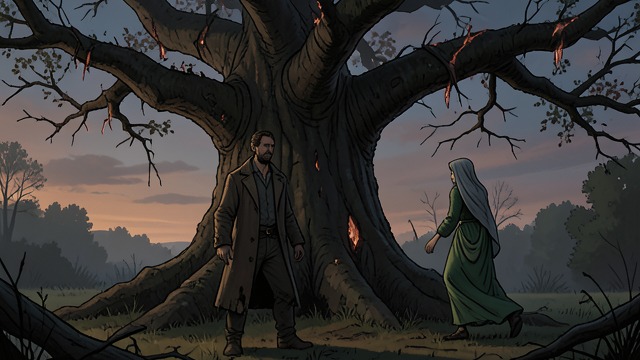
Annon receives a Dryad’s kiss and the gift of memory in an encounter that turns his defense of a tree into a profound change in how he understands himself and others. The Dryad, Neodesha, grants him a boon that preserves every memory rather than letting pain fade; by reliving his earliest terror, Annon discovers what happened between his mother and Tyrus and is urged to face the man he has known as his uncle. The gift is wisdom, but it is not comfort: Annon must carry the full weight of what he remembers.
The encounter at the tree
After the battle, Annon waits beneath the oak he has helped save. The Dryad comes at dusk and warns him not to look at her, because seeing her will make him forget. Her presence first reaches him through voice and movement; she speaks his language, and he recognizes her as the being whose tree he defended. The restraint required of him gives the encounter its first tension: he must listen without looking, even as her voice draws his attention toward her.
Neodesha explains that Annon’s speaking her name gives him power over her. He can use it to bind her or free her from the tree, although she does not want to be freed. If he looks at her, however, he will forget her name and the power will turn against him. The boon is therefore not a simple gift without conditions: knowledge creates an asymmetry between them, and Annon must choose whether to hold that advantage or accept a different bond.
The kiss and its cost
Neodesha tells Annon that he saved her tree by facing her enemies rather than fleeing, and that this act has earned her trust. She offers the Dryad’s kiss, which brings wisdom and prevents her from stealing his memories when he looks at her. Its benefit comes with a clear cost. Annon will remember every word spoken to him, every hurt and joy; the pain of memory may lessen for others as they forget, but his will remain complete. The kiss thus makes recollection both a source of understanding and an enduring exposure to suffering.
The kiss arrives before Annon can finish deciding whether to accept it. As Neodesha presses her lips to his, his mind seems to awaken and his life opens before him. When he opens his eyes, he can see her without losing what she has told him. She explains that she has lived for several thousand years: at sixteen, the age at which Dryads are reborn, she bit the fruit of a tree in Mirrowen that grants eternal life, as part of her binding. Her appearance and identity overturn Annon’s expectation of what a Dryad might look like, while her long life underscores the difference between his brief human past and her extended existence.
Memory becomes testimony
Neodesha encourages Annon to speak about his life. He tells her about feeling abandoned by Tyrus, his pursuit of Druidecht lore, the fireblood, Tyrus’s summons to Kenatos, the quest for Drosta’s lair, and his encounters with Drosta and the Kishion. The disclosure takes until midnight. For Annon, speaking is a release from emotions and confusion he has carried alone; for Neodesha, listening is part of a different practice in which visitors may leave memories with her by surrendering them.
She describes how some visitors seek to forget their troubles, and how those who give up too much can even lose their sense of identity and abandon family ties. Such forgetfulness may relieve pain, but it leaves people weaker, with an ache and an absence they cannot repair. Annon rejects that escape: he does not want to be rid of his memories. Neodesha instead directs him to use his new wisdom to solve his problems, beginning with his sister. The gift is framed not as knowledge for its own sake but as a demand to examine what he remembers and act upon it.
The recovered infancy
As Annon searches his newly accessible memories, he reaches an episode from when he was less than two years old. He remembers his mother’s face marked by claw wounds and the fierce love he felt for her. He also remembers her shaking him and making him cry, while he was too young to understand the words around him. The memory holds love and fear together rather than simplifying his mother into either a source of comfort or a threat.
He remembers Tyrus, also scarred by claw marks, lifting him against his chest and shielding him. Blue and orange flames spit around them as Tyrus carries him away from a stone hut into a storm. Their home burns; there are screams of rage, pain, and madness. Tyrus covers Annon with his cloak and tries to soothe him, while the child is cold, hungry, frightened, and clinging to him for safety. The recollection makes Annon’s separation from his mother tangible and supplies a history behind the responsibility Tyrus has carried for him.
Kinship, grief, and what follows
When Annon wakes from the memory, his head is in Neodesha’s lap and she is gently stroking his hair. Because she experiences his memories as he relives them, their connection is also an act of shared witness. She interprets what he has recovered: Annon’s mother had the fireblood and was mad, while Tyrus felt, and still feels, a degree of responsibility for him. She cautions Annon against judging Tyrus harshly and asks him to recognize how suffering binds people to one another. Her counsel changes the meaning of the childhood memory without erasing its terror.
Neodesha believes Tyrus does not intend Annon harm and tells him that their meeting is no coincidence: Tyrus is in Canton Vaud, waiting for him. Nizeera affirms that they will face him together. Annon’s gift therefore redirects him from solitary remembrance toward a confrontation informed by the past. The Dryad’s kiss does not resolve the pain of his childhood; it equips him to remember it fully and to approach Tyrus with a more complicated understanding of love, fear, and responsibility.
The event also gives concrete form to the difference between forgetting and healing. Neodesha’s tree can offer people relief by taking memories, but Annon’s boon preserves the very experiences that make him vulnerable. In this encounter, memory is not an escape from suffering or a guarantee of comfort. It is a means of recognizing relationships that pain had obscured—and a responsibility to meet the living with what the past has revealed.
Annon learns Tyrus’s true plan
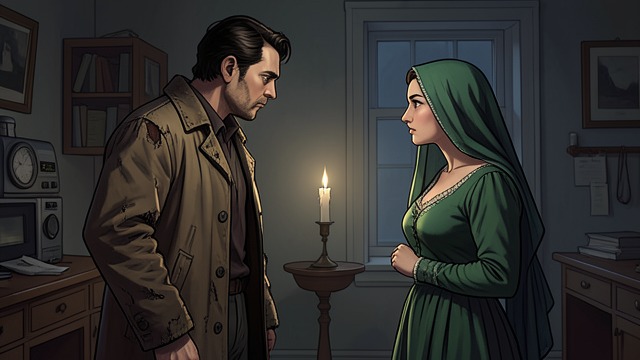
Annon learns Tyrus’s true plan in a private reckoning that recasts their family history and the failed Scourgelands expedition as parts of one unfinished struggle against the Plague. Tyrus explains why he chose distance and concealment: he believed the Arch-Rike had betrayed his expedition, and he returned to Kenatos to gather knowledge while remaining inside what he calls a gilded prison. He now entrusts Annon with the secret, the evidence behind his suspicions, and the work he believes may prevent another outbreak.
The family history behind the deception
The conversation begins with Annon recalling that his mother was Merinda, not Tyrus’s sister as Tyrus had led him to believe. Tyrus confirms the deception and urges Annon to reason through it rather than accept answers passively. Annon recognizes that Tyrus took him from a mother whose uncontrolled magic endangered him, but asks why he has no memory of a sister. Tyrus explains that Hettie was taken at birth by a Romani midwife who did not know the twins were twins. Tyrus himself had not known in time to save both: he chose to save Annon’s life and lost Hettie to the Romani. The false account of Merinda’s relationship to Tyrus helped conceal the family’s circumstances; it also contributed to the Romani kidnapping Hettie to blackmail him.
What Tyrus lacked, he insists, was not money but freedom. He had spent years inside Kenatos, where attempts to test the limits of his liberty tightened the constraints around him. He could not simply claim Annon or explain himself: he needed access to knowledge held in the city, and he feared that the Arch-Rike would kill him for what he knew. His return to Kenatos after Annon’s birth was therefore both an act of concealment and a deliberate return to danger. He left Annon to be raised by the Druidecht in Wayland, told the Arch-Rike only that the expedition had failed and that he had been recovering, and hid the fact that Merinda had borne a child.
The failed expedition and the suspected betrayal
Tyrus describes his life’s work as an effort to banish the Plague, which he has seen devastate the world twice. Guided by the example of Band-Imas, he believes lasting change depends on gathering people around a cause larger than any one individual. He assembled scholars, fighters, and the gifted Bhikhu who was Annon’s father, secured the Arch-Rike’s blessing, and led them into the Scourgelands. The party was destroyed. Tyrus survived because Merinda, gravely wounded, used the magic in her blood to save the others; the exertion cost her control of her mind. He promised to get her home and give her unborn child a chance at life.
Merinda also disclosed the Druidecht secret that Dryads guarded the Scourgelands. Tyrus came to understand that the expedition had not simply encountered formidable defenses: it had been violently repelled almost as soon as it entered the woods. He reasoned that the attackers had known the party was coming and assembled too quickly for that response to be chance. When Annon identifies the Arch-Rike, Tyrus confirms the suspicion: the ruler had approved the expedition while, in Tyrus’s view, knowingly sending it to its deaths. The Rikes of Kenatos, he concludes, have reasons to preserve the secret of a past injustice in the Scourgelands.
Tyrus does not present that conclusion as established history. The wrong done to the Dryads remains unknown, and even he calls for facts rather than speculation. Annon has learned from a Dryad that the Scourgelands’ Dryads are vengeful and that a taint, injustice, or betrayal lies behind their hostility. Tyrus believes the record survives in the trees themselves, where another Dryad might read what human memory has lost. The distinction between suspicion and proof shapes his plan: his mission is not merely to enter the forbidden woods, but to find a way to learn what happened there.
Knowledge gathered in Kenatos
Tyrus stayed in Kenatos because its archives offered clues unavailable through Druidecht oral teaching, though they contained no detailed records of Dryads. He studied what he could, even bringing a tree into the Paracelsus Towers courtyard after learning that it was the last of its kind on the road to Kenatos and otherwise faced the woodcutter’s axe. He waited beside it without looking at the visitor who came, learned her name, and received a Dryad’s kiss. The insight that followed helped him understand what he needed to do: a Dryad not bound to a particular tree might enter the Scourgelands and bind herself to its trees to discover their history.
Tyrus says he explained this purpose to the Dryad and that she agreed willingly. He denies Annon’s assumption that he forced her, arguing that Annon’s knowledge of Dryad lore should make him recognize the difference between abuse of trust and a freely accepted undertaking. Tyrus also reveals that the Dryad became his wife under her people’s customs. When a Dryad chooses a mortal as a mate, she wears a bracelet around her ankle until his death; the bond to the tree in the tower binds Tyrus to her in turn. The disclosure transforms the tree that Tyrus had seemed to keep for private study into part of a reciprocal relationship and the larger investigation.
The daughter and the next stage of the plan
Tyrus reveals that he has a daughter, born of that union, and that she lives in Stonehollow, the homeland of his family and of those with the fireblood. He arranged for her to be raised as an orphan among people who would protect and teach her at the right time, rather than seek her out himself. At sixteen, she must decide whether to bond with a tree. The stones Tyrus sent Hettie to find are meant to locate her: she should wear a necklace set with a blue stone, and the other stones will be drawn to it. The stones are thus not simply objects to bargain over; they are the means by which Tyrus hopes to find the daughter whose choice and knowledge may matter to the Scourgelands mission.
Tyrus’s confession turns Annon from a neglected relation into the person chosen to carry the hidden account forward. He tells Annon that if the Kishion had killed him, the secret might have remained lost for another generation, while the Plague could return. Though he admits he has not been a good father or uncle, he says Annon helped inspire the solution. Annon’s response is not presented as an instant erasure of the past: he is startled by Tyrus’s disclosure and must judge whether to trust a man who deliberately deceived him. But when Tyrus says the expedition needs a Druidecht and needs him in particular, Annon nods firmly. Later, Tyrus identifies the need for a Shaliah as well, explaining that the previous party had been wounded and many killed; Khiara’s healing ability and strength in the keramat make her essential to a renewed journey.
An inheritance of knowledge and obligation
The revelations join several forms of hidden knowledge: the family truth Tyrus concealed, the Dryads’ memory preserved in trees, and the political secret behind the Arch-Rike’s authorization of a doomed expedition. Tyrus does not offer Annon a clean reconciliation or a complete solution. He gives him a chain of reasons, admissions, and still-unanswered questions, then asks him to act on what he can discern. The event’s decisive change is that Tyrus’s private investigation becomes a shared undertaking. Annon’s Druidecht knowledge, his newly gained insight, and his family connection to Tyrus now place him inside a mission intended to repair an unknown wrong and stop the Plague before it returns.
The anti-Plague alliance gathers at Prince Aran’s estate
The anti-Plague alliance gathers at Prince Aran’s estate as Tyrus Paracelsus turns a failed expedition into a renewed collective undertaking. He names the Arch-Rike of Kenatos as the betrayer who caused the first mission’s destruction, reveals the danger posed to the Romani, and gives each companion a role in confronting the Plague and its political enablers. The gathering’s promise of cooperation is tested almost immediately by Kiranrao’s demand for an equal bargain—and by the arrival of the forces they mean to oppose.
The cause and the earlier defeat
The alliance is rooted in Tyrus’s first journey into the Scourgelands, an attempt to defeat the Plague that ended in near-total destruction. His companions had entered the maze of diseased woods believing they could find and destroy the source of the recurring catastrophe, but they were hunted and killed before reaching its inner core. Tyrus survived, but not with an explanation for the failure. The new gathering begins only after he has worked out why the expedition was defeated and returned to pursue its unfinished purpose.
Prince Aran had already framed the undertaking as a cause larger than any one faction. He called the formation of Kenatos a “mastermind,” using the term for people aligned around a common goal, and extended it to the alliance assembled at his estate. In his account, Tyrus had come to him after the failed expedition, wounded and close to death. Aran had sworn his house would join a second attempt; too young to take part at the time, he had trained for the day he could. He now describes the mission as a rebellion against death, while acknowledging that the participants may fail or die.
Tyrus reveals the betrayal
Tyrus explains that the first expedition failed because the Arch-Rike had learned its full purpose and sent agents into the Scourgelands to stop it. The Arch-Rike was one of three people entrusted with the complete truth, making the betrayal a consequence of trust as well as a military defeat. Tyrus says he spent years concealing that he understood what had happened while he remained a prisoner in Kenatos; now free, he intends to finish what he began.
His accusation changes the stakes of the meeting. The Arch-Rike is not merely an opponent obstructing a new expedition: Tyrus says he intends to exterminate the Romani and is using them for his own ends. Tyrus has seen documents and treaty signatures connecting the Arch-Rike with the King of Wayland, including plans involving the shipping routes. He warns that Havenrook will fall when the next Plague comes and that the Romani will be destroyed by the catastrophe he expects the Arch-Rike to unleash. He tells Kiranrao that his ring affirms the truth of this account, rather than asking him to accept it on Tyrus’s word alone.
Tyrus also reveals that Hettie’s place in the gathering is bound up with concealed family history. She was stolen as an infant by a Romani midwife; she and Annon are twins, but she is not Tyrus’s niece by blood. Tyrus presents her participation as a chance to earn freedom from the conditions governing her life, promising that she may settle in Silvandom afterward, where Romani are forbidden. His appeal makes the expedition’s political stakes personal, even as it asks Hettie to help protect a people from whom she has suffered constraint.
Recruits and assigned missions
Tyrus makes the alliance’s different needs explicit, addressing its members according to the skills and obligations they bring. He asks Annon to join as a Druidecht, saying that Annon’s mother saved his life in the Scourgelands and that he wants to honor her memory by completing their former work. Annon accepts with pride. His expertise in forests and their unseen inhabitants gives the mission a form of knowledge distinct from the military and political resources represented by the others.
Khiara is asked to join as a healer. Tyrus recalls that the first expedition’s members were wounded and many died, and argues that her skills could have helped more of them survive. He also points to her ability to raise the group’s spirits and to her strength in the keramat. Khiara agrees by nodding. Prince Aran likewise commits to the journey south, to Stonehollow, and confirms that he has the stones needed for the mission.
Paedrin is assigned a task linked to the vow of his master, Aboujaoude, who died on the earlier journey so that Annon and Hettie could live. Tyrus asks Paedrin to find the sword stolen by Cruw Reon and use it in the Scourgelands, thereby also addressing the dishonor Cruw Reon brought upon the Shatalin temple. Hettie is to help Paedrin claim the weapon: Tyrus invokes her training as a thief and says the sword must be stolen from the Shatalin temple, since Cruw Reon is cursed and will no longer touch it.
The assignments extend beyond the southern expedition. Kiranrao is told to alert the Romani to the Arch-Rike’s treachery, find evidence of the treaty in Wayland, and disrupt the Arch-Rike’s agents outside the city. Annon, Erasmus, and Khiara are to seek the oracle of Basilides for information Tyrus needs and then return. The group is therefore a coalition in action as well as in name: its members are sent along different routes to gather proof, obtain knowledge, recover a weapon, and prepare for the assault on the Plague’s source.
Bargain and arrival of the enemy
Kiranrao resists being recruited on terms that leave him outside the decision-making. He insists that he will serve no one unless he is a full partner, and threatens to leave the others to their fate. Tyrus answers that he knows Kiranrao’s price and offers not information but the silver blade Iddawc. Kiranrao has wanted the weapon for years and accuses Tyrus of having tricked him when he stole it without receiving what it was worth. Tyrus acknowledges the grievance and says the blade requires a special master capable of taming it.
Kiranrao accepts. His agreement is a negotiated exchange, not a surrender: Tyrus obtains his participation by offering Iddawc, a weapon whose influence Annon recognizes as dangerous. The bargain therefore secures a needed ally while placing a new source of risk inside the coalition. The alliance’s unity rests on a shared objective, but it does not erase the participants’ separate appetites, histories, and terms.
Before the meeting can move into its next phase, an abrupt arrival reveals how exposed the gathering is. Paracelsus agents, Rikes of Seithrall, and Kenatos soldiers enter in force, accompanied by the Kishion and the Arch-Rike himself. The attack interrupts Tyrus’s effort to turn disclosure and recruitment into a plan of action. The assembled alliance has identified its enemy and accepted its first assignments, but its opponents have arrived before the coalition can depart.
Significance of the gathering
The scene converts the failure of the first Scourgelands expedition into the basis for a second attempt. Its crucial reversal is not that the Plague has been defeated, but that Tyrus now understands his earlier defeat as deliberate betrayal and can name the political power behind it. That recognition expands the conflict: the expedition must face both the danger in the Scourgelands and the Arch-Rike’s influence within the world the group is trying to protect.
The alliance is also deliberately broader than a single community. Prince Aran’s image of a mastermind describes a common undertaking formed by people with different motives, while Tyrus’s assignments preserve their distinct skills and obligations. The meeting’s ideal of collective action is immediately placed under strain by Kiranrao’s insistence on a bargain and by the Arch-Rike’s sudden arrival. Cooperation is necessary, but the scene does not present it as effortless or secure; it begins as a choice made under threat, sustained by disclosure, personal promises, and negotiated terms.
The Arch-Rike’s assault on Prince Aran’s estate
The Arch-Rike’s assault on Prince Aran’s estate turns an attempted seizure into a confrontation over who commands the bound spirits and the people controlled by Kishion magic. The Arch-Rike brings an overwhelming force to the prince’s manor and orders a general attack, but Tyrus breaks the charms holding the spirits, reversing the balance of power. Amid the ensuing violence, Annon directs the newly freed spirits against their captors and uses a warning conveyed through Neodesha to remove Paedrin’s ring without triggering its lethal consequence.
Causes and Forces
The attack begins with a sudden arrival that recalls an earlier encounter with the Quiet Kishion. Paracelsus members appear alongside the Rikes of Seithrall and soldiers of Kenatos. The Paracelsus carry cylinders, each apparently bringing six or eight additional men; the narrator estimates roughly a dozen of them. The gathered force wears a mixture of gleaming necklaces, dark cassocks, hauberks, and the Kenatos crest, making clear that this is a coordinated show of institutional and military power.
At the far door, the Quiet Kishion stands beside the Arch-Rike. The latter is identifiable by his short white hair, black cassock, and commanding presence. He gives no terms or explanation: his order is to kill everyone. Annon begins summoning fire, while Paedrin lunges toward Tyrus, and the assault rapidly becomes a struggle on several fronts.
Tyrus Breaks the Bindings
As the attack unfolds, Tyrus is targeted by magical blasts from three directions. The attacks are absorbed by the gemstone in the amulet around his neck, and he evades Paedrin’s next charge. Tyrus’s ring flashes red, reversing Paedrin’s momentum and throwing him backward. Tyrus then speaks a word in the Vaettir tongue, an ancient term meaning a graveyard. Its force erupts through the chamber: explosions shatter the Paracelsus members’ amulets and rings and drive them back.
The destruction of the charms does more than interrupt the attack. It breaks the spirits’ servitude all at once, and they fill the manor as violet and purple lights, sparks, and ribbons of magic. Tyrus tells Annon that the spirits are his and will serve him. Their change of allegiance is immediate: they recognize their freedom and turn their power against the people who had held them captive. The reversal exposes the violence concealed within the attackers’ magical equipment; the necklaces and rings that helped sustain their control also bound the spirits.
Annon and the Freed Spirits
Annon does not need to speak aloud to direct the spirits. Responding to his thoughts and urgent need, they swarm the Quiet Kishion, drive back soldiers rushing toward Khiara and Prince Aran, and strike the Kenatos forces with their magic. Annon also sends several spirits to help Hettie, restoring her strength after she has been hurt in the fighting. Their resistance is both collective and purposeful: they attack the captors, protect the threatened, and answer Annon’s appeal.
The Arch-Rike counters by producing black sticks and igniting them with blue flames. Their smoke kills spirits, prompting him to call his men toward its protection and order them to keep fighting. The freed spirits therefore face a new threat even after the charms are shattered. Their liberation has altered the battle, but it has not ended the danger; the Arch-Rike still commands soldiers and the Quiet Kishion remains active.
Paedrin’s Ring and the Reversal
The fight also turns on Paedrin’s Kishion ring. Prince Aran tells Hettie to cut it off, while Tyrus warns that Paedrin cannot remove it himself without dying. Hettie raises her dagger, distressed by what she may have to do, and Annon intervenes. The rule that removal will kill Paedrin appears to leave no safe choice, but a spirit relays Neodesha’s warning: someone else must free him, and Paedrin has not yet shed blood.
Annon understands the condition through the memory of rabbits caught in snares. The more a trapped animal struggles, the tighter the loop becomes; escape depends on someone else releasing it. He applies that memory to Paedrin’s predicament and pulls the ring from his finger himself. The moment recasts the ring’s binding as a trap with a specific condition, not an unavoidable sentence of death. It also makes Annon’s connection to Neodesha consequential in the middle of the battle: her warning reaches him through a spirit, while remembered experience helps him act on it.
Consequences and Significance
The assault produces two linked reversals. Tyrus’s destruction of the charms frees the spirits and deprives the attackers of the objects through which they held them; Annon’s intervention frees Paedrin from the ring without the outcome Hettie had been ordered to risk. In each case, an apparently fixed form of magical control proves vulnerable to a different kind of release: the charms must be broken, while the ring must be removed by another person before Paedrin has killed anyone.
The battle remains dangerous, as the Arch-Rike’s smoke and the continuing attack demonstrate, but the assailants no longer hold uncontested control over the chamber. The spirits’ change of allegiance supplies Annon and his companions with powerful allies, while the ring’s removal gives Paedrin a chance to escape its imposed service. The assault thus brings the broader conflict into focus: authority backed by armed force and magical restraints can be challenged when the captive spirits are freed and the conditions of a binding are understood.
Battle at Prince Aransetis’s manor
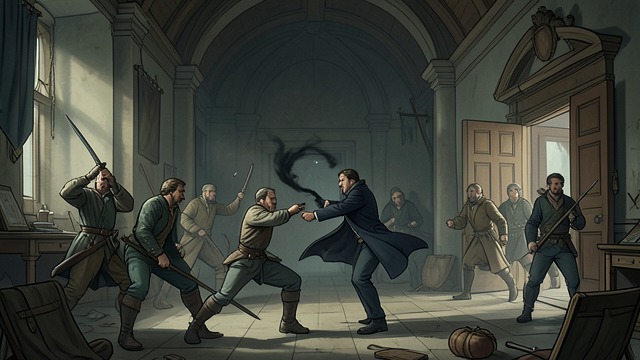
The Battle at Prince Aransetis’s manor turns the expedition’s gathering danger into an open crisis: the Arch-Rike’s forces press the defenders, Paedrin regains his freedom and fights the Quiet Kishion, and Tyrus takes the confrontation beyond the room by vanishing with their seemingly unstoppable opponent. As the Arch-Rike and Kiranrao also escape, the burden of the unfinished quest shifts to Annon, while the survivors must abandon the manor before it can be attacked again.
Causes and Stakes
The manor battle grows out of the expedition’s struggle against the Arch-Rike and the threat posed by his Kishion protector. The defenders’ immediate stakes are both personal and collective: Paedrin has to resist the Arch-Rike’s influence, the group must contend with an opponent whose resilience defeats ordinary attacks, and the quest cannot afford to lose the people needed for its journey into the Scourgelands.
The larger danger has been building through the destruction of places and relationships that might otherwise offer protection. Annon knows a forest where creatures recognize travelers and grant safe passage, and he trusts in Druidecht as knowledge of an active relationship between people and the unseen beings around them. By contrast, his passage toward Havenrook has shown him woods stripped of spirits by human damage. That contrast clarifies what is at stake in the manor: the party has abilities and alliances, but they are not a guarantee against violence or loss.
Annon’s understanding of protection is practical as well as spiritual. He has guided a woodcutter toward trees that can be felled without harming sacred ones, and he explains that fire can renew a forest rather than simply destroy it. His outlook differs from Paedrin’s initial fear that fire must mean danger, but it rests on judgment and responsibility, not on the assumption that power is harmless. At the manor, the dwindling presence of spirits makes the limits of that protection unmistakable.
The Battle and Its Reversals
Paedrin’s freedom marks the first major reversal. Once the voice that had occupied his mind is gone, he thanks Annon, then turns against the Quiet Kishion with a renewed sense of duty. He fights using the Uddhava techniques he learned from Master Shivu, but the assault does not secure an immediate victory: the Kishion defeats him, and Paedrin loses consciousness. His brief resistance nevertheless changes his position from a controlled instrument into an opponent acting by his own choice.
Prince Aran then stands between the advancing Kishion and the others. The Arch-Rike orders the Kishion to kill the defenders, but Prince Aran’s effort to stop him exposes the imbalance between them. The prince recognizes his opponent as Chin-Na; the Kishion’s unusual resilience makes the exchange of blows futile, and he defeats the prince. Meanwhile, the spirits leave the room one by one, and Annon feels their power receding. The battle thus strips away both human and supernatural forms of defense at once.
With the Kishion still standing, Tyrus gives Iddawc to Kiranrao. Kiranrao turns toward the Arch-Rike and declares that the Arch-Rike belongs to him, but the moment does not produce a lasting capture. The Arch-Rike withdraws his cylinder and disappears; Kiranrao follows in a cloud of dark smoke after looking back and nodding farewell. Their separate escapes turn the apparent opening into another reversal: neither the enemy nor the person who has taken Iddawc is secured by the defenders.
Tyrus’s Choice and Annon’s Charge
The confrontation leaves Annon facing an impossible choice. The party’s fighters are down, Nizeera cannot answer his call to flee, and he believes escape through Tyrus’s device would abandon Paedrin, Prince Aran, and Nizeera to their enemies. He also understands that the expedition needs them to survive the Scourgelands. The danger is therefore not only immediate defeat but the possibility that saving some companions will mean leaving others behind.
Tyrus intervenes by lunging at the Kishion. Before doing so, he gives Annon a desperate reminder: Tyrus’s daughter is in Stonehollow. The reference identifies her as the missing linchpin and makes clear that Tyrus is entrusting the quest to Annon. When Tyrus strikes the Kishion, both vanish. Their disappearance removes Tyrus from the scene and leaves Annon responsible for the task that had been his uncle’s to carry.
The loss sharpens Annon’s decision rather than resolving it. He turns to Hettie and prepares to face the remaining Kenatos soldiers and Rikes. Tyrus’s departure is at once a tactical intervention and a transfer of responsibility: Annon must continue the quest without knowing what has become of Tyrus or the Kishion.
Aftermath and Significance
Paedrin survives the encounter and later comes to himself with Khiara above him. His freedom from the Arch-Rike’s influence remains central to what the battle has changed; when Hettie rushes toward him, he cannot yet trust her, and he signals her to wait. The reunion is therefore not an uncomplicated restoration. The battle has freed Paedrin from one form of control, but the distrust between him and Hettie still shapes their immediate relationship.
Prince Aran insists that the survivors leave, reasoning that the Arch-Rike has already managed to send men to the manor and could do so again. Annon agrees and calls Nizeera to the woods. Paedrin joins him, grips his shoulder, and acknowledges the debt he owes. He describes the absence of the Arch-Rike’s taint in his mind as a return to freedom. The survivors’ departure establishes the practical outcome of the battle: they cannot hold the manor as a refuge and must seek safety elsewhere.
The event’s defining movement is from apparent confinement to uncertain freedom. Paedrin breaks the mental hold on him, but is still overpowered; Prince Aran stands his ground, but cannot defeat the Kishion; Kiranrao and the Arch-Rike escape with their own objectives intact; and Tyrus removes the Kishion from the room at the cost of leaving Annon to carry the quest forward. The manor battle thus changes who is free to act and who must lead, without bringing the larger conflict to an end.
The Scourgelands quest party’s division
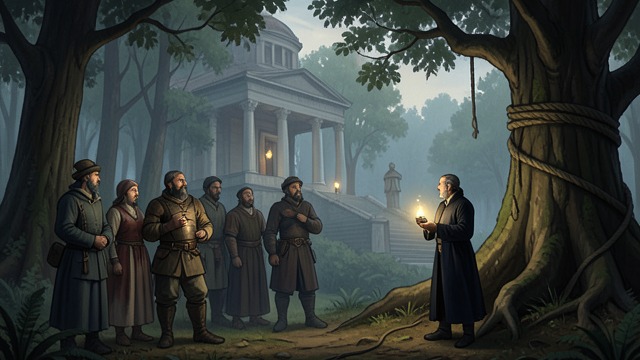
The Scourgelands quest party’s division turns the expedition into several linked missions after Tyrus vanishes in a struggle with the Kishion. With the company’s fighters down and the survivors facing an impossible choice, Annon inherits responsibility for the quest: Tyrus’s final reminder that his daughter is in Stonehollow leaves Annon holding both a secret and a charge. The group disperses toward Stonehollow, a hidden oracle, the Shatalin temple, and a guarded tree portal, setting its members on separate paths toward the same struggle against the Plague.
The Charge Passes to Annon
Tyrus’s disappearance comes at the point when the expedition seems close to ending before it has entered the Scourgelands. Annon sees the remaining spirits dart away and understands that his fireblood might destroy the soldiers but cannot stop the Kishion. Escaping by Tyrus’s device would leave Paedrin, Prince Aransetis, and Nizeera to die, so the available choices seem to doom either the people left behind or the quest itself.
Tyrus pushes past Annon and lunges at the Kishion. Before the two vanish, he looks back and reminds Annon that his daughter is in Stonehollow. The reminder identifies her as the missing linchpin, but it also carries a transfer of responsibility: Tyrus is entrusting Annon with the quest. Annon feels the weight of that handover as despair, not triumph.
Afterward, Annon tells the survivors that Tyrus shared information with him that he has not shared with anyone else. He insists that it remain secret for now, then asks whether they will accept the tasks Tyrus gave them to aid the journey into the Scourgelands. The assignments are therefore not an improvised change of destination; they continue a plan whose full basis Annon is not yet disclosing.
Separate Destinations, Shared Purpose
Prince Aransetis is the first to state his destination: Stonehollow. His route follows directly from Tyrus’s reminder about his daughter, though the available account does not further identify what the prince is to do there. Annon’s announcement keeps the information about the daughter within the group rather than turning it into a public explanation of the assignment.
Annon asks Khiara and Erasmus to accompany him to the oracle of Basilides. The temple is being built in secret in the mountains, away from Kenatos, as a refuge should the city fall; it remains under construction, and the party must first discover its location. Khiara agrees after glancing toward Prince Aransetis, whose attention does not meet hers. Erasmus weighs the peril in his characteristically gambling terms: he has lost his ducats, may be wanted in several kingdoms, and recalls that the last party to venture into the Scourgelands died. Yet he also judges that Tyrus has improved their odds and accepts the assignment in hopes that the oracle will offer useful knowledge of their chances.
Annon’s further instructions direct Paedrin and Hettie toward the forest west of Silvandom, where a Dryad tree saved by Annon is guarded by the Bhikhu. Nizeera is to guide them, and Annon promises that spirits will watch for them. He frames the route as preparation for a later attempt on the Scourgelands, emphasizing the safety of numbers and warning that the Arch-Rike may retaliate after his defeat.
Paedrin and Hettie Choose a Route
Paedrin accepts his charge in open opposition to the Arch-Rike. He intends to resist the Arch-Rike’s influence over the people and explains that, while imprisoned in the Arch-Rike’s dungeon, he was brought before his master to be disavowed. The master’s words seemed to condemn him, but Paedrin understood from his eyes that he was communicating without speech: the story of Cruw Reon carried information meant to aid the quest and perhaps restore the Shatalin temple. Paedrin accepts the assignment, but initially insists on going alone.
His stated destination changes from the forest route to Kenatos. Because the Arch-Rike’s minions will be searching the kingdoms for a Bhikhu, Paedrin believes he can disappear within the city and move freely there. He must find his master, who can tell him where to begin the search for the Shatalin temple; he also asks whether a portal exists in or near Kenatos. The route thus joins a personal purpose—finding his master—to the expedition’s larger need to restore the temple.
Annon is surprised when Paedrin finally agrees to travel with Hettie, and he doubts their declared plan to part company in Kenatos will hold. The two reach agreement only after verbal sparring. Their partnership is unsettled rather than reconciled: Paedrin is determined to proceed, while Annon sees stubbornness on both sides and suspects that the promised separation may not come to pass.
The Portal and the Parting
Annon explains that the portal opens through a gap in the tree and that travelers emerge at another portal by thinking of their destination. When Hettie asks whether passage will involve sleep, as it did when Drosta found them, the question recalls the party’s earlier experience without changing the practical terms of this journey: she and Paedrin intend to pass through together.
Before leaving, Hettie’s expression softens. She embraces Annon fiercely, kisses his cheek, and apologizes, telling him that he has changed. Annon accepts the apology, touches her cheek, and fingers her earring as he asks her to be safe and says he will miss her. Their farewell makes the division more than a logistical rearrangement: the newly reunited siblings are choosing separate work at the moment Annon most wishes he could keep the whole company together.
Paedrin floats up to the opening; Hettie climbs the rough surface after him. He waits with a disdainful expression, and when she reaches him they lock arms and enter the gap together. Annon feels the magic pass through him and their absence at once. He hopes they will meet again and that Tyrus was right to trust them, but their departure deepens his sense of inadequacy and leaves him wishing they could have stayed.
The Remaining Company
Prince Aransetis follows through the portal toward Stonehollow. Before going, he studies Annon as though weighing him and urges him to be wise, reminding him that Tyrus has placed considerable faith in him. Annon apologizes for the blood shed at the prince’s home, knowing that the Vaettir regard life; the prince accepts the apology and calls him wise. The exchange gives their separation a measure of mutual recognition, even as the prince leaves Annon with the burden of command.
Khiara watches the prince with a pleading look, but he does not acknowledge her unspoken request. He bows stiffly and departs. Her silent appeal contrasts with the explicit assignments around her: the division sends people toward distinct objectives, but it does not resolve every personal attachment among them.
Annon is left with Khiara, Erasmus, and Nizeera. Hettie asks whether Tyrus is dead; Annon cannot answer, acknowledging both Tyrus’s cleverness and the Kishion’s apparent invincibility. The question keeps the handover suspended between inheritance and loss. Annon has accepted responsibility for stopping the Plague, but the departure of his sister, Paedrin, and the prince leaves him feeling the burden grow heavier, while Tyrus’s fate remains unknown.
Tyrus’s interrogation and apparent death
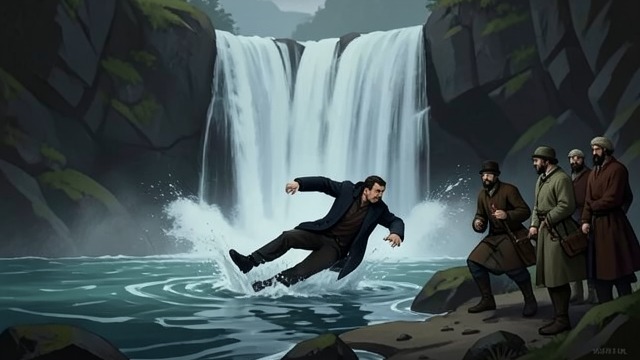
Tyrus Paracelsus’s interrogation and apparent death turns an escape into a decisive defeat: captured by a Kishion, Tyrus cannot overcome the force binding his pursuer, and a magically compelled confession reveals the existence and parentage of his daughter. The Arch-Rike learns where to send the Kishion next, while Tyrus is left mortally wounded and his allies are placed in danger.
The failed escape
The confrontation begins after the Tay al-Ard carries Tyrus and the Kishion to a waterfall. The turbulent water disorients them both, and Tyrus loses his grip on the cylinder. He reaches the surface with the aid of spirit magic from a ring and struggles ashore, hoping to reach Drosta’s lair, where stone might shelter him from pursuit. The Fear Liath’s power adds a wave of terror, but the Kishion behind him is the more immediate threat.
Tyrus had gambled that the waterfall’s natural force would unsettle the Kishion. Unlike magic, drowning was a danger that could provoke ordinary human panic; Tyrus also knew where the Tay al-Ard would take them, while the Kishion did not. But the delay is not enough. Tyrus senses the Kishion emerging from the pool and understands that he is still too far from Drosta’s lair.
A contest of powers
Tyrus refuses to return with his pursuer and offers to free him from the ring that binds him. The Kishion responds with silence. Tyrus then draws on the powers held in his rings, bracelets, charms, and jewels, testing fire, ice, poison, wind, love, and spirit magic. The spirit magic surrounds the Kishion in a many-colored display, but none of the attacks affects him: he walks through them as if they were rain.
Tyrus’s last attempt is not an attack but a song. He opens a locket whose spirit melody recalls his dead sister and parents he can no longer remember. The Kishion stops. The moment briefly interrupts the assault, but it does not free Tyrus or turn the encounter in his favor. The Kishion regains control and uses a potion to make him answer questions.
The compelled confession
The Kishion asks about a woman Tyrus had said was in Stonehollow. Under the potion’s influence, Tyrus reveals that she is his daughter. He explains that he left her at an orphanage run by Winemiller, has visited only once, and does not know where she is now or what name she was given. His answers expose a hidden family connection, but they offer no precise location for the Kishion to follow.
Asked about the girl’s mother, Tyrus identifies the Dryad tree in the Paracelsus Towers. The disclosure changes the stakes of the interrogation: the Kishion is no longer pursuing Tyrus alone but has learned of a daughter with a powerful and distinctive maternal connection. The confession is forced from him by magic, and Tyrus is aware of his inability to stop speaking.
The Arch-Rike’s order and Tyrus’s fate
The Kishion’s voice shifts, revealing that the Arch-Rike is speaking through him from Kenatos. The Arch-Rike says that Tyrus had sent Prince Aransetis to fetch the girl and dispatched a Bhikhu after Cruw Reon and the youth Tyrus had passed off as his nephew, in pursuit of Basilides. He threatens those who aided Tyrus, claiming knowledge of the Uddhava, and orders the Kishion to go to Stonehollow and bring Tyrus’s daughter to him. The Kishion uses Tyrus’s scent to prepare to track her.
The Arch-Rike then orders Tyrus killed. The Kishion stabs him, and Tyrus recognizes the wound as mortal. The account ends with the waterfall as the last thing Tyrus remembers; it establishes an apparent death, not a subsequent confirmation of his fate. The event’s reversal is stark: Tyrus’s calculated escape and varied magic yield neither safety nor freedom, but a forced disclosure that gives the Arch-Rike a new target and puts Tyrus’s allies at risk.
Event 1
Event 2
Event 3
Event 4
Event 5
Event 6
Event 7
Event 8
Event 9
Event 10
Event 11
Event 12
Event 13
Event 14
Event 15
Event 16
Event 17
Event 18
Event 19
Event 20
Event 21
Event 22
Event 23
Event 24
Event 25
Event 26
Event 27
Event 28
Event 29
Event 30
Event 31
Event 32
Event 33
Event 34
