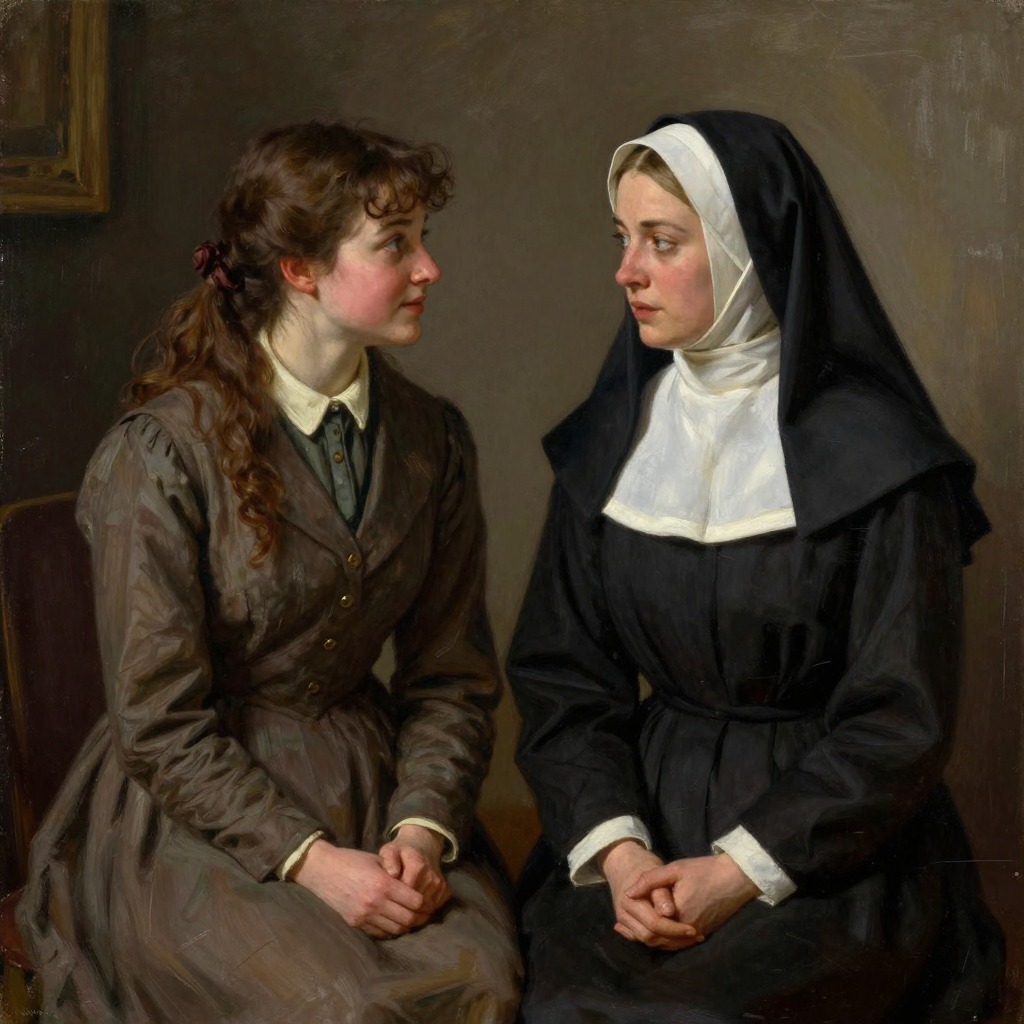
The convent near Lisle
Jane EyreThe convent near Lisle is the religious house where Eliza Reed, Jane Eyre's cousin, chooses to spend the rest of her life after the death of their aunt, Mrs. Reed. It represents a retreat from the world that perfectly suits Eliza's character—a place of rigid order, solitude, and religious formalism where her punctual habits and desire for control can be permanently secured from disturbance. The narrative confirms that she indeed takes the veil and becomes the superior of the convent, which she endows with her fortune, marking the culmination of a life trajectory defined by ascetic discipline and a rejection of worldly frivolity.
Eliza's Decision and the Nature of the Convent
Eliza Reed announces her plan to enter the convent near Lisle in the aftermath of her mother's death. She tells Jane that she will "take up my abode in a religious house near Lisle—a nunnery you would call it; there I shall be quiet and unmolested." Her stated purpose is to devote herself "for a time to the examination of the Roman Catholic dogmas, and to a careful study of the workings of their system." She expresses the hope that if she finds it "the one best calculated to ensure the doing of all things decently and in order," she will "embrace the tenets of Rome and probably take the veil." This language reveals that Eliza's attraction to the convent is not primarily spiritual or mystical but organizational: she values a system that guarantees order, decency, and regularity. The convent is, for her, the ultimate institutional expression of the rigid formalism she has already practiced at Gateshead, where she divided her time into precise portions, studied the Rubric of the Common Prayer Book three times a day, and devoted hours to stitching an altar cloth for a new church.
The Convent as a Fulfillment of Character
Jane's internal reaction to Eliza's announcement is telling: "'The vocation will fit you to a hair,' I thought: 'much good may it do you!'" This observation underscores that the convent is not a place of transformation for Eliza but of perfect accommodation. Her entire life at Gateshead—her coldness, her meticulous accounting, her devotion to routine, her rejection of her sister Georgiana's frivolity—has been a preparation for this cloistered existence. When Jane later reports that "Eliza actually took the veil, and is at this day superior of the convent where she passed the period of her novitiate, and which she endowed with her fortune," the detail that she becomes superior confirms that her ambition for control and order has found its natural outlet. The convent, far from being a place of self-abnegation, becomes the arena where her dominant traits—methodical precision, emotional austerity, and a desire for hierarchical authority—are rewarded and institutionalized.
Contrast with Other Characters and Thematic Significance
The convent near Lisle stands in thematic contrast to other forms of retreat and vocation in the novel. Unlike St. John Rivers, who goes to India as a missionary driven by an expansive, world-transforming ambition, Eliza retreats into a closed, contemplative world. Unlike Jane, who ultimately finds fulfillment in a marriage of mutual love and equality, Eliza chooses a life of celibate solitude. The convent also contrasts with the "convent-like" atmosphere of Lowood Institution, which was a charitable establishment governed by the harsh, hypocritical Mr. Brocklehurst; Eliza's convent is a place she freely chooses and endows with her own fortune, making her its patron rather than its dependent. The convent thus represents one possible answer to the novel's central question of how a woman with intelligence, will, and no fortune can shape her own life: by embracing a system of absolute order and renouncing the world entirely. It is a path that Jane explicitly rejects, but one that the narrative treats as a legitimate, if chillingly austere, resolution for a character like Eliza.