London
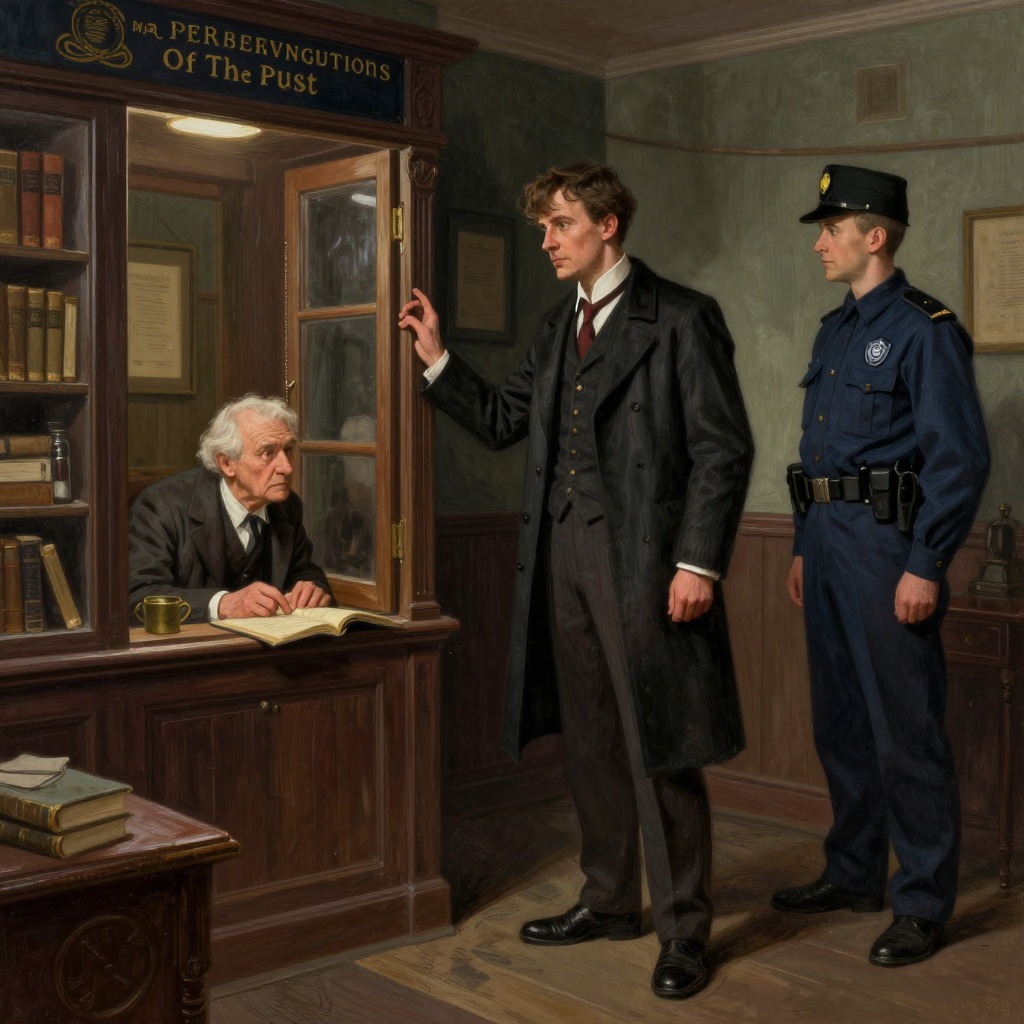
Nineteen Eighty-FourLondon is the chief city of Airstrip One, the third most populous province of the superstate of Oceania, and the setting of nearly every scene in Nineteen Eighty-Four. It is where Winston Smith, an Outer Party worker at the Ministry of Truth, opens his diary on a bright cold April day and where, after his arrest, he is carried away to the windowless Ministry of Love. The city is doubly real: a concrete, decaying capital of shored-up houses, gritty dust and boiled-cabbage hallways, and a psychological landscape saturated by posters, telescreens and the Thought Police. London carries the novel's whole arc, from the furtive purchase of the diary in a junk shop and the lovers' room above it, to the Hate Week demonstration in a central square and the final, gin-soaked surrender in the Chestnut Tree Café.
Physical Setting and Ruin
Winston's London is visibly falling to pieces. From his window he sees vistas of rotting nineteenth-century houses with sides shored up by baulks of timber, windows patched with cardboard and roofs with corrugated iron, their crazy garden walls sagging; bombed sites where plaster dust swirls and willowherb straggles over rubble, and sordid colonies of wooden dwellings like chicken-houses. The old flats of Victory Mansions, built around 1930, smell of boiled cabbage and old rag mats, the lift seldom works, plaster flakes from ceilings, pipes burst in hard frosts and the roof leaks in snow. The cold April day is lit by a harsh blue sky, and the only vivid colour in the streets comes from the posters plastered everywhere. The city is also under fire: rocket bombs explode twenty or thirty times a week, and proles call them steamers, seeming to sense them seconds in advance.
Surveillance and Party Presence
London is organized for watching. The enormous face of Big Brother, with its heavy black moustache, gazes from posters on every landing, house-front and commanding corner, captioned "BIG BROTHER IS WATCHING YOU", while a torn INGSOC poster flaps in the wind at street level. In his flat a telescreen receives and transmits simultaneously, so that any sound above a whisper is heard and any movement is scrutinised. Helicopter patrols skim between the roofs like bluebottles, snooping into windows; only the Thought Police matter more than the patrols. Among the grimy landscape stand the four Ministries that divide the government of London between them: the glittering white pyramid of the Ministry of Truth, the Ministry of Peace, the Ministry of Plenty, and the windowless Ministry of Love, ringed with barbed-wire entanglements and steel doors. Even the coins in Winston's pocket repeat the Party slogans and carry the watching eyes of Big Brother, so that no street, stamp or cigarette packet offers escape.
Prole London
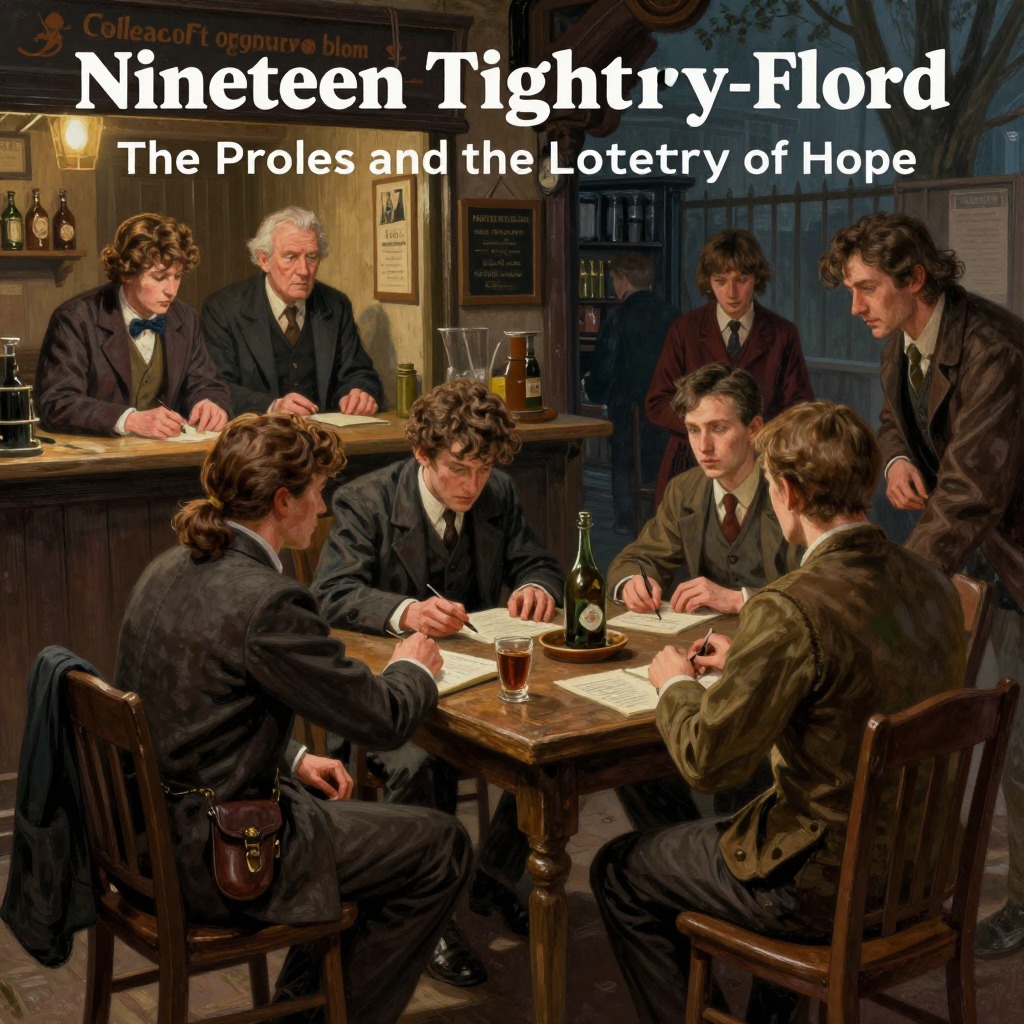
Beneath or beside this Party-controlled city exists a swarming prole London. Winston wanders into its slums north and east of what had once been Saint Pancras Station: cobbled streets of little two-storey houses with battered doorways giving straight onto the pavement, puddles of filthy water, broken and boarded windows, ragged barefoot children, and girls with crudely lipsticked mouths. A rocket bomb demolishes a group of houses and leaves a severed human hand on the pavement, which Winston kicks into the gutter; life resumes as though nothing had happened. In prole pubs, customers argue over lottery numbers and a very old man tells Winston fragments of a vanished world, remembering top hats and a shove received on Shaftesbury Avenue on Boat Race night. It is in this quarter that Winston finds Mr Charrington's junk shop, buys the blank book that becomes his diary, and later rents the room above the shop, where the singing of a powerful red-armed woman in the yard drifts up through the summer evenings.
Central Spaces and Events
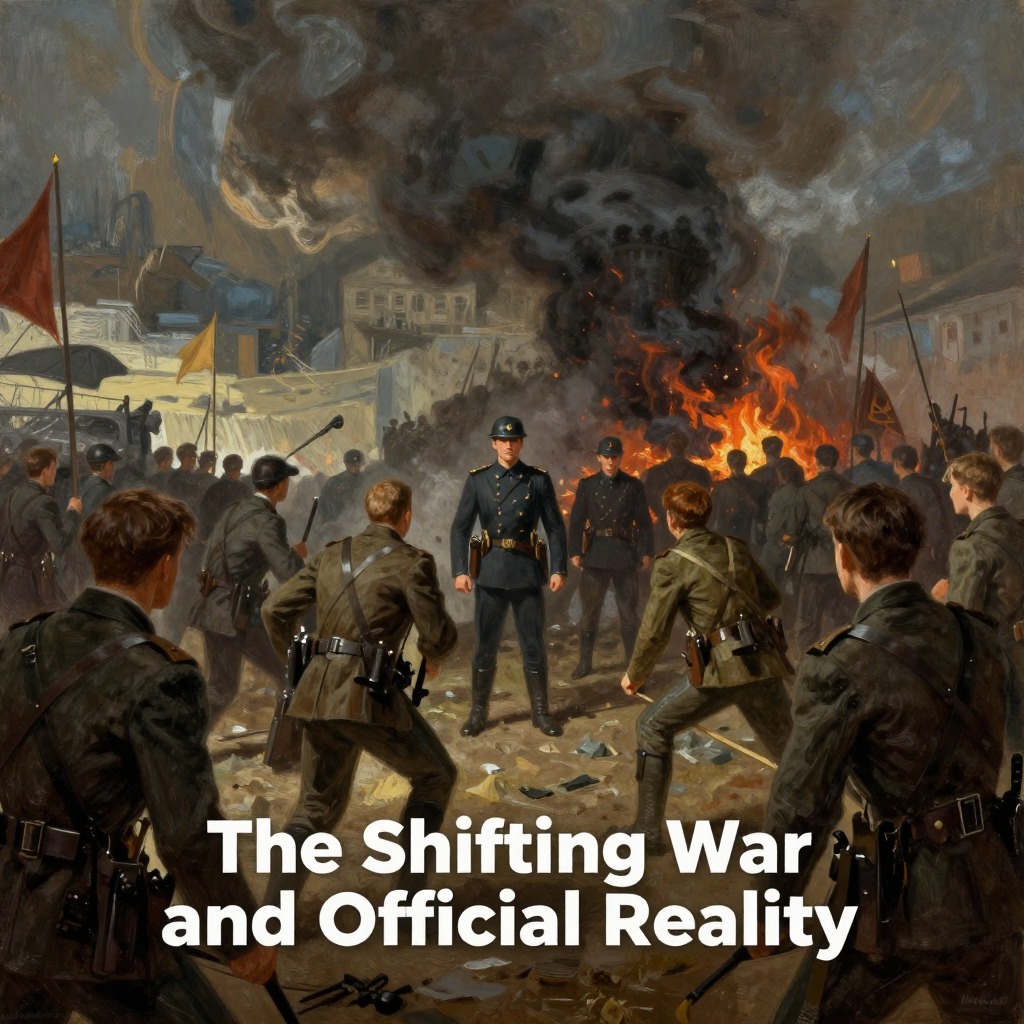
The public centre of London is Victory Square, dominated by a fluted column topped by a statue of Big Brother. There Winston keeps his first rendezvous with Julia, watching a convoy of Eurasian prisoners pass in trucks while she murmurs instructions; there, during Hate Week, an Inner Party orator on a scarlet-draped platform denounces Eurasia until a scrap of paper changes the names in mid-sentence and the crowd learns that Oceania is at war with Eastasia, the posters and banners being ripped down as sabotage. The same weeks bring a rocket bomb on a crowded film theatre in Stepney, burying several hundred victims, and another on a playground that kills several dozen children, followed by riots in which Goldstein is burned in effigy. At the end of the novel the action returns to the Chestnut Tree Café, where Winston sits in his usual corner with an ever-filled glass of Victory Gin, a chessboard and a copy of the Times, waiting for the bulletin of the African front before the final realisation that he loves Big Brother.
Erased History
London's past has been abolished as thoroughly as its bombed buildings have decayed. Winston cannot recall whether London was always like this; nothing remains of his childhood except bright-lit tableaux. He remembers an air raid that took everyone by surprise, possibly the atomic bomb on Colchester, the family's flight down a spiral staircase into a Tube station, and a drunken old man repeating "We didn't ought to 'ave trusted 'em", but he can trace no continuous history, since every record has been rewritten and every alignment redescribed. Architecture offers no proof: anything old is ascribed to the Middle Ages, and statues, inscriptions and street names have been systematically altered. At Mr Charrington's shop, the engraving of St Clement's Dane and the rhyme about the bells of St Clement's open a brief window onto a lost London "disguised and forgotten", and Winston hears in memory the bells of a city that no longer exists. His own vision of London is of a vast, ruinous city of a million dustbins, the reality behind the Party's claim that the standard of living has risen by twenty per cent.
Narrative Significance
London is the novel's instrument for measuring what totalitarianism does to a place and a people. The textures of its austerity, the uncooperative plumbing, the cigarettes that shed their tobacco, the horrible food and the gritty soap, make Oceania's tyranny tangible; Thomas Pynchon's introduction notes that London is still recognisably the London of the post-war austerity period. Yet the same ruined capital contains the novel's one source of hope: the proles, who sing, breed and go on living in the courtyards and back streets while the Party does not sing at all. Winston's journey through London, from the Ministry of Truth to the junk shop to the Chestnut Tree Café, traces his movement from isolated rebellion to capture, and the city's survival of bombs and lies suggests a vitality that the Party cannot kill. The novel ends where it began, in the city, with Winston gazing up at the enormous face and loving Big Brother; London is the ground on which that defeat and that strange peace are played out.