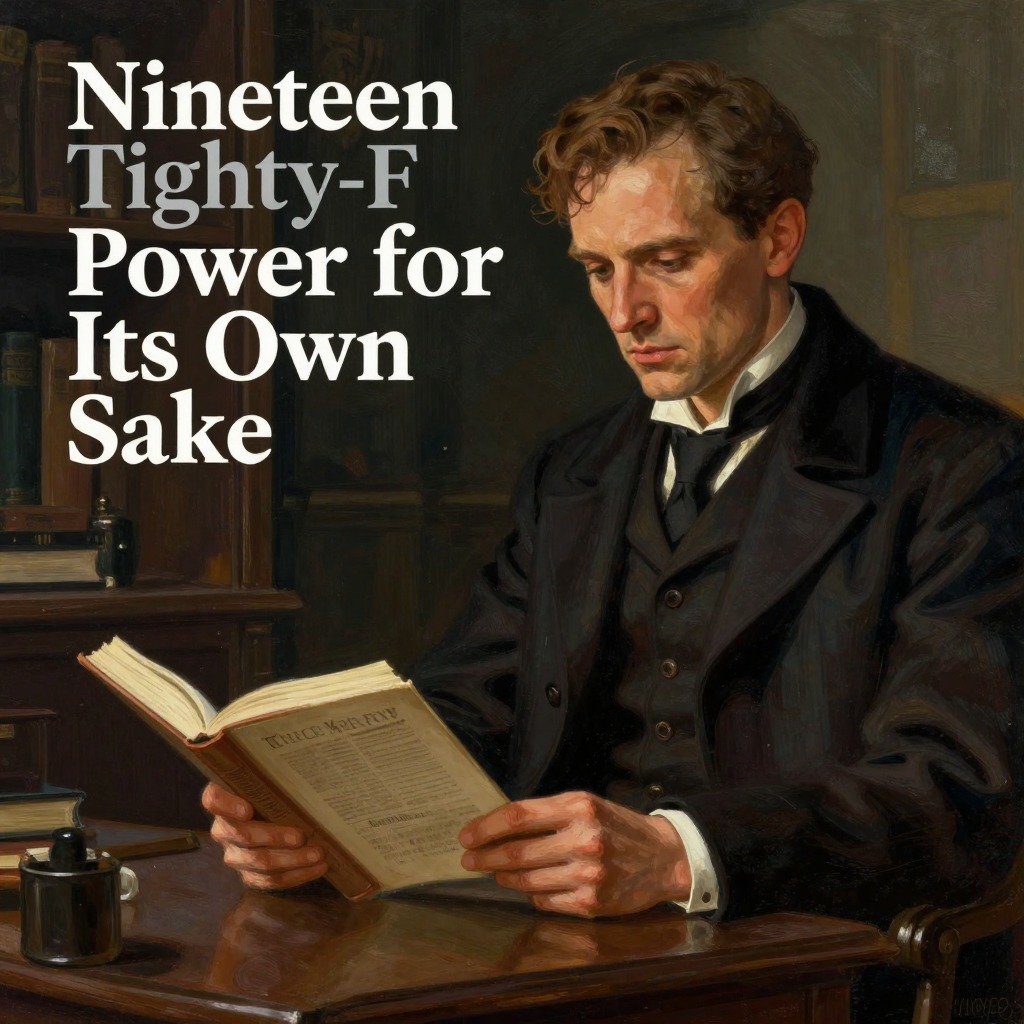
The Party is immortal
Nineteen Eighty-Four“The Party is immortal” is the central doctrinal claim of Ingsoc, the political religion of Oceania, and in Nineteen Eighty-Four it is spoken by the Inner Party official O'Brien as the culminating lesson of Winston Smith's re-education in the Ministry of Love. The assertion rests on a biological metaphor: the individual is only a cell of the greater organism of the State, so that “the death of the individual is not death.” Read against O'Brien's declaration that the Party seeks power for its own sake, the phrase is less a promise than a program: the Party earns immortality by absorbing and converting its enemies, and the novel's final sentence — “He loved Big Brother” — records the program's success.
The Doctrine Stated
O'Brien delivers the doctrine at the point in Winston's imprisonment when learning and understanding have given way to acceptance. The Party, he declares, is the first ruling group in history that knows what it is doing: “The Party seeks power entirely for its own sake. We are not interested in the good of others; we are interested solely in power.” Not wealth, not luxury, not long life or happiness — “only power, pure power.” He contrasts this self-knowing tyranny with its predecessors: the German Nazis and the Russian Communists came close in method but never had the courage to recognize their own motives, pretending that the seizure of power was unwilling and temporary. Against his own tired face he sets the image of the organism: “the individual is only a cell,” and “the weariness of the cell is the vigour of the organism.” Individual death is therefore not death, and the Party is immortal.
Power as Suffering
This immortality is sustained not by wealth or comfort but by a specific kind of power — power over human beings, and above all over the mind. O'Brien defines its method without euphemism: “Power is in inflicting pain and humiliation. Power is in tearing human minds to pieces and putting them together again in new shapes of your own choosing.” Suffering is the guarantee of obedience, because only while a man suffers can the Party be certain that he is obeying its will and not his own. The world being built is “the exact opposite of the stupid hedonistic Utopias that the old reformers imagined”: a world of fear and treachery and torment in which progress means progress towards more pain and every emotion except fear, rage, triumph and self-abasement is destroyed.
A System Without Law
The doctrine is institutionalized in an order from which law itself has been abolished. Nothing is illegal in Oceania — “nothing was illegal, since there were no longer any laws” — yet the mere opening of a diary is reasonably certain to be punished by death or, at the least, twenty-five years in a forced-labour camp. A Party member lives “from birth to death under the eye of the Thought Police”: his friendships, his relaxations, his behaviour towards his wife and children, the expression of his face when alone, the words he mutters in sleep, are all scrutinized, and he has no freedom of choice in any direction whatever. The endless purges, arrests, tortures and vaporisations are not punishment for crimes actually committed but the wiping-out of persons who might commit a crime at some time in the future. The enforcement arm of the doctrine is the Ministry of Love, a windowless building impossible to enter except on official business, its approaches roamed by gorilla-faced guards in black uniforms armed with jointed truncheons.
The Party's permanence also has an epistemological foundation: it controls what can be remembered. From the totalitarian point of view, as Thomas Pynchon observes in his introduction to the novel, memory is relatively easy to deal with — there is always some agency like the Ministry of Truth to deny the memories of others and to rewrite the past. The Party that decides what happened yesterday decides what is possible tomorrow, and a power that can rewrite memory at will has no need to fear any rival version of history.
The Proof of Conversion
Winston Smith's entire arc is the test of the doctrine. He begins it as a man who fills half a page of his secret diary with “DOWN WITH BIG BROTHER,” already certain that the Thought Police would get him just the same. The Ministry of Love shows what that certainty means. By the end, the heretic has been not merely broken but remade: in the Chestnut Tree Café he sits at his reserved corner table, watches the giant face on the wall, and understands that it has taken him forty years to learn what kind of smile was hidden beneath the dark moustache. “But it was all right, everything was all right, the struggle was finished. He had won the victory over himself. He loved Big Brother.” The Party's immortality is confirmed precisely because the conversion is inward and genuine rather than extorted.
Authorial and Historical Context
The claim of immortality was Orwell's way of naming a danger he took to be real and present in 1948. He had gone to Spain in 1937 to fight against Franco and his Nazi-supported fascists and had learned there the difference between real and phony anti-fascism; every line of serious work he had written since 1936 was aimed, as he put it, “against totalitarianism and for democratic socialism.” He was particularly angered by the English Left's willingness to accept the Russian regime as “Socialist,” a habit that produced, in his phrase, “a sort of schizophrenic manner of thinking” in which the same words could bear two irreconcilable meanings and concentration camps could be right and wrong simultaneously. The doctrine of the Party's immortality is the extrapolation of that corruption: a will to power that, once freed from the pretense of liberation, would claim not only the present but the future and the past, and would not rest until every heretic had been brought genuinely to love his own annihilation.