Garden of the Green Dragon
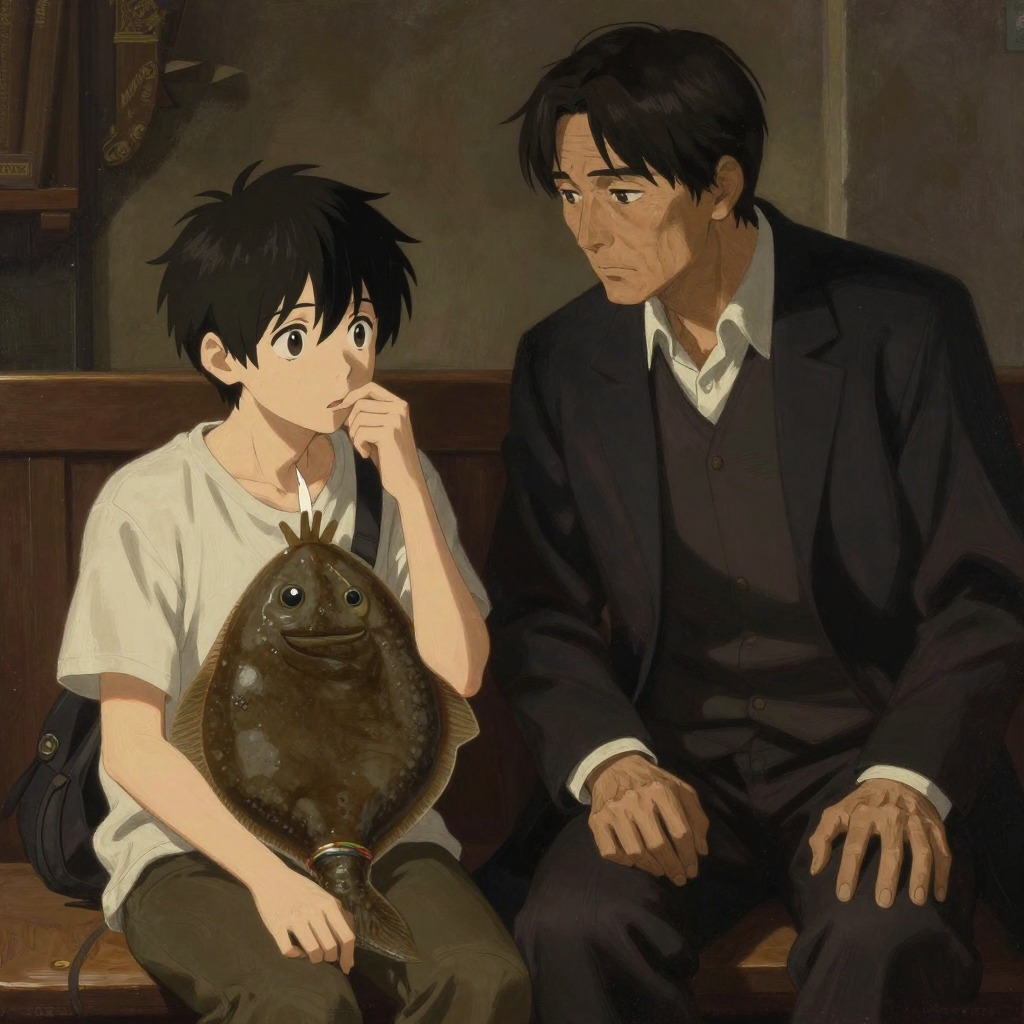
No Longer HumanThe Garden of the Green Dragon, an antique shop in the Okubo district of Tokyo, served as the home and place of business for Flatfish, a man who acted as Yozo's guardian after the Kamakura suicide incident. The shop's signboard, which proclaimed in bold letters "Garden of the Green Dragon, Art and Antiques," was the only impressive thing about the establishment. Inside, the long, narrow space was dusty and contained nothing but shelf after shelf of useless junk. Flatfish did not depend on the sale of this rubbish for a living; he apparently made his money by performing services such as transferring possession of the secret property of one client to another to avoid taxes. The shop was typically left in the care of a seventeen-year-old boy, who played catch in the street with neighborhood children and considered the parasite living on the second floor a simpleton if not an outright lunatic.
Yozo's Confinement and Humiliation
After being expelled from college, Yozo went to live in a tiny room on the second floor of Flatfish's house. Minute sums of money were remitted from home every month for his support, never directly to him, but secretly to Flatfish. Every other connection with home was severed. Flatfish was invariably in a bad humor; even if Yozo smiled to make himself agreeable, Flatfish would never return the smile. The change in him was so extraordinary as to inspire Yozo with thoughts of how contemptible human beings are who can metamorphize themselves as simply and effortlessly as they turn over their hands. Flatfish seemed to be keeping an eye on Yozo, as if he were very likely to commit suicide, and he sternly forbade him to leave the house. Unable to drink or to smoke, Yozo spent his whole days from the moment he got up until he went to bed trapped in his cubicle of a room, with nothing but old magazines to read. He was leading the life of a half-wit, and had quite lost even the energy to think of suicide.
The Dinner and the Failed Conversation
One evening towards the end of March, Flatfish invited Yozo downstairs to a dinner graced by the rare presence of sake. The host himself was impressed by the unwonted delicacy of sliced tuna, and in his admiring delight he expansively offered a little sake even to his listless hanger-on. Flatfish asked Yozo what he planned to do in the future. Yozo did not answer, but picked up some dried sardines with his chopsticks from a plate on the table and, while he examined the silvery eyes of the little fish, he felt the faint flush of intoxication rise in him. He suddenly became nostalgic for the days when he used to go from bar to bar drinking, and even for Horiki. He yearned with such desperation for "freedom" that he became weak and tearful. Flatfish pursued his discourse, speaking in a manner of speech that held strange, elusive complexities, intricately presented with overtones of vagueness. Yozo, baffled by these precautions so strict as to be useless, and by the intensely irritating little maneuvers surrounding them, felt past caring. In later years, Yozo came to realize that if Flatfish had at the time presented him with a simple statement of the facts—that his family had decided to send him a more adequate allowance once he had entered school—there would have been no untoward consequences. But as a result of Flatfish's unnecessary precautions, or rather, of the incomprehensible vanity and love of appearances of the people of the world, Yozo was subjected to a most dismal set of experiences. When Yozo finally said with conviction that he wanted to be a painter, Flatfish laughed at him with an indescribably crafty shadow passing over his face, a laugh that enabled Yozo to catch a glimpse of the very nadir of adult life.
Yozo's Flight
The next morning at dawn, Yozo ran away from Flatfish's house. He left behind a note, scrawled in pencil in big letters on his writing pad, stating that he was going to discuss his plans for the future with a friend and would return that night. He did not run away because he was mortified at having been lectured by Flatfish; he was, exactly as Flatfish described, a man whose feelings were up in the air, and he had absolutely no idea about future plans or anything else. He also felt rather sorry for Flatfish that he should be a burden on him, and found it quite intolerably painful to think that if by some remote chance he felt like bestirring himself to achieve a worthy purpose, he would have to depend on poor old Flatfish to dole out each month the capital needed for his rehabilitation. After leaving Flatfish's house, Yozo walked as far as Shinjuku, where he sold the books he had in his pockets, then stood there uncertainly, utterly at a loss what to do. He eventually decided to visit Horiki, and from there his life took a new direction, leading him into a series of relationships and dependencies that marked the next phase of his decline.
Narrative Significance
The Garden of the Green Dragon represents a period of enforced passivity and social death for Yozo. It is the place where his family's rejection and Flatfish's contempt converge, stripping him of agency and reducing him to a state of listless dependence. The shop's dusty, junk-filled interior and the cheerless existence of Flatfish and his illegitimate son mirror the stagnation and hopelessness of Yozo's own condition. His flight from this house is a desperate bid for freedom, but it also sets in motion the chain of events—his life as a kept man, his marriage to Yoshiko, and his eventual descent into drug addiction and institutionalization—that leads to his final disqualification as a human being. The Garden of the Green Dragon thus stands as a symbol of the suffocating, judgmental world of "society" from which Yozo can find no lasting escape.