William Collins
Pride and PrejudiceWilliam Collins, a twenty-five-year-old clergyman and the Bennet family's cousin, is one of the most memorably absurd characters in Jane Austen's Pride and Prejudice. As the heir to the Longbourn estate through an entail, he arrives at the Bennet home with a letter announcing his intention to heal a long-standing family breach and to make amends for his inheritance by marrying one of the Bennet daughters. His mixture of servility toward his patroness, Lady Catherine de Bourgh, and self-importance regarding his own position makes him a figure of relentless comedy, yet his actions also expose the harsh economic realities that govern marriage for women of limited fortune. His failed proposal to Elizabeth and his swift, pragmatic engagement to her friend Charlotte Lucas form a crucial subplot that deepens the novel's critique of pride, prejudice, and the marriage market.
Identity and Background
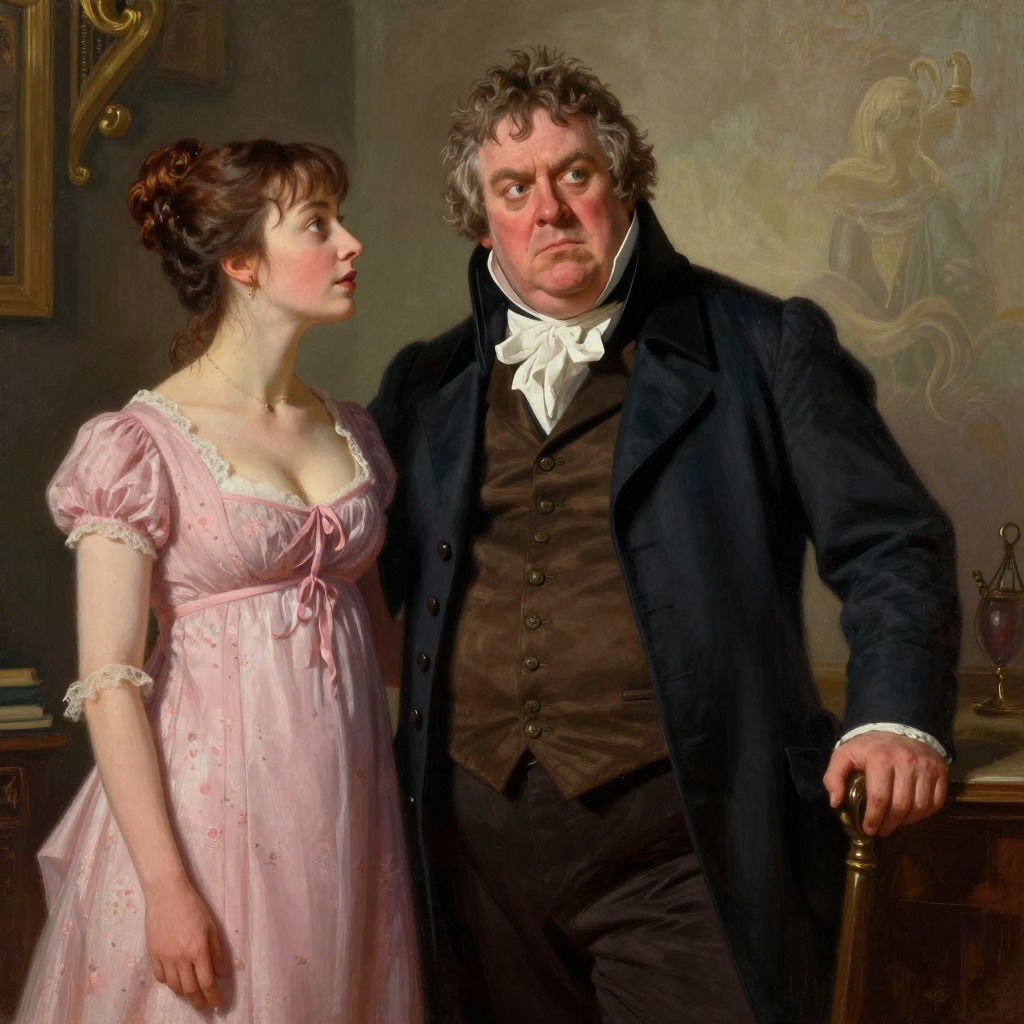
Mr. Collins is introduced as a tall, heavy-looking young man of five-and-twenty, with a grave and stately air and very formal manners. He is the son of an illiterate and miserly father, and though he attended one of the universities, he merely kept the necessary terms without forming any useful acquaintance. His education and society have done little to remedy the deficiencies of nature. A fortunate chance recommended him to Lady Catherine de Bourgh when the living of Hunsford became vacant, and he now serves as the rector of her parish. His character is a mixture of pride and obsequiousness, self-importance and humility, shaped by his father's subjection and his own unexpected prosperity. He is the next in line to inherit the Longbourn estate, a fact that makes him both a threat and a potential suitor in the eyes of Mrs. Bennet.
Arc Through the Plot
Mr. Collins's visit to Longbourn is the central action of his role in the novel. He arrives with the intention of choosing a wife from among the Bennet daughters, initially fixing on Jane Bennet. After Mrs. Bennet hints that Jane is likely to be soon engaged, he promptly transfers his attentions to Elizabeth. His proposal to Elizabeth is a masterpiece of unintentional comedy: he lists his reasons for marrying—the duty of a clergyman to set an example, the addition to his happiness, and the express advice of his patroness, Lady Catherine—and assures Elizabeth that he will inherit Longbourn after her father's death, making the match a form of compensation. Elizabeth's firm refusal bewilders him, as he cannot conceive that any woman would reject such an advantageous offer. He persists in believing her refusal is mere feminine coquetry, until Mrs. Bennet's frantic attempts to force the match and Mr. Bennet's dry support of Elizabeth's decision finally convince him to withdraw. Within days, he transfers his affections to Charlotte Lucas, who accepts him for the sake of a comfortable home. Their engagement is announced, and they marry shortly thereafter. Mr. Collins returns to Hunsford with his bride, and Elizabeth later visits them, witnessing the peculiar domestic arrangement in which Charlotte manages her husband's absurdities with quiet competence.
Relationships and Conflict
Mr. Collins's relationships are defined by his obsequiousness toward those above him and his condescension toward those he considers beneath him. His veneration for Lady Catherine de Bourgh is almost comically excessive; he speaks of her with rapturous praise, quotes her opinions as oracular, and is perpetually anxious to please her. His relationship with Elizabeth is one of comic conflict: he cannot understand her refusal, and his persistence in interpreting her rejection as encouragement reveals his profound self-deception. His marriage to Charlotte Lucas is a transaction based on mutual convenience rather than affection. Charlotte, a sensible and intelligent woman of twenty-seven, accepts him solely for the establishment he offers, and she manages their household by keeping him occupied in his garden and book-room, minimizing his presence in her daily life. Elizabeth is initially horrified by Charlotte's choice, seeing it as a betrayal of principle, but she comes to understand the economic pressures that drive such decisions. Mr. Collins's relationship with Mr. Bennet is one of mutual incomprehension: Mr. Bennet finds him endlessly amusing and deliberately provokes him, while Mr. Collins remains oblivious to the mockery.
Change and Ending
Mr. Collins undergoes no significant change or growth; he remains the same pompous, self-satisfied figure from his first appearance to his last. After Lydia's elopement with Wickham, he writes a letter to Mr. Bennet offering condolences that are barely disguised as gloating, suggesting that Lydia's disgrace is a blessing in disguise because it prevents the contamination of the rest of the family. He later writes to congratulate Elizabeth on her engagement to Mr. Darcy, but his letter is filled with warnings about Lady Catherine's disapproval, revealing his continued subservience to his patroness. In the novel's final chapter, he and his wife visit Lucas Lodge to escape Lady Catherine's anger over Darcy's marriage, and Mr. Collins is shown still parading his obsequious civility, which Darcy bears with admirable calmness. His character is static, a fixed point of absurdity against which the growth of Elizabeth and Darcy is measured.
Thematic Significance
Mr. Collins embodies several of the novel's central themes. He is a living example of the marriage market's mercenary logic: he seeks a wife not for love but for social convenience, and Charlotte accepts him for the same reason. His proposal to Elizabeth, with its cold enumeration of practical advantages, stands in stark contrast to Darcy's passionate, if flawed, first proposal. His servility toward Lady Catherine and his pride in his own position illustrate the novel's critique of class snobbery and the arbitrary nature of social hierarchy. His character also serves as a foil to Darcy: where Darcy is genuinely proud but capable of growth and self-awareness, Mr. Collins is merely conceited and incapable of reflection. Elizabeth's refusal of Mr. Collins is a crucial moment in her development, demonstrating her commitment to marrying for affection rather than security, and her subsequent horror at Charlotte's acceptance deepens her understanding of the limited choices available to women of her class. Mr. Collins, in his unvarying absurdity, remains one of Austen's most enduring comic creations, a figure whose every word and gesture exposes the folly of valuing rank and fortune above sense and feeling.