Henry George's book
Henry George's book, encountered by Dmitri Ivanovitch Nekhludoff during his university years, provides the theoretical framework for his evolving convictions about land ownership and social justice. The work, which argues that land cannot be legitimately held as private property, first captivates Nekhludoff as a young student and later resurfaces as the intellectual catalyst for his practical reforms.
Intellectual Foundation and Early Conviction
As a third-year university student preparing an essay on land tenure, Nekhludoff reads Herbert Spencer's Social Statics and is particularly impressed by Spencer's views on landholding. He then discovers Henry George's writings, which offer a brilliant corroboration of Spencer's arguments. The young Nekhludoff, heir to his mother's 10,000 acres, fully realizes the cruelty and injustice of private property in land. Being one of those to whom a sacrifice to the demands of conscience gives the highest spiritual enjoyment, he decides not to retain property rights and gives the small piece of land inherited from his father to the peasants. This early act of conviction, grounded in George's ideas, marks the first significant moral stand of his youth.
The Crisis of Inheritance and Moral Awakening
Years later, inheriting his mother's large estates forces Nekhludoff to confront a painful choice: either give up his property as he had done ten years before, or silently confess that all his former ideas were mistaken and false. He cannot choose the former because he has formed luxurious habits and lacks the same youthful resoluteness; he cannot choose the latter because denying the clear and unanswerable proofs of the injustice of landholding drawn from Spencer and Henry George is impossible. This inner conflict, directly framed by George's ideas, becomes a central crisis of his moral awakening. After the trial of Katerina Maslova, when Nekhludoff begins to examine his life, Henry George's fundamental position recurs vividly to his mind: the earth cannot be any one's property; it cannot be bought or sold any more than water, air, or sunshine. All have an equal right to the advantages it gives to men.
Practical Application and the Land Reform
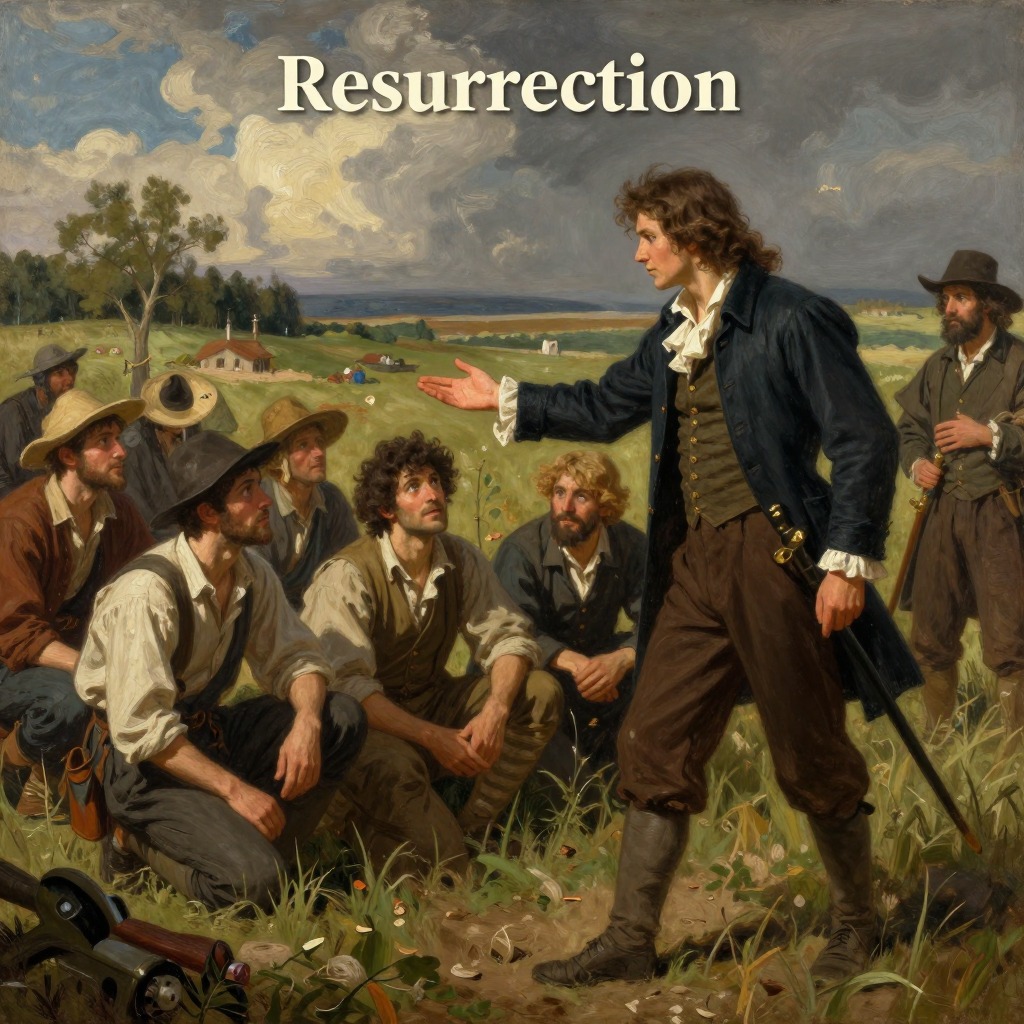
Driven by this renewed conviction, Nekhludoff travels to his estates to implement a practical reform. At Kousminski, he decides to let the land to the peasants at a low rent, enabling them to cultivate it without depending on a landlord. He recognizes this as a step towards a less rude form of slavery, a movement towards the solution of the land problem. At Panovo, his aunts' estate, he goes further, proposing to give up the land altogether and let the peasants rent it at a price fixed by themselves, with the rent forming a communal fund for their own use. He explains to the skeptical peasants the principles of Henry George's single-tax system: the earth is no man's; it is God's. All have the same right to it, but there is good land and bad land. He who uses the good land must pay those who have no land the value of the land he uses, with the payment going to the commune for its needs. This, he argues, would prevent the rich from buying up all the land and exacting anything they like for its use.
Thematic Significance
Henry George's book functions as more than a political treatise in the novel; it is the intellectual embodiment of Nekhludoff's spiritual quest for a just and meaningful life. The theory provides a concrete, actionable framework for his abstract moral awakening, transforming his personal guilt into a program of social reform. The book's ideas are tested against the harsh realities of peasant poverty and official obstruction, revealing both the power and the limitations of abstract principles when confronted with entrenched social structures. Ultimately, George's work represents the possibility of a rational, economic solution to the suffering Nekhludoff witnesses, a solution that aligns with his newfound commitment to live not for himself but for others.