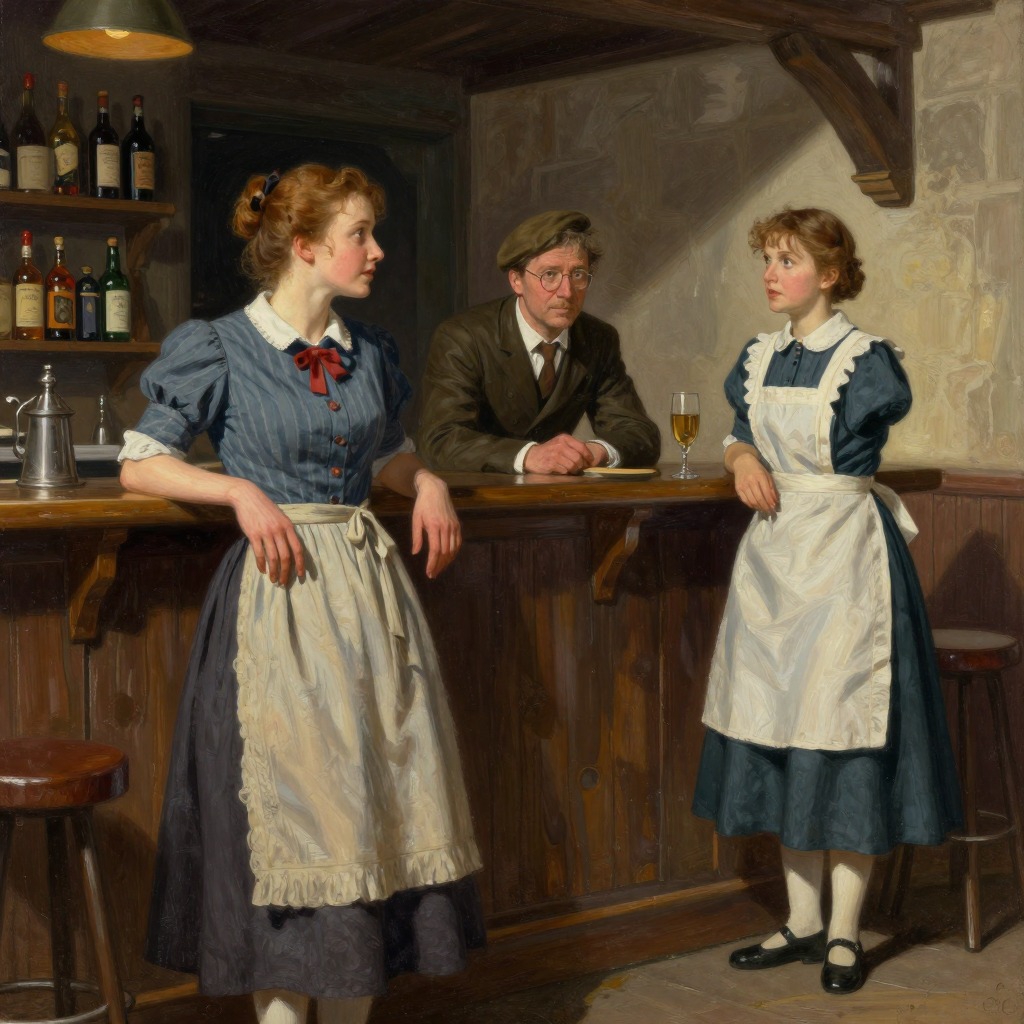
Emilie
The CastleEmilie is a chambermaid at the Castle Inn, one of the three maids who share a cramped, dark room and a life of fear and drudgery. She appears only in the final chapter of the novel, when Pepi, the deposed barmaid, describes her to K. as a companion in misfortune. Pepi presents Emilie as a woman of about Frieda's age, older than Pepi herself, who has fully adjusted to the wretchedness of her position. Unlike Pepi, who briefly escaped the maids' quarters to work in the bar, Emilie has never left, and she is one of the two friends who remain behind, bound together by their shared fate and their acceptance of it.
Life in the Maids' Room
Emilie's life is defined by the conditions of the chambermaids' existence at the Castle Inn. The maids sleep in a room that is "really no more than a big cupboard with three compartments," with beds stacked above each other. Their work is confined to the corridor where the secretaries stay, a place they can only enter when the gentlemen are working, and they must clean in absolute silence. They are forbidden to show themselves in the corridor at mealtimes, and their days are spent in artificial light and stuffy air, always dead tired. The worst part of their existence is the fear they endure at night, when they hear someone slinking around outside their door and clutch each other in terror, half dead with fright. Emilie, like her companions, has learned to live with this constant dread, and Pepi notes that the maids "don't really know the gentlemen at all, they've hardly set eyes on them."
The Community of the Three Maids
Emilie is part of a tight-knit trio with Pepi and Henriette, a community that sustains itself through mutual support and shared misery. Pepi describes how the three of them "stick together" and "live as nice a life as possible," finding warmth and comfort in their cramped quarters. When Pepi was promoted to barmaid, she did not forget her friends; she immediately spoke to the landlord about Henriette and Emilie, hoping to do something for them. The landlord was not entirely inflexible in Henriette's case, but for Emilie, who is older, he could give no hope. Despite this, Emilie and Henriette did not want to leave; they had adjusted to their wretched life, and Pepi believes their tears when she said goodbye were mostly grief because she had to leave the room they shared and go out into the cold. In their world, everything outside their room seems cold, and their secret bond is what makes their life bearable.
Role in Pepi's Invitation to K.
Emilie's significance lies in her role in Pepi's desperate plan to persuade K. to join them. After losing her position as barmaid, Pepi invites K. to come down to the maids' room, promising that he will like her friends, including Emilie. She tells him that the three of them will tell him stories of Frieda until he is sick and tired of them, and that they have pictures of Frieda as well. Emilie, along with Henriette, represents the alternative life that Pepi offers K.—a secret, hidden existence of warmth and companionship, away from the cold and the struggles of the village. Pepi assures K. that if he comes, no one will know about him except the three of them, and that the secret will bind them even more closely together. Emilie is thus part of the final temptation presented to K., a vision of a refuge from his exhausting and fruitless pursuit of the castle.
Narrative Significance
Emilie is a minor character who serves to illuminate the social structure of the Castle Inn and the lives of its lowest servants. Her existence, along with that of Henriette, underscores the theme of exclusion and the desperate need for human connection in a world governed by rigid hierarchies and cold officialdom. Through Pepi's description of Emilie, the novel reveals the hidden world of the chambermaids, a world of fear, drudgery, and secret solidarity that stands in stark contrast to the distant, inaccessible castle. Emilie's acceptance of her fate, her adjustment to a life of misery, highlights the novel's exploration of how individuals cope with powerlessness and despair, finding small comforts in the bonds they form with others who share their suffering.