School
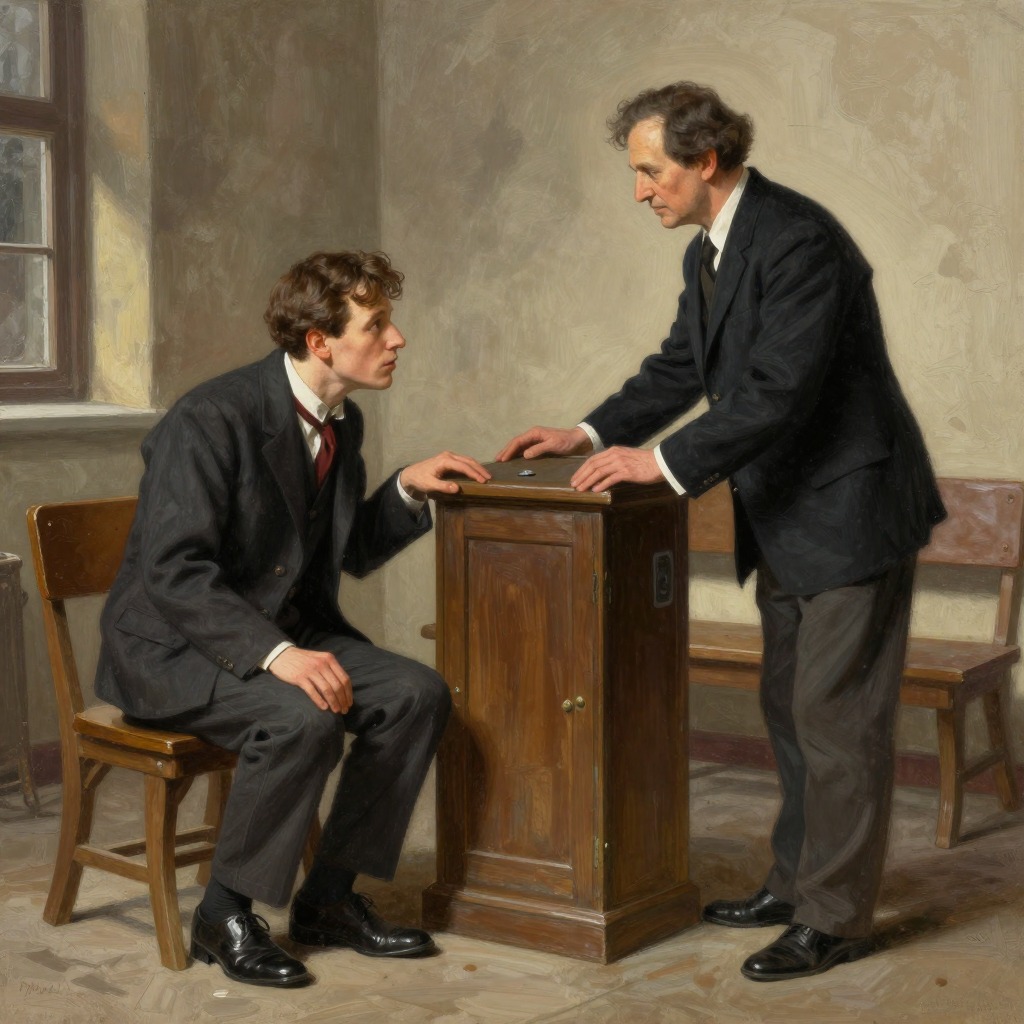
The CastleThe School stands in a fenced garden covered with snow, a long, low building that curiously combines the character of something temporary and something very old. It is located beyond the village church—which is only a chapel extended like a barn—and is the first place K. encounters the village's educational authority. When K. first sees it, children are just coming out with their teacher, a small, narrow-shouldered young man who holds himself very upright and is used to being in command. This teacher, who later becomes K.'s superior, is the one who asks K. if he likes the castle and tells him that strangers never do. The School thus enters the narrative as a site of observation and judgment, where K.'s status as a stranger is immediately registered.
The School as a Place of Employment and Humiliation
After the village mayor offers K. the temporary post of school janitor, the School becomes K.'s workplace and residence. The teacher, who delivers the offer, makes clear that the position is a favor, not a right, and that K. is a millstone around the parish's neck. The duties are menial: cleaning and heating both classrooms daily, doing small repairs, clearing the garden path of snow, running errands for the teacher and his assistant, and doing all the gardening in warmer seasons. In return, K. and his household may live in one of the classrooms, but they may not cook in the school building, and they must uphold the dignity of the school, with the teacher insisting that K. put his relationship with Frieda on a legal footing as soon as possible. The salary is deferred until after a month's service on probation, leaving K. and Frieda almost penniless. The School, far from being a haven, is a place of constant humiliation, where K. is addressed as "fellow" and ordered about like a servant.
Life in the Schoolhouse: Domesticity and Conflict
The Schoolhouse becomes K.'s home, but it is a miserable one. The large room, which also serves as the school gymnasium, is cold and sparsely furnished. There is only a single straw mattress, neatly covered with a woollen shawl of Frieda's, but no eiderdown, and just two stiff, coarse blankets that give hardly any warmth. The stove has used up all the wood, and the woodshed is locked, with the teacher holding the key. Frieda tries to make the room habitable, covering the teacher's desk with a white crochet-work tablecloth and preparing meals, but the conditions are dire. The assistants, who have followed K. and Frieda, add to the chaos, and the first morning brings a confrontation with Miss Gisa, the assistant teacher, who is horrified to find the janitor's family still in bed when the children arrive. She sweeps the remains of their supper off the desk with her ruler, breaking the coffee-pot, and scratches K.'s hand with her cat's claws, drawing blood. The School is thus a place where K.'s domestic life is exposed to public scrutiny and where his authority is constantly undermined.
The School as a Site of Conflict and Dismissal
The School becomes the stage for K.'s most direct conflict with the teacher. When the teacher catches the assistants fetching firewood from the locked woodshed, he threatens to thrash them. Frieda intervenes, claiming she broke down the door herself, but the assistants point to K., and the teacher dismisses K. on the spot for dereliction of duty. K. refuses to leave, insisting that only the village mayor can dismiss him, and the teacher is forced to move his class to the other room, leaving K. alone. This confrontation reveals the School as a microcosm of the village's power struggles, where K.'s position is always precarious and subject to the whims of petty officials. The School, which was meant to be a refuge, becomes a prison of sorts, and K.'s stubborn refusal to be expelled mirrors his larger struggle against the castle's authority.
The School and the Collapse of K.'s Relationship with Frieda
It is in the School that K.'s relationship with Frieda begins to unravel. Frieda, who had been lively and determined, becomes weary and withdrawn. K. dismisses the assistants, but Frieda is drawn to them, and when K. leaves for the Castle Inn, Jeremias breaks the school window and helps Frieda escape. The School, which had been their shared home, becomes a place of abandonment. When K. returns, he finds Frieda gone, and the School is left empty and cold. The School thus marks the end of K.'s brief domestic happiness and his descent into isolation. It is a place where his hopes for a settled life are shattered, and where he is left alone to face the village's hostility.
The School's Narrative Significance
The School serves as a counterpoint to the Castle. While the Castle is remote and inaccessible, the School is close and intrusive, a place where K. is constantly watched and judged. It represents the village's mundane, bureaucratic power, which is just as oppressive as the Castle's distant authority. The School's physical characteristics—its low, temporary, and old appearance—mirror K.'s own precarious and degraded status. It is a place of waiting and disappointment, where K.'s attempts to establish himself are continually thwarted. The School, in its ordinariness, becomes a symbol of the impossibility of K.'s project, a space where the promise of a new life turns into a series of humiliations and failures.