Schwarzer
The CastleSchwarzer is the young man who confronts K. on his first night in the village, challenging his right to stay and setting in motion the bureaucratic entanglement that defines K.'s struggle with the castle. As the son of a deputy warden, he embodies the castle's authority and its petty, officious nature, and his actions have lasting consequences for K.'s standing in the community.
Identity and Introduction
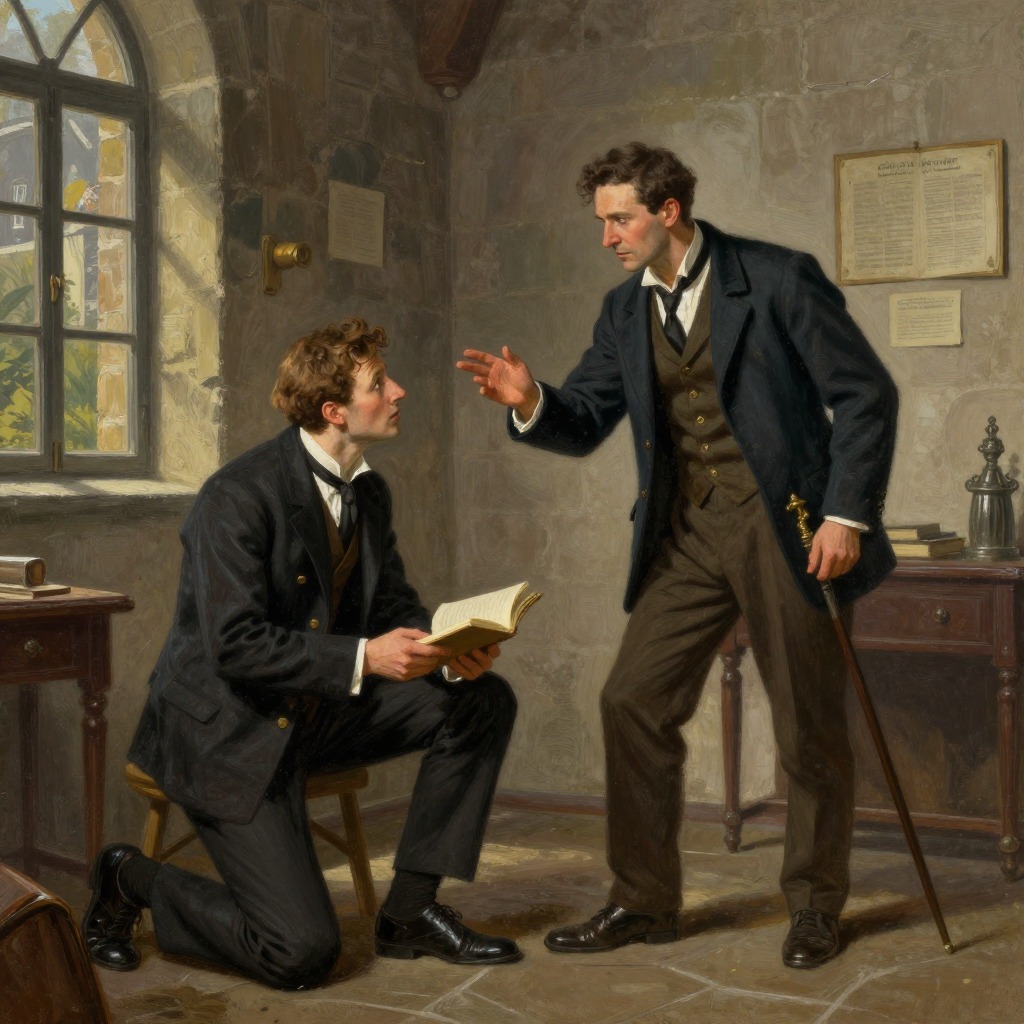
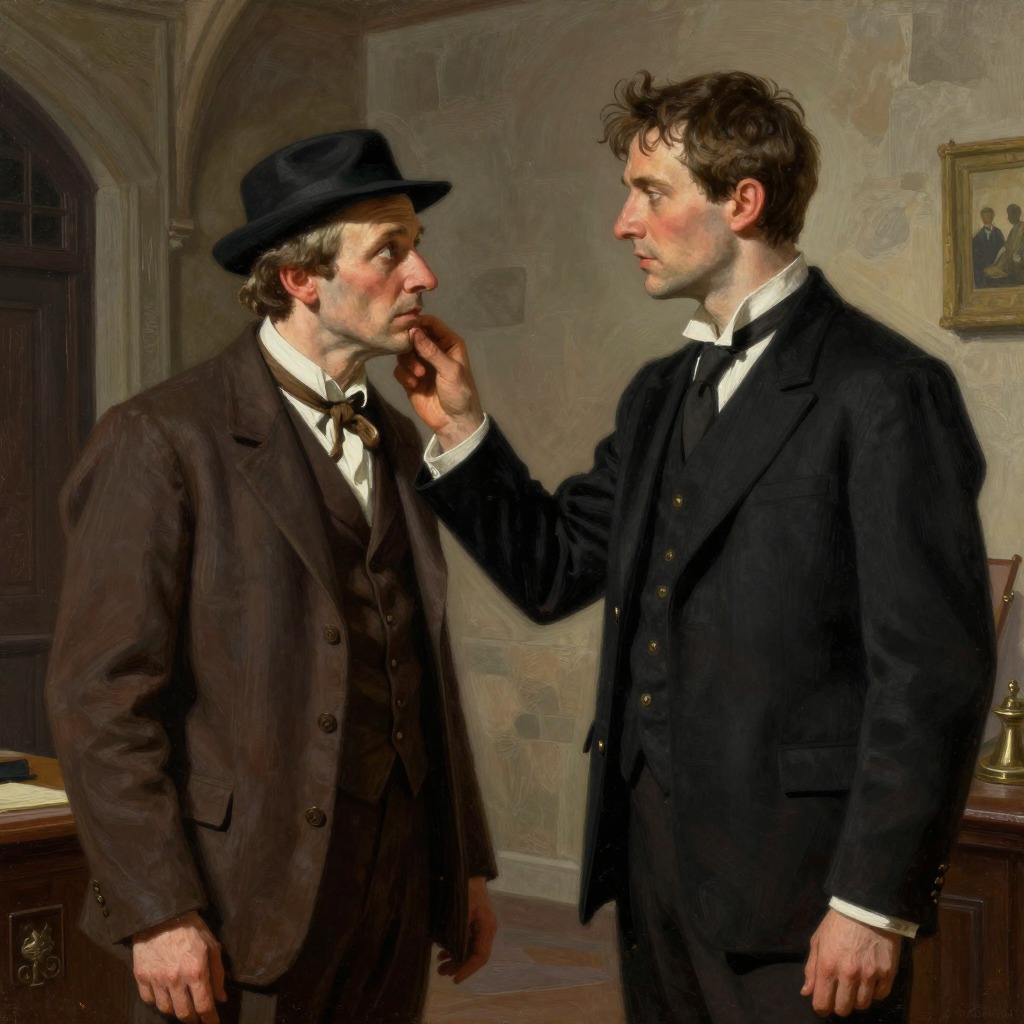
Schwarzer first appears in the inn where K. has sought lodging, waking him from sleep to demand a permit for staying in the village. He introduces himself as the son of the castle warden, though it later emerges that his father is only a deputy warden, one of the most junior. He is described as a young man in town clothes with a face like an actor's—narrowed eyes and strongly marked eyebrows—and he speaks with a mixture of malice and caution that K. recognizes as a kind of diplomatic training. His manner is derisive, and he treats K. with contempt, calling him a "common, lying vagabond" when his initial telephone check finds no record of a land surveyor. This confrontation establishes Schwarzer as a gatekeeper figure, enforcing the castle's rules with a self-importance that belies his relatively low rank.
Role in K.'s Arrival and Its Aftermath
Schwarzer's actions on that first night have a profound impact on K.'s subsequent experiences. By telephoning the castle to verify K.'s claim, he draws the attention of the authorities to K. in a way that K. later reflects was nonsensical and premature. K. considers that if Schwarzer had not intervened, he might have been able to settle into the village quietly, perhaps finding work as a traveling craftsman, without the immediate scrutiny that made his position so precarious. Instead, Schwarzer's call leads to a series of contradictory responses from the castle—first denying K.'s existence, then confirming him as "the land surveyor"—which K. interprets as a deliberate attempt to keep him in a state of terror. Schwarzer's role thus marks the beginning of K.'s struggle with the castle's inscrutable bureaucracy, and K. holds him responsible for the difficulties that follow, even as he acknowledges that Schwarzer's conduct may have inadvertently given him a kind of direct, if hostile, engagement with the authorities.
Later Appearances and Relationships
Schwarzer reappears later in the novel, now living in the village for the love of Miss Gisa, the assistant teacher. He has used his connections to secure a post as an assistant teacher, though his duties mainly consist of sitting near Gisa during lessons and correcting exercise books with her. K. observes him with a mixture of disdain and grudging respect, noting that Schwarzer's love for Gisa is a "grave and silent" one, and that he makes constant sacrifices for her, even refusing to return to the castle when his father sends messengers to fetch him. Despite his lowly position, Schwarzer is spoken of with a certain respect in the village, and he treats K. with the boundless disdain due to a school janitor. K. reflects that Schwarzer is still in his debt from that first evening, and that his actions may have determined the course of everything that followed. Schwarzer's presence in the village thus serves as a reminder of K.'s initial humiliation and the ongoing power dynamics that shape his life.
Significance and Thematic Role
Schwarzer embodies the arbitrary and often petty exercise of authority that characterizes the castle's relationship with the village. His insistence on the permit, his telephone call, and his later disdain for K. all illustrate the way the castle's rules are enforced by minor officials who are themselves subject to the same incomprehensible hierarchy. Schwarzer's character also highlights the theme of social exclusion: as the son of a deputy warden, he is not a true insider, yet he uses his position to assert power over K., a stranger. His love for Gisa, which leads him to abandon his duties at the castle, suggests a human desire for connection that exists alongside the bureaucratic coldness, but it does not make him more sympathetic to K. Ultimately, Schwarzer represents the obstacles that K. must navigate, and his actions set the stage for the novel's exploration of authority, identity, and the impossibility of true belonging.