Sister Sandrine Bieil
The Da Vinci CodeSister Sandrine Bieil, the conservatrice d'affaires of the Church of Saint-Sulpice, is a nun whose outwardly humble role as caretaker of the church conceals a far more dangerous identity: she is a sentry for the Priory of Sion, entrusted with a silent alarm that, when triggered, would warn the brotherhood's highest members that their security has been fatally breached. Her murder at the hands of Silas, the albino monk of Opus Dei, makes her the final casualty of the night's systematic decapitation of the Priory's leadership, and her death ensures that the precious truth of the keystone is lost forever.
Identity and Role
Sister Sandrine has lived for over a decade in a modest two-room suite on the second floor of the Church of Saint-Sulpice, to the left of the choir balcony. Her formal residence is the nearby convent, but she prefers the quiet of the church itself, where she has made herself comfortable with a bed, phone, and hot plate. As the church's conservatrice d'affaires, she is responsible for overseeing all nonreligious aspects of church operations: general maintenance, hiring support staff and guides, securing the building after hours, and ordering supplies like communion wine and wafers. This position gives her legitimate access to the church at all hours and a plausible reason to be present, making her an ideal covert guardian for the Priory's interests.
The Night of the Attack
In the early hours of the morning, Sister Sandrine is awakened by the shrill of her telephone. The caller is the abbé, her boss, who in fifteen years has never before called her at this hour. He tells her he has received a call from an influential American bishop, Manuel Aringarosa, the head of Opus Dei, requesting that one of his numeraries—a visiting monk—be allowed to see Saint-Sulpice that very night. The abbé asks her to let the monk in at one o'clock, just twenty minutes away. Sister Sandrine, though uneasy about Opus Dei's conservative practices and its views on women, agrees to the request. As she swings her legs off the bed, chilled by the cold stone floor, she feels an unexpected apprehension, a sense that something is wrong.
When Silas arrives, Sister Sandrine leads him into the cavernous nave of Saint-Sulpice. The church, built over the ruins of an ancient temple to the Egyptian goddess Isis, has an eccentric history and a well-documented association with secret societies. Silas, a massive albino monk in a hooded robe, tells her he is French by birth but had his calling in Spain and now studies in the United States. He asks to be left alone to pray, and despite her unease, she agrees and returns to her quarters. But instead of going to bed, she climbs to the choir balcony and watches him from the shadows, her suspicion deepening.
The Silent Alarm and Her Death
From her hiding place, Sister Sandrine watches Silas remove his cloak, revealing a back soaked with blood-red slashes from a recent whipping and a bloody cilice belt around his thigh. She realizes he is not a simple pilgrim but a man searching for the keystone. She leaves the balcony and races to her room, where she retrieves a sealed envelope hidden under her bed frame. Inside are four Paris phone numbers. Trembling, she begins to dial. The first three calls produce terrifying results: a hysterical widow, a detective working late at a murder scene, and a somber priest consoling a bereaved family. All three contacts are dead. She then calls the fourth and final number, the one she was not supposed to call unless the first three could not be reached, and gets an answering machine. She leaves a desperate message: "The floor panel has been broken! The other three are dead!"
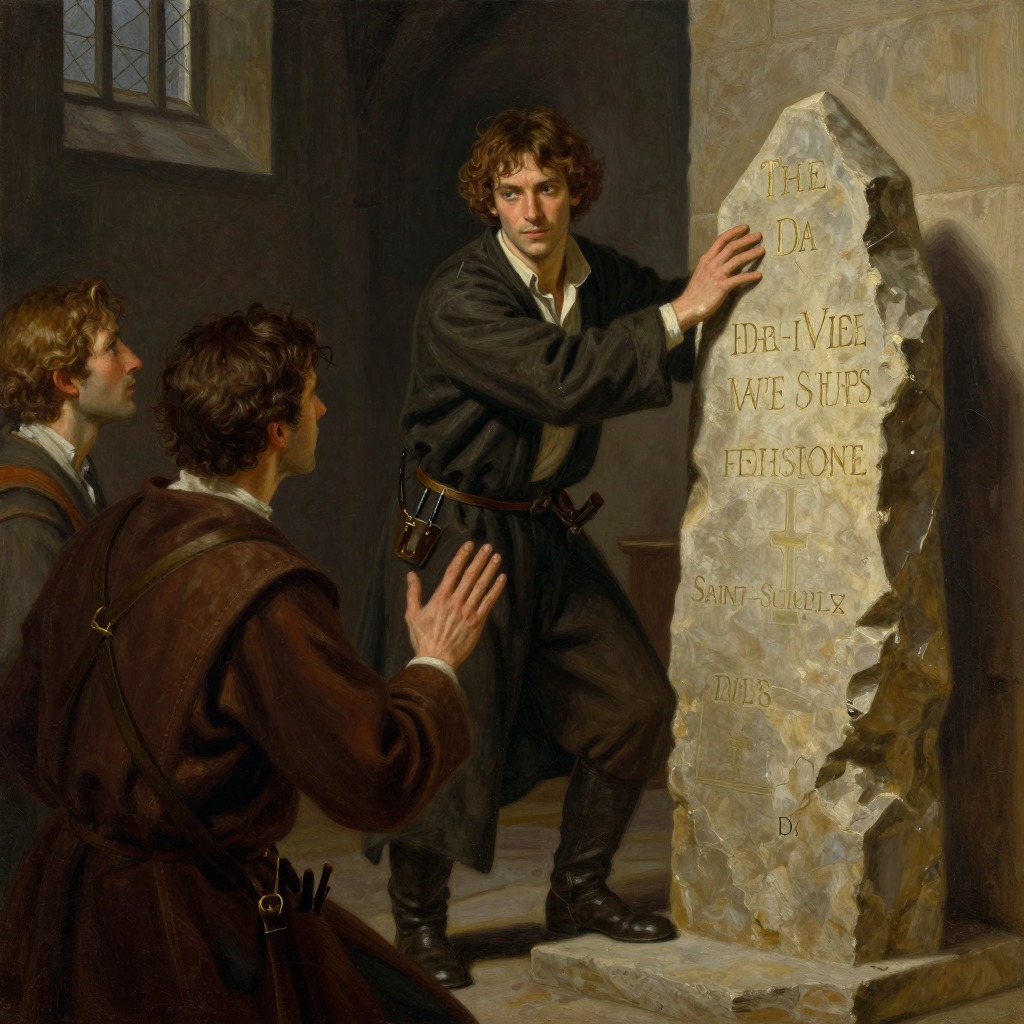
Silas, having found the stone tablet bearing the inscription "Job 38:11" and realizing he has been tricked, comes looking for her. He finds her in her room, still on the phone. He tells her that the four men are dead and that they played him for a fool, and demands to know where the keystone is. She tells him she does not know, that the secret is guarded by others—others who are now dead. When she defiantly says that Jesus had but one true message and that she cannot see it in Opus Dei, Silas lunges at her, lashing out with the heavy iron candle stand he is carrying. As she falls, her last feeling is an overwhelming sense of foreboding: all four are dead, and the precious truth is lost forever.
Thematic Significance
Sister Sandrine's death is the final, tragic link in the chain of murders that decapitates the Priory of Sion. Her role as a sentry, a woman of the cloth who serves the brotherhood rather than the Church hierarchy, underscores the novel's theme of hidden loyalties and the secret war between the Priory and its enemies. Her murder, committed by a man who believes he is doing God's work, highlights the novel's critique of religious fanaticism and the violence it can justify. Her failure to complete the alarm ensures that the keystone's secret is lost to the Priory, setting the stage for the desperate, improvised plan that Sophie and Langdon must follow.