Church of Rome
The Divine ComedyThe Church of Rome, the spiritual institution founded by Christ and entrusted to Saint Peter, appears throughout Dante's Divine Comedy as a body whose sacred identity has been tragically compromised by its entanglement in temporal power and material greed. The poem presents the Church not merely as a setting but as a living entity whose health or corruption determines the moral state of Christendom. Dante's journey repeatedly encounters the consequences of the Church's fall from its apostolic ideal, and the poem's most searing invectives are reserved for those who have betrayed its spiritual mandate.
The Ideal of the Two Suns and the Corruption of the Papacy
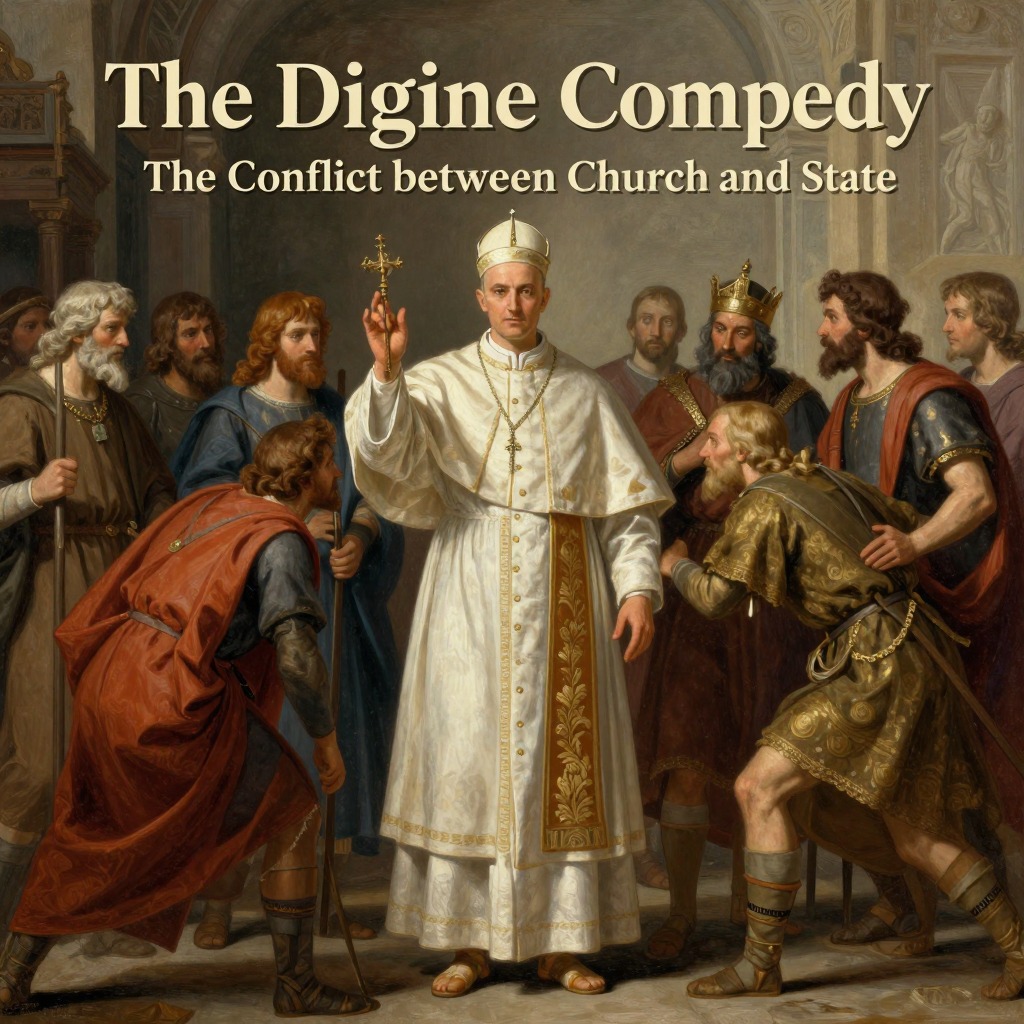
Dante's political theology, articulated most fully by the Lombard soul Marco in Purgatory, posits that God ordained two distinct authorities to guide humanity: the spiritual authority of the Pope and the temporal authority of the Emperor. Marco explains that Rome, which once reformed the world, "accustomed was / Two suns to have, which one road and the other, / Of God and of the world, made manifest" (E07211-E07213). This dual governance, each power sovereign in its own sphere, maintained the proper order of human life. The calamity of the present age, Marco declares, stems from the fact that "One has the other quenched, and to the crosier / The sword is joined, and ill beseemeth it / That by main force one with the other go" (E07214-E07216). The Church, by usurping the authority of the Empire, has abandoned its spiritual character and plunged the world into chaos. Marco's diagnosis is unequivocal: "the Church of Rome, / Confounding in itself two governments, / Falls in the mire, and soils itself and burden" (E07363-E07365). This conflation of spiritual and temporal power is the root of the universal corruption that Dante witnesses.
The Church as a Corrupt Institution in Purgatory
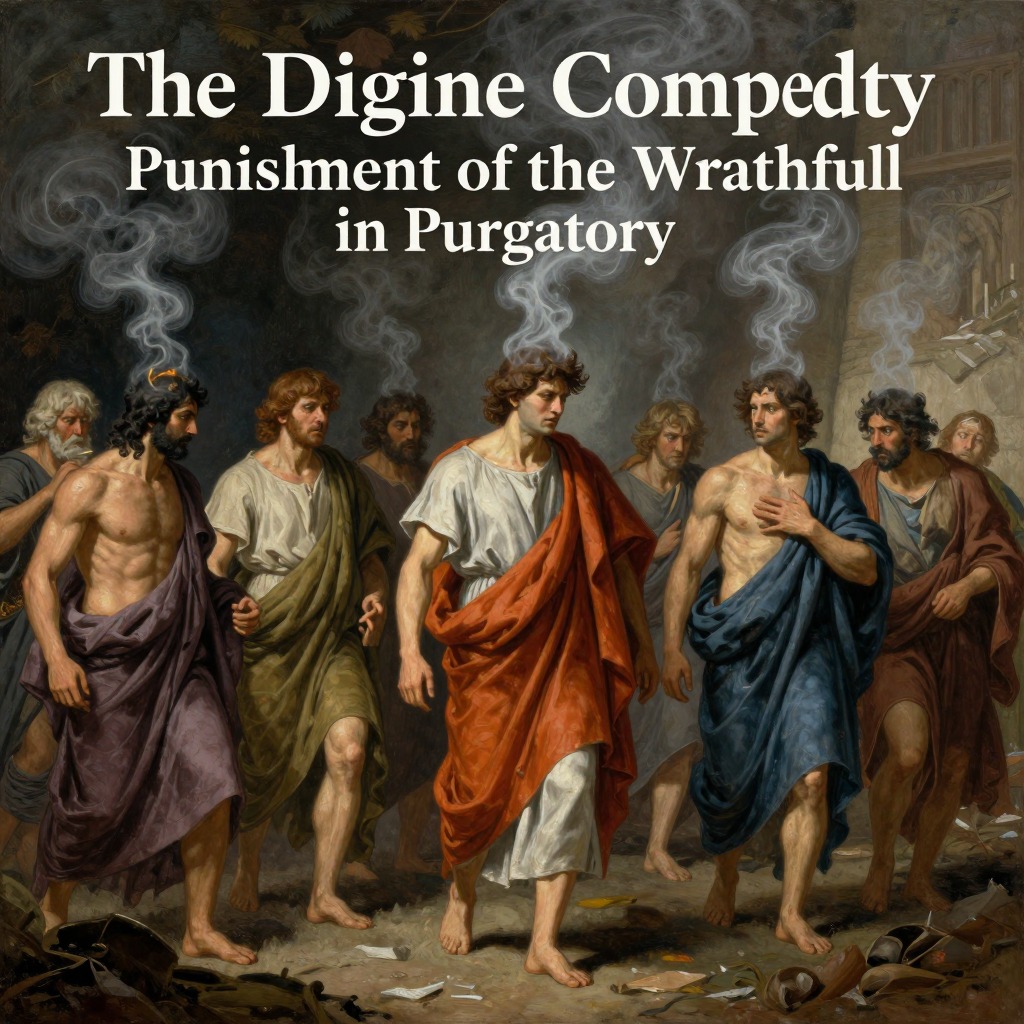
The critique of the Church's temporal ambition is not confined to political theory but is dramatized in the encounters with specific popes and prelates undergoing purgation. On the Fifth Terrace, where the avaricious are purged, Dante meets Pope Adrian V, who confesses that his conversion came too late. Adrian describes how, upon becoming "the Roman Shepherd," he "discovered life to be a lie" and saw that "the heart was not at rest" in the pursuit of earthly power (E07644-E07647). Until that moment, he was "wholly avaricious," a state for which he now lies prostrate, his eyes fixed on the earth because his own had been fastened on earthly things (E07650-E07657). The punishment itself is a direct contrapasso: as avarice "extinguished our affection / For every good, whereby was action lost, / So justice here doth hold us in restraint, / Bound and imprisoned by the feet and hands" (E07658-E07661). Adrian's humility is underscored when he refuses Dante's reverence, saying, "Straighten thy legs, and upward raise thee, brother, / Err not, fellow-servant am I / With thee and with the others to one power" (E07670-E07672). This moment of grace within the corrupt institution shows that individual salvation remains possible, but the institution itself is deeply compromised.
The Church as a Corrupt Institution in Paradise
The condemnation of the Church's corruption reaches its most intense pitch in Paradise, where the blessed souls themselves denounce the papacy's fall. On the sphere of Saturn, Saint Peter Damiano, a contemplative who was reluctantly made a cardinal, laments the luxury and worldliness of the modern clergy. He contrasts the apostolic poverty of Peter and Paul—"Came Cephas, and the mighty Vessel came / Of the Holy Spirit, meagre and barefooted, / Taking the food of any hostelry" (E12777-E12779)—with the contemporary prelates who "need, and some to lead them, / So heavy are they, and to hold their trains" and who "cover up their palfreys with their cloaks, / So that two beasts go underneath one skin" (E12780-E12784). The most devastating indictment comes from Saint Peter himself in the Heaven of the Fixed Stars. Peter's face changes color as he speaks, and he declares that the one who "usurps upon the earth my place, / My place, my place, which vacant has become / Before the presence of the Son of God, / Has of my cemetery made a sewer / Of blood and stench" (E13548-E13552). The papacy, the very seat of Christ's vicar, has been turned into a source of filth. Peter insists that the early popes—Linus, Cletus, Sixtus, Pius, Urban, and Calixtus—shed their blood not for gold but for the acquisition of eternal life (E13566-E13571). The keys entrusted to him were never meant to become "the escutcheon on a banner, / That should wage war on those who are baptized" (E13575-E13577). The Church has become a den of "rapacious wolves" in shepherds' garb, and Peter cries out, "O wrath of God, why dost thou slumber still?" (E13581-E13583).
The Church's Deviation from Its Mission
The poem's critique extends beyond the papacy to the entire ecclesiastical hierarchy and its abandonment of the Church's true mission. In Paradise, the soul of Folco of Marseilles, a former lover turned bishop, denounces the clergy's obsession with canon law at the expense of the Gospels. He declares that "the Evangel and the mighty Doctors / Are derelict, and only the Decretals / So studied that it shows upon their margins" (E11040-E11042). The Pope and Cardinals are intent on worldly power, their "meditations reach not Nazareth, / There where his pinions Gabriel unfolded" (E11043-E11045). The Church has forgotten its founding message of humility and poverty, a theme that echoes the life of Saint Francis, whose marriage to Lady Poverty is celebrated by Thomas Aquinas in the Heaven of the Sun. The Church's fall is thus presented as a betrayal of its own foundational ideals, a turning away from the spiritual nourishment of the Gospel toward the corrupting pursuit of temporal wealth and influence. This deviation is the central tragedy of the Comedy, a sacred institution that has become the source of the very evils it was meant to heal.