The Three Ladies Benedight
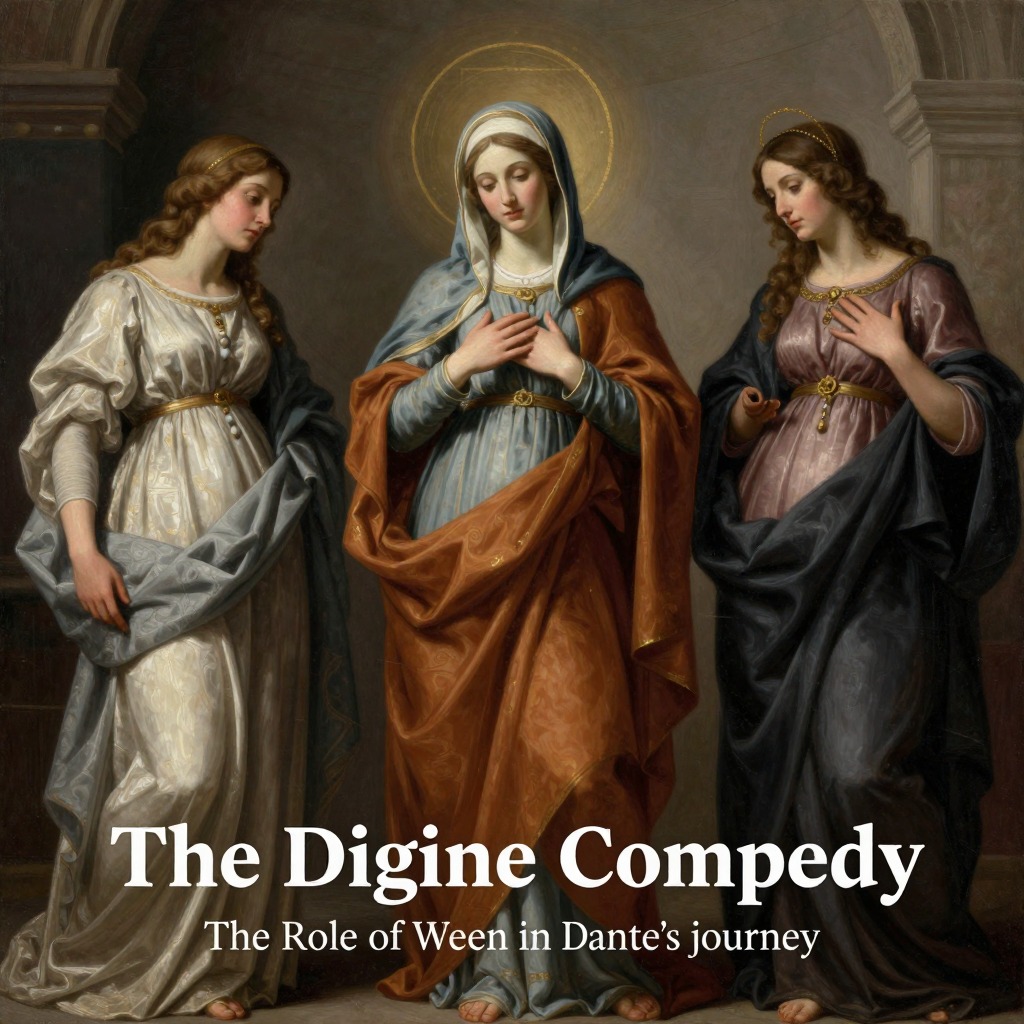
The Divine ComedyThe Three Ladies Benedight are the three heavenly women whose compassionate intervention makes Dante's journey through the afterlife possible. They are, in descending order of the chain of grace, the Virgin Mary, Saint Lucia, and Beatrice. Together they form a celestial rescue mission that begins in the Empyrean and reaches down to the very edge of Hell, where Virgil is summoned to become Dante's guide. Their coordinated action is the theological and narrative foundation of the entire poem, demonstrating that divine love works through a hierarchy of willing intermediaries, each responding to the need of a soul in peril.
Identity and Hierarchy
The three ladies are distinguished by their rank in heaven and by the specific role each plays in Dante's salvation. The highest is the Virgin Mary, the "gentle Lady" in heaven who first grieves at Dante's predicament and initiates the rescue. She is described as one who "grieves at this impediment, to which I send thee, so that stern judgment there above is broken" (E00439-E00441). Her compassion is the prime mover of the entire chain. Below her is Saint Lucia, the "foe of all that is cruel," whom Mary beseeches with the words, "Thy faithful one now stands in need of thee, and unto thee I recommend him" (E00442-E00444). Lucia, in turn, hastens to Beatrice, who is sitting with the ancient Rachel, and rebukes her: "Beatrice, the true praise of God, why succourest thou not him, who loved thee so, for thee he issued from the vulgar herd? Dost thou not hear the pity of his plaint? Dost thou not see the death that combats him beside that flood, where ocean has no vaunt?" (E00445-E00453). Beatrice is the third lady, the one who knew Dante in life and whom he loved; she is the direct link to the pilgrim himself.
The Chain of Intercession
The rescue unfolds as a cascade of compassion. Mary, moved by pity, speaks to Lucia; Lucia, moved by Mary's entreaty, goes to Beatrice; and Beatrice, moved by Lucia's words, descends to Limbo to enlist Virgil. Beatrice herself narrates this sequence to Virgil when she appears to him among the souls "in suspense" . She tells him: "A gentle Lady is in Heaven, who grieves at this impediment, to which I send thee, so that stern judgment there above is broken. In her entreaty she besought Lucia, and said, 'Thy faithful one now stands in need of thee, and unto thee I recommend him.' Lucia, foe of all that cruel is, hastened away, and came unto the place where I was sitting with the ancient Rachel. 'Beatrice,' said she, 'the true praise of God, why succourest thou not him, who loved thee so, for thee he issued from the vulgar herd? Dost thou not hear the pity of his plaint? Dost thou not see the death that combats him beside that flood, where ocean has no vaunt?'" (E00439-E00453). Each lady acts not for her own sake but for another's, and the chain is held together by love: Beatrice tells Virgil, "Love moved me, which compelleth me to speak" .
The Descent to Virgil
Beatrice's descent to Limbo is the crucial link between heaven and the infernal realm. She finds Virgil among the souls of the virtuous pagans, who live "in suspense" without hope of heaven . She addresses him with great respect, calling him "O spirit courteous of Mantua, of whom the fame still in the world endures, and shall endure, long-lasting as the world" (E00403-E00405). She explains that a friend of hers, "and not the friend of fortune, upon the desert slope is so impeded upon his way, that he has turned through terror, and may, I fear, already be so lost, that I too late have risen to his succour, from that which I have heard of him in Heaven" (E00406-E00411). She commands him: "Bestir thee now, and with thy speech ornate, and with what needful is for his release, assist him so, that I may be consoled" (E00412-E00414). Virgil, moved by her authority and by the heavenly will she represents, agrees to guide Dante. When Dante later hesitates at the beginning of the journey, Virgil recounts this entire episode to restore his courage, concluding: "What is it, then? Why, why dost thou delay? Why is such baseness bedded in thy heart? Daring and hardihood why hast thou not, seeing that three such Ladies benedight are caring for thee in the court of Heaven, and so much good my speech doth promise thee?" (E00466-E00471).
The Effect on Dante
The knowledge that three heavenly ladies are interceding for him transforms Dante's state of mind. At the start of Canto II, he is paralyzed by fear and self-doubt, wondering whether he is worthy of such a journey: "I not Aeneas am, I am not Paul, nor I, nor others, think me worthy of it" (E00377-E00378). He compares himself to a man who "unwills what he willed, and by new thoughts doth his intention change" (E00382-E00383). But after Virgil tells him of the three ladies, Dante's spirit revives. The poem describes this change with a simile: "Even as the flowerets, by nocturnal chill, bowed down and closed, when the sun whitens them, uplift themselves all open on their stems; such I became with my exhausted strength, and such good courage to my heart there coursed, that I began, like an intrepid person" (E00472-E00477). He declares: "Thou hast my heart so with desire disposed to the adventure, with these words of thine, that to my first intent I have returned. Now go, for one sole will is in us both, Thou Leader, and thou Lord, and Master thou" (E00481-E00485). The three ladies thus convert Dante's cowardice into resolve, making the entire journey possible.
Thematic Significance
The Three Ladies Benedight embody the poem's central theological principle: that salvation is a gift of grace, not a human achievement, and that this grace flows through a hierarchy of love. Mary, the most compassionate, initiates the rescue; Lucia, the enemy of cruelty, transmits the plea; Beatrice, the personal beloved, descends to the threshold of Hell to secure a guide. Each acts freely and willingly, and their cooperation demonstrates the harmony of heaven. The chain also establishes the poem's narrative structure: the journey is not Dante's own idea but a response to a call from above. The three ladies are the unseen patrons of the entire Comedy, and their presence is felt whenever Dante's courage falters. They are the guarantee that the journey is willed by God and that the pilgrim will not be abandoned. Their intervention is the answer to the question Dante himself poses at the outset: "But I, why thither come, or who concedes it?" . The answer, revealed through Virgil's account, is that the three ladies have already conceded it, and their will is one with the divine will.