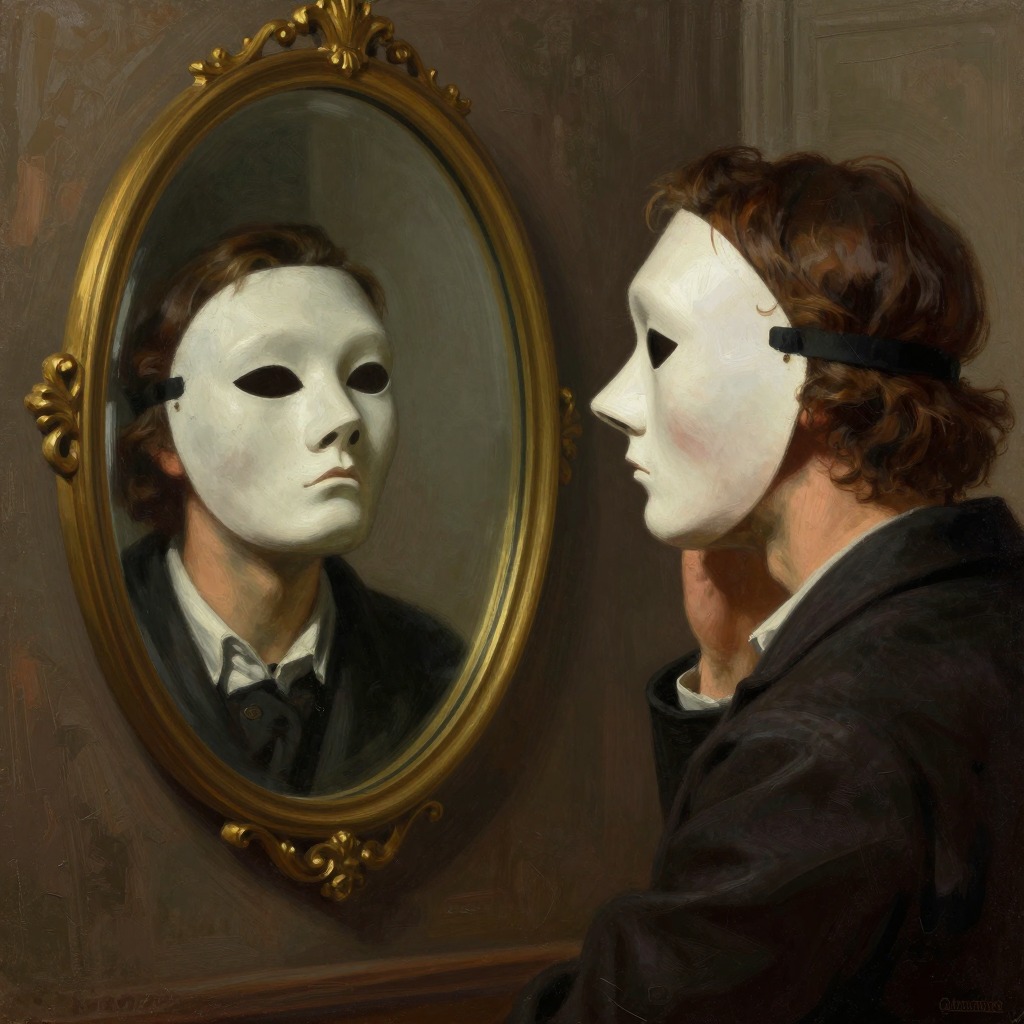
The double face, a charming Janus
The FallThe double face, a charming Janus is the motto Jean-Baptiste Clamence invents for himself after the crisis that shatters his former life. It is the emblem he would place on his visiting card, above the warning "Don't rely on it," and it crystallizes the central insight of his confession: that he is not a simple, unified being but a creature of permanent contradiction, a play actor whose every virtue conceals a corresponding vice.
Origin and Self-Discovery
Clamence arrives at this image only after a long process of self-examination. In his earlier life as a successful Parisian lawyer, he had lived in the illusion of a harmonious, admirable self, a man who helped blind people cross streets, gave alms, and defended widows and orphans with noble eloquence. But the laughter he heard on the Pont des Arts and the memory of his failure to save a drowning woman forced him to see the reverse side of his virtues. He discovered that his modesty helped him to shine, his humility to conquer, and his virtue to oppress. The surface of all his virtues had a less imposing reverse side. This recognition of his own duplicity is what leads him to formulate the Janus-faced motto.
The Janus Figure as a Mask and a Mirror
The double face is not merely a personal confession but a tool Clamence uses in his new profession. He constructs a portrait of himself that is "the image of all and of no one," a mask that is both lifelike and stylized, so that his listeners recognize themselves in it. When he holds out this portrait, it becomes a mirror. By accusing himself up and down, he provokes others into judging themselves, thereby relieving himself of the burden of his own guilt. The Janus face thus allows him to dominate: he is both the penitent who confesses and the judge who condemns, the one who accuses himself and the one who, by extension, has the right to judge everyone else.
Theatricality and the Performance of Self
Clamence's entire life, he realizes, has been a performance. He was always bursting with vanity, and the refrain of his whole life was "I, I, I." He lived on the surface of life, in the realm of words, never in reality. The double face is the ultimate expression of this theatricality. He had been an amateur actor during his military service, and he perfected little speeches for his amorous conquests. After his fall, he continues to play a role, but now he is conscious of it. He admits that he is a "play actor," and his motto, "Don't rely on it," warns that his confession, like his former kindness, is not to be trusted. The mask is a deliberate construction, a way of managing the impression he makes on others.
The Double Face and the Judge-Penitent
The profession of judge-penitent is the practical application of the Janus-faced principle. Clamence explains that since every judge ends up as a penitent, he has reversed the process: he overwhelms himself with accusations in order to have the right to judge others. The double face allows him to be both at once. He accuses himself up and down, but then imperceptibly passes from the "I" to the "we," and finally to the judgment of his listener. This is the stroke of genius that allows him to silence the laughter and to avoid being judged himself. He has accepted duplicity instead of being upset about it, and has settled into it, finding the comfort he was looking for throughout life.
Thematic Significance
The double face, a charming Janus is the key to understanding Clamence's philosophy and his critique of modern humanity. It represents the universal hypocrisy that he believes characterizes everyone. He argues that every man has two faces, that he cannot love without self-love, and that the idea that comes most naturally to man is the idea of his own innocence. The Janus face is the emblem of this universal condition: everyone is a judge and a penitent, accusing others while seeking to be absolved themselves. Clamence's motto is thus both a personal confession and a diagnosis of the human race, a mirror in which his interlocutor is forced to see his own double face.