Prince Lef Nicolaievitch Muishkin
The IdiotPrince Lef Nicolaievitch Muishkin, the last scion of an ancient but impoverished noble family, returns to Russia from a Swiss sanatorium at the age of twenty-six, carrying nothing but a small bundle and a profound, unsettling innocence. He is immediately labeled an "idiot" by those who mistake his epilepsy, his naive candor, and his lack of social guile for feeble-mindedness. Yet, as the novel unfolds, Muishkin's character reveals itself as a complex embodiment of pure, almost supernatural compassion, a man whose truth-telling and pity for the suffering expose the moral bankruptcy of the society around him, even as his own inability to navigate its cruelties leads to his destruction. He is at once a holy fool, a tragic hero, and a living test of whether absolute goodness can survive in a fallen world.
Identity and Background
Muishkin is the last of the Muishkin princes, a fact he states with simple directness: "there are none, except myself. I believe I am the last and only one" . His father was a sublieutenant in the army, and the family had long been poor. Orphaned as a child, he was taken in by the wealthy landowner Nicolai Andreevitch Pavlicheff, who paid for his education and, after a series of severe epileptic fits that left him "little better than an idiot" , sent him to Switzerland to be treated by Professor Schneider. Muishkin spent four years there, and though his condition improved, he was not cured. He returns to Russia with no money, no plans, and a distant relation to Mrs. Epanchin, the last of the Muishkin line on her side. His appearance is striking: he is fair, with large blue eyes and a thin, pointed beard, and his face, though pleasant, is "quite colourless" and bears the heavy expression "which some people affirm to be a peculiarity as well as evidence, of an epileptic subject" .
Life and Plot Trajectory
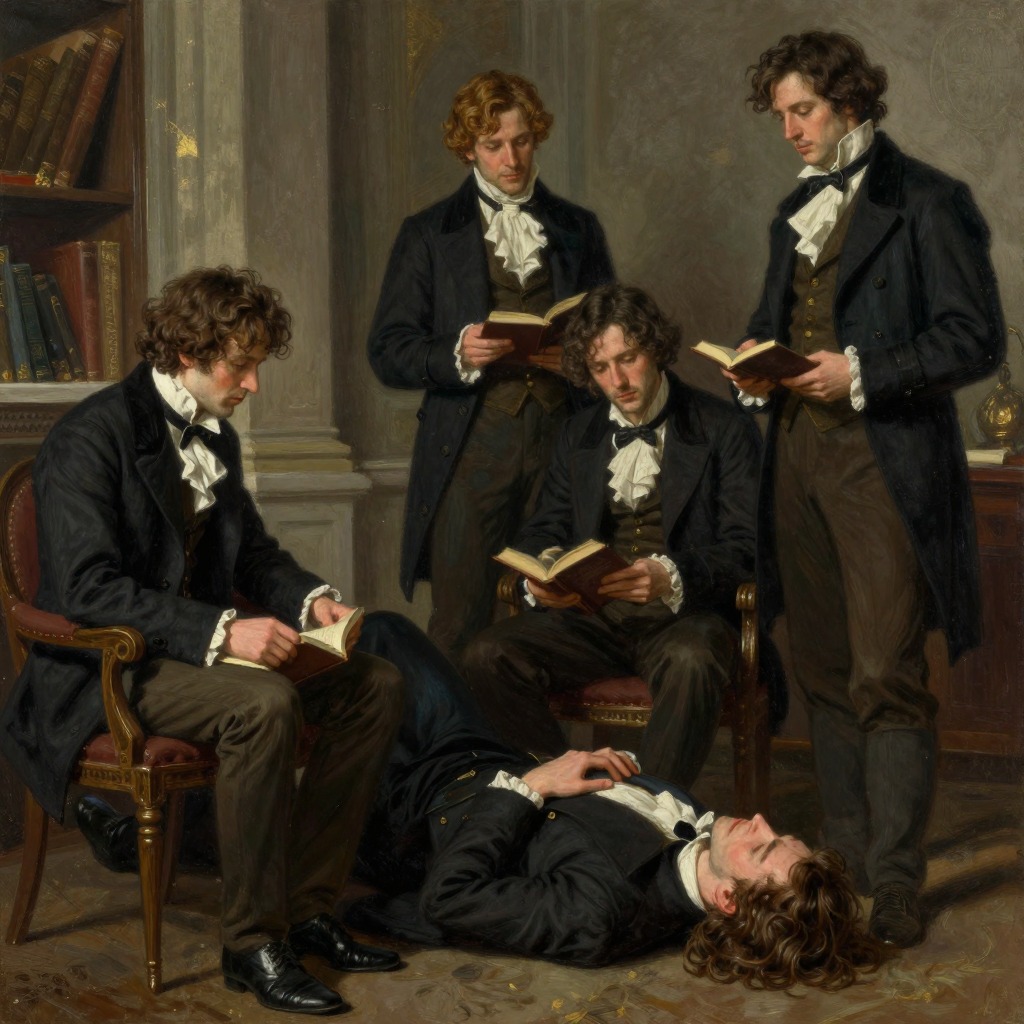
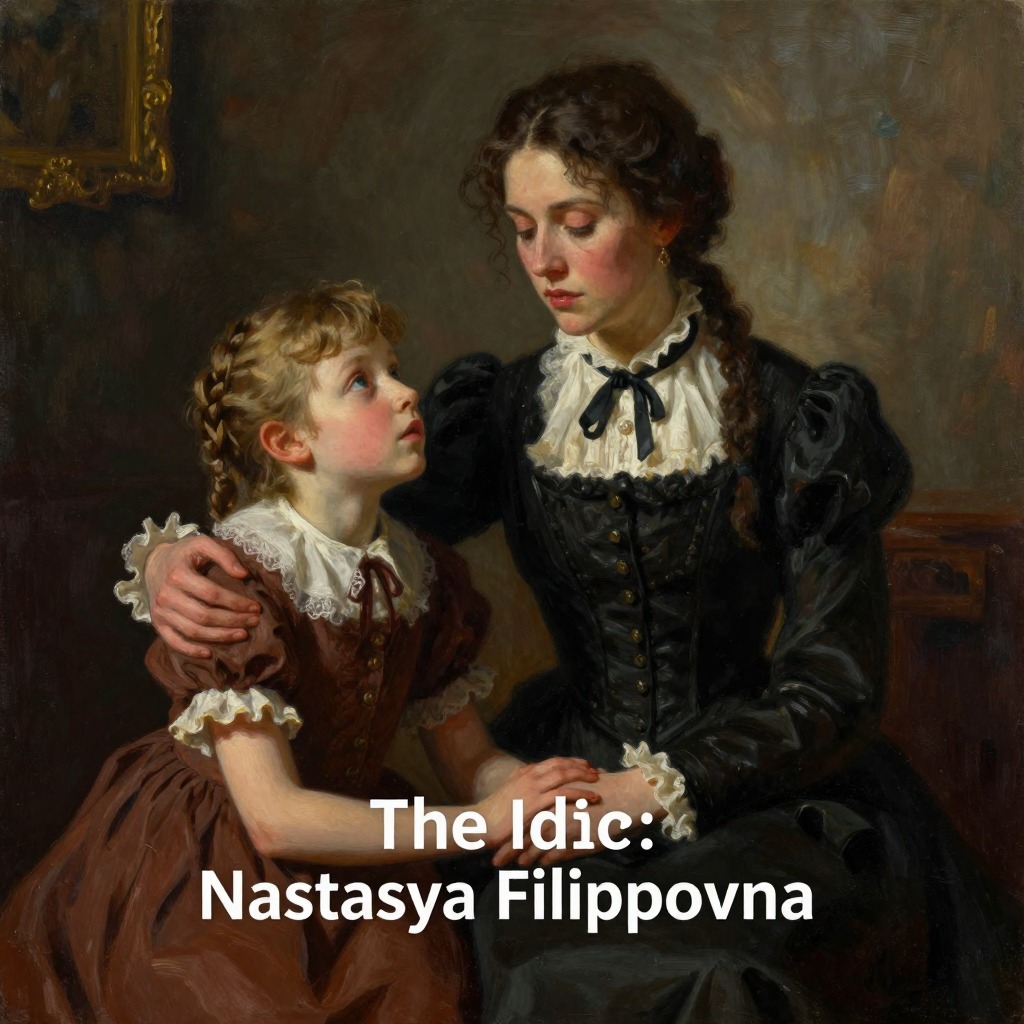
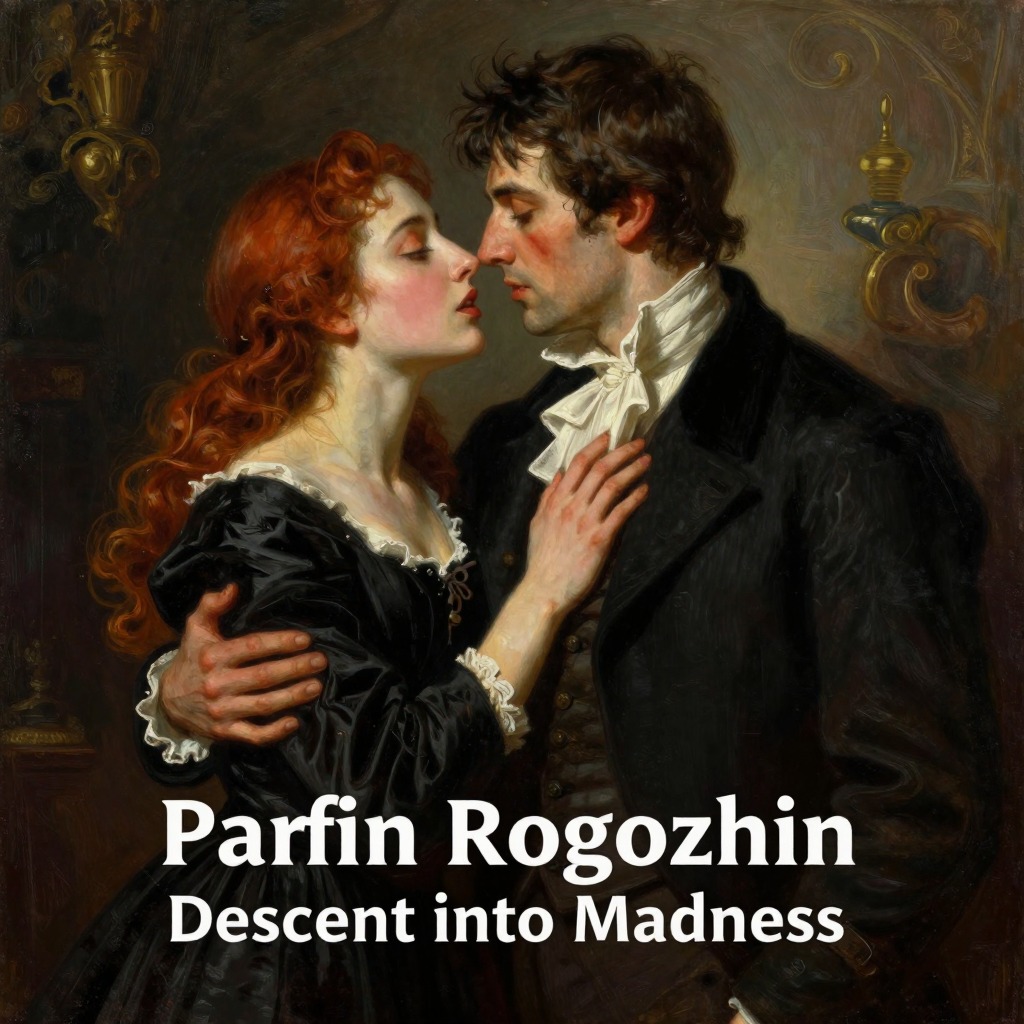
Muishkin's journey in Russia is a rapid descent from hopeful arrival to utter ruin. On the train to St. Petersburg, he meets Parfen Rogojin, a dark, passionate merchant who tells him of his obsessive love for Nastasia Philipovna Barashkoff. This encounter sets the novel's central tragedy in motion. Muishkin's first visit is to the Epanchin family, where his artless conversation and remarkable calligraphy win him a tentative welcome. He is drawn into the orbit of Nastasia Philipovna, a beautiful and tormented woman who has been the kept mistress of Afanasy Ivanovitch Totski. At her birthday party, Muishkin witnesses Rogojin's offer of a hundred thousand roubles for her and, in a moment of profound pity, proposes marriage to her himself. Nastasia, torn between her desire for redemption and her conviction that she is unworthy, flees with Rogojin. Muishkin follows her to Moscow, and for six months his whereabouts are unknown. He returns to St. Petersburg and then to Pavlofsk, where he becomes entangled with Aglaya Ivanovna Epanchin, the youngest and most beautiful of the Epanchin daughters. Aglaya is drawn to his sincerity but tormented by his past with Nastasia. The two women eventually confront each other, and in the ensuing chaos, Muishkin, unable to abandon the desperate Nastasia, loses Aglaya. On the day of his wedding to Nastasia, she flees once more with Rogojin. Muishkin goes to Rogojin's house and finds him in a state of madness, having murdered Nastasia. The novel ends with Muishkin sitting beside the body, stroking Rogojin's hair, his own mind having retreated into idiocy.
Key Actions and Objectives
Muishkin's primary objective is not to acquire wealth or status but to connect with others and to alleviate suffering. His actions are consistently driven by a radical, almost unworldly compassion. He offers to marry Nastasia Philipovna not out of romantic love but out of a profound pity, declaring, "I take you as a good, honest woman, Nastasia Philipovna—not as Rogojin's mistress" . He forgives Gania Ivolgin for slapping him in the face, saying, "Oh! how ashamed you will be of this afterwards!" . He attempts to mediate between the nihilistic young men who claim to be Pavlicheff's son and his own sense of justice, offering them money and friendship. He exchanges crosses with Rogojin, a ritual of brotherhood, even as he senses the man's murderous intent. His actions are often misinterpreted as weakness or foolishness, but they stem from a consistent moral vision: that every person, no matter how fallen, is worthy of love and forgiveness.
Relationships and Conflict
Muishkin's relationships are the crucible in which his character is tested and destroyed. His bond with Rogojin is the most complex: a strange, intense friendship born of a shared moment on a train, marked by mutual fascination, suspicion, and a terrible, unspoken rivalry over Nastasia. Muishkin tells Rogojin, "I love you very much, Parfen" , even as he knows Rogojin has tried to kill him. His relationship with Nastasia Philipovna is one of pure, agonizing pity. He sees her suffering and her madness, and he wants to save her, but his love is not the passionate love she craves. He confesses to Aglaya, "I do not love her. Oh! if you only knew with what horror I recall the time I spent with her!" . His relationship with Aglaya is a tragic mismatch of expectations. She is drawn to his purity but demands a conventional, possessive love that he cannot give, because his heart is divided by his pity for Nastasia. The conflict between these two women tears him apart, and his inability to choose decisively leads to the destruction of both relationships.
Change and Ending
Muishkin undergoes a profound and devastating change. He begins the novel as a hopeful, if naive, young man, eager to re-enter the world and find his place. He ends it as a complete mental and emotional wreck. The final scene is one of utter desolation: he sits beside Rogojin in the dark room where Nastasia's body lies, stroking the murderer's hair as Rogojin raves in a fever. When the police arrive, they find Muishkin "unconscious and in a raging fever" , and he is returned to Schneider's sanatorium in Switzerland, where he is described as an "idiot" once more. His fate is sealed not by a single mistake but by the cumulative weight of his compassion. He could not abandon Nastasia, and he could not win Aglaya. His goodness, which should have been a beacon, became a source of chaos, and the world he tried to heal crushed him.
Narrative Role and Evaluation
Muishkin functions as a Christ-like figure, a "holy fool" whose presence exposes the hypocrisy, greed, and spiritual emptiness of Russian society. His simplicity is a mirror in which others see their own failings. He is the moral center of the novel, but his morality is not of this world. Dostoevsky uses him to explore the question of whether absolute goodness is possible in a fallen world, and the answer the novel provides is tragically ambiguous. Muishkin's failure is not a failure of character but a failure of the world to accommodate him. He is a living reproach to a society that values money, status, and passion over compassion and truth. His final descent into idiocy is a kind of martyrdom, a retreat from a world that could not bear his light. He remains, in the words of the novel's title, "the idiot," a figure of profound, heartbreaking significance.