Grigory Danilovich Rimsky
The Master and MargaritaGrigory Danilovich Rimsky, the financial director of the Variety Theatre, is introduced as a thin, sharp-featured man with a precise and prickly manner. He is the embodiment of bureaucratic rationality, a man who lives by contracts, adding machines, and the careful management of funds. His office, located on the second floor of the theatre, is a space of official order, furnished with a desk, a fireproof safe, and a scale model of a past review. Rimsky's professional identity is defined by his role as the guardian of the theatre's financial and administrative integrity, a position that makes him the natural antagonist to the chaotic and irresponsible director, Stepan Likhodeev.
The Unraveling of Order
Rimsky's world begins to disintegrate on the morning after the black magic seance. The disappearance of Likhodeev, followed by the equally inexplicable vanishing of the administrator Ivan Varenukha, throws the theatre into chaos. Rimsky, left as the senior official, is besieged by a series of impossible events. He receives telegrams from Yalta purportedly from Likhodeev, who claims to have been magically transported there. Rimsky's sharp mind immediately grasps the absurdity: the distance is nearly a thousand miles, and the timeline makes it physically impossible. Yet, the evidence—the handwriting, the signatures—is undeniable. His rational framework begins to crack as he is forced to confront phenomena that defy all logical explanation. The final blow comes when he discovers that the telephones are dead, and a mysterious female voice whispers a threat directly into his ear, warning him not to call anyone.
The Confrontation with the Supernatural
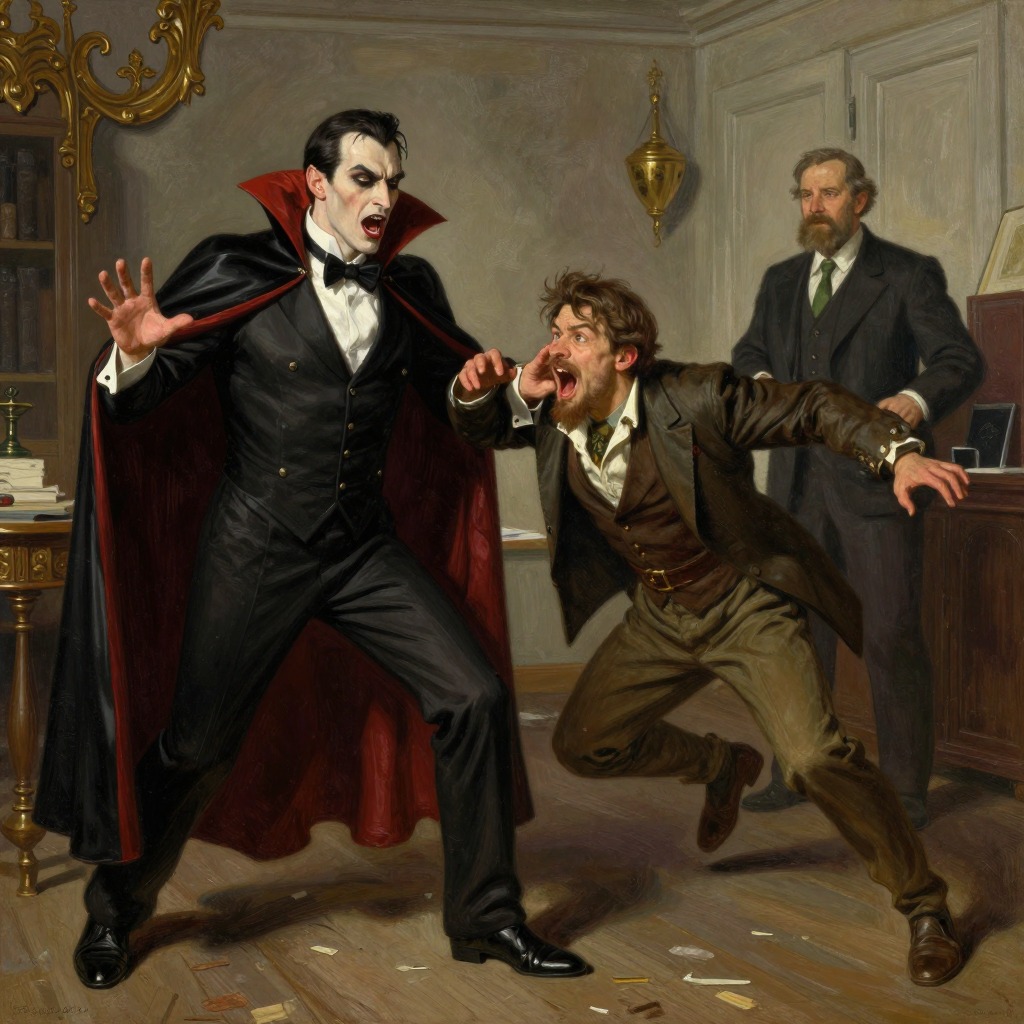
The climax of Rimsky's ordeal occurs late at night in his office. Varenukha, who has been transformed into a vampire, returns and begins telling a fabricated story about Likhodeev's drunken escapades in Pushkino. Rimsky, with his seismographic sensitivity to falsehood, instantly knows that every word is a lie. His terror deepens as he notices the administrator casts no shadow and that a putrid, malarial dampness fills the room. The final horror arrives when a naked, red-haired vampire girl appears at the window, her arm lengthening like rubber as she tries to open the latch. Rimsky, paralyzed with fear, realizes his end has come. The scene is a masterful inversion of the bureaucratic world: the safe, the desk, the adding machine are all rendered powerless against the icy, decaying touch of the undead.
Flight and Transformation
Rimsky is saved only by the crowing of a rooster, which forces the vampires to flee. In the aftermath, he is utterly transformed. The once-composed financial director, now white as snow with not a single black hair on his head, becomes a trembling old man. He abandons his hat, his office, and his entire professional life, fleeing the theatre in a panic. He hires a cab, pays an exorbitant fare, and boards the Leningrad express, vanishing from Moscow entirely. This flight is not a strategic retreat but a complete psychological collapse. Rimsky, the man who governed the theatre's finances, is himself governed by a terror so profound that it erases his former identity. His disappearance, alongside those of Likhodeev and Varenukha, completes the decapitation of the Variety Theatre's administration, leaving the institution in a state of utter disarray.
Thematic Significance
Rimsky's story is a powerful illustration of the novel's central theme: the impotence of rational, bureaucratic systems when confronted with the irrational and the supernatural. He is a man of figures and facts, yet he is undone by a reality that refuses to conform to either. His fate mirrors that of Berlioz, another rationalist who is destroyed by the very forces he denies. Rimsky's transformation from a sharp administrator to a terrified fugitive underscores the novel's critique of a society built on fear and denial, where the most terrible vices—cowardice and the refusal to see the truth—are the very mechanisms that ensure one's destruction.