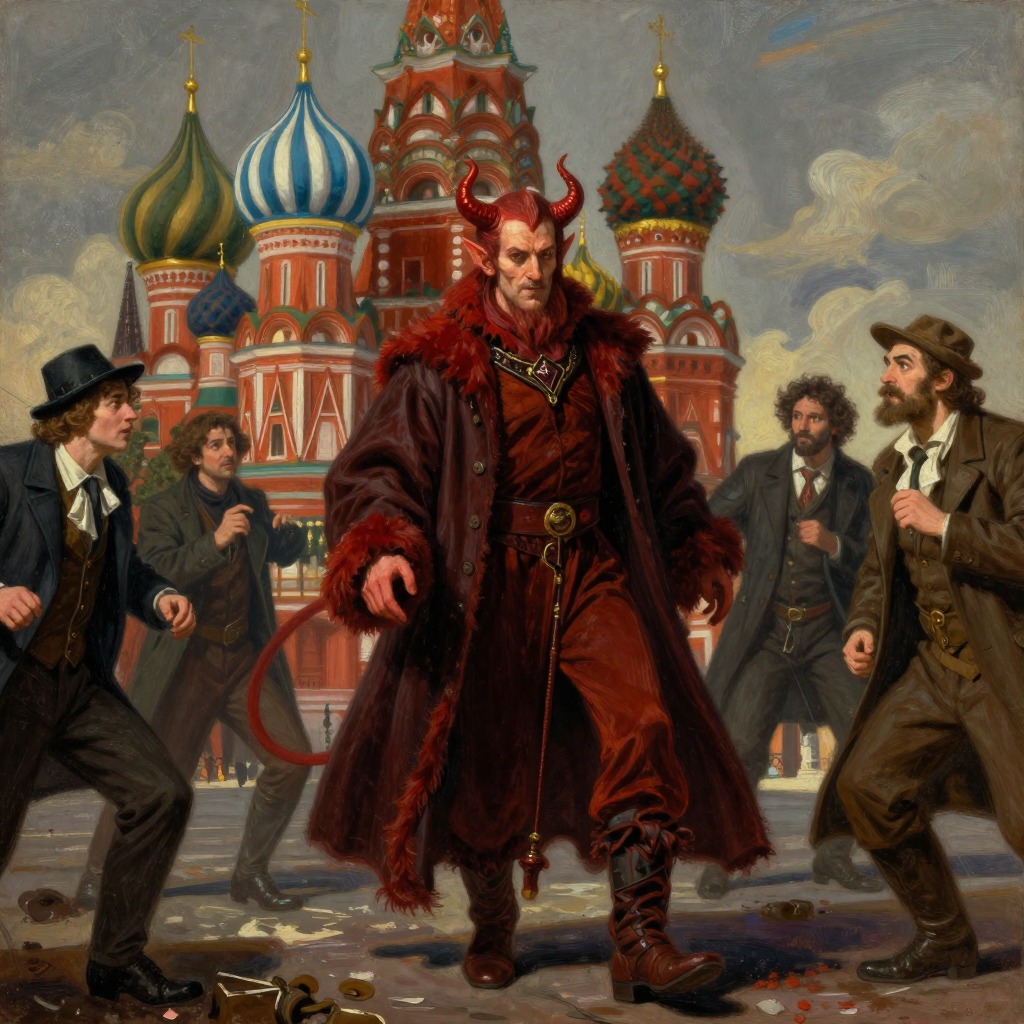
Stepan Likhodeev
The Master and MargaritaStepan Bogdanovich Likhodeev, known as Styopa, is the director of the Variety Theatre in Moscow. A man of dissolute habits and professional negligence, he embodies the corruption and incompetence rife within the Soviet cultural bureaucracy. His character serves as the initial point of contact for the infernal forces that descend upon Moscow, and his mysterious disappearance triggers a cascade of administrative chaos and supernatural terror.
Identity and Background
Styopa Likhodeev is introduced as a man of considerable physical and moral disrepair. He shares the infamous Apartment No. 50 on Sadovaya Street with the late Mikhail Alexandrovich Berlioz, the editor of a literary journal. This apartment has a sinister reputation; its previous occupants vanished without a trace, and within a month of Styopa and Berlioz moving in, both of their wives also disappeared. Styopa's wife was allegedly found on Bozhedomka Street, having been given a room on the condition she never return to Sadovaya. Styopa himself is a heavy drinker, a womanizer, and a man who uses his position to have liaisons with women and to avail himself of a government car. He is described by Woland's retinue as someone who has been "up to some terrible swinishness lately," doing nothing of what he is supposed to do and pulling the wool over his superiors' eyes.
The Confrontation with Woland
Styopa's downfall begins on the morning after a night of heavy drinking. He wakes up in his bedroom with a crippling hangover, unable to open his eyes or move. He is confronted by a stranger in a black beret, who introduces himself as Professor Woland, a specialist in black magic. Styopa has no memory of meeting Woland or signing a contract for seven performances at the Variety Theatre, yet the contract is produced, bearing his own dashing signature and authorizing an advance of ten thousand roubles. The situation is compounded by the appearance of Woland's retinue: a long, checkered individual named Koroviev, a huge black cat named Behemoth who drinks vodka and eats pickled mushrooms, and a short, red-haired, fanged man named Azazello. They accuse Styopa of being a useless director and, with Woland's permission, Azazello declares his intention to "chuck him the devil out of Moscow." Styopa loses consciousness and awakens to find himself sitting on a stone jetty by the sea, in the city of Yalta.
Consequences and Aftermath
Styopa's sudden and inexplicable transportation to Yalta throws the Variety Theatre into chaos. The financial director, Grigory Danilovich Rimsky, and the administrator, Ivan Savelyevich Varenukha, are baffled by telegrams from Yalta that appear to be from Styopa, begging for confirmation of his identity and for money. The situation is further complicated by the fact that Styopa had spoken to Rimsky on the phone from Moscow that same morning. The impossibility of his being in both places at once leads to a breakdown of rational order. The subsequent investigation into the theatre's affairs is hampered by the disappearance of the entire top administration, including Styopa, Rimsky, and Varenukha. The bookkeeper, Vassily Stepanovich Lastochkin, is left to deal with the aftermath, including the discovery that the theatre's cash receipts have been magically transformed into foreign currency, leading to his own arrest. Styopa's disappearance is the first domino to fall in a series of supernatural events that dismantle the normal functioning of the theatre and expose the fragility of the Soviet system in the face of the inexplicable.
Narrative Role and Significance
Styopa Likhodeev functions as a narrative device to introduce the full force of Woland's power into the Moscow storyline. His character is a satirical portrait of the Soviet official: corrupt, lazy, and utterly self-serving. His punishment—being unceremoniously dumped in Yalta—is both a comic and a terrifying demonstration of the arbitrary power that Woland wields. Unlike Berlioz, who is killed for his atheistic arrogance, Styopa is merely removed from the scene, a fate that reflects his relative insignificance. His story serves as a warning and a prelude to the more devastating exposures and punishments that Woland's retinue will inflict on the literary and bureaucratic elite of Moscow.