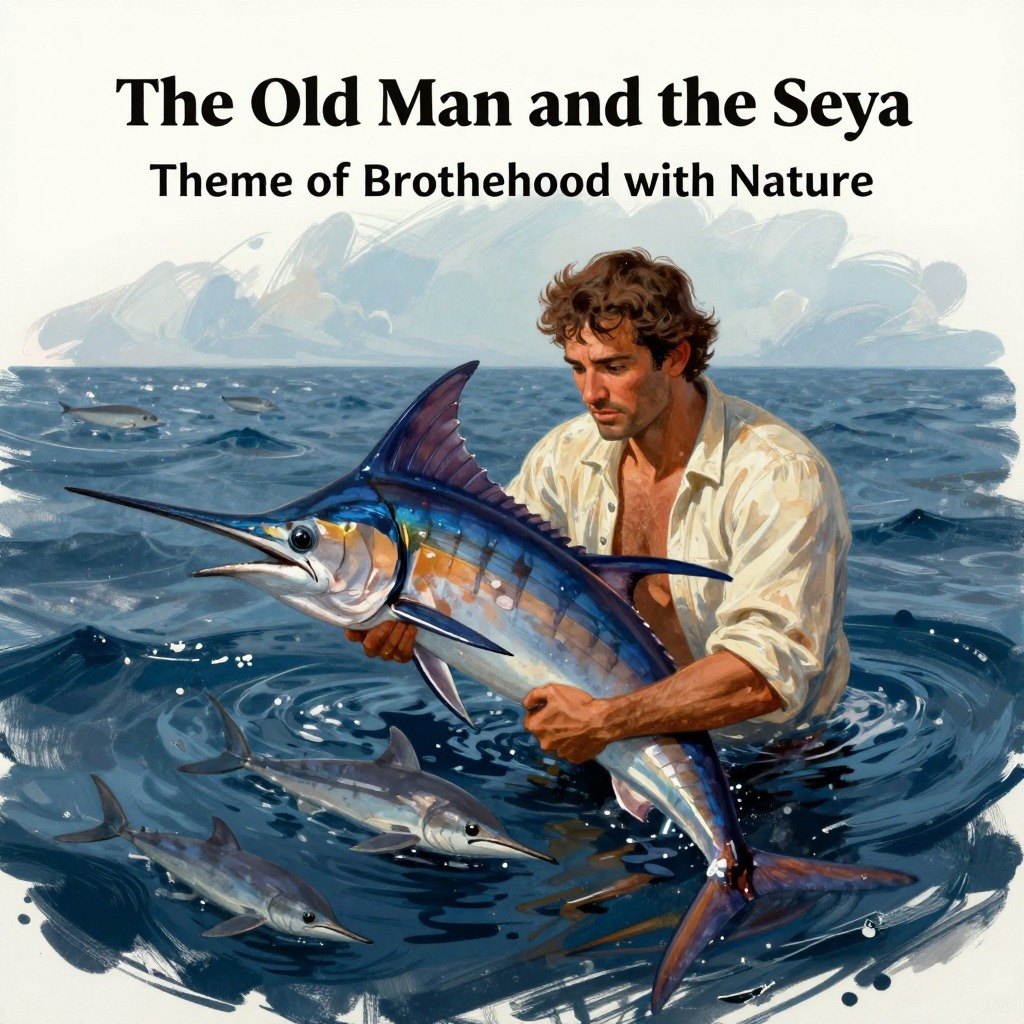
the flying fish as friends
The Old Man and the SeaIn Ernest Hemingway's The Old Man and the Sea, flying fish are a recurring symbol of friendship, brotherhood, and the sustaining, yet fragile, bonds of life at sea. They are the first creatures Santiago names as his "principal friends on the ocean," a designation that establishes them as a touchstone of companionship in his solitary world. More than mere background fauna, the flying fish weave through the narrative as a source of physical nourishment, a marker of the sea's rhythms, and a poignant contrast to the harsher realities of predation and loss that define Santiago's epic struggle.
Identity and Role as Companions
Santiago's affection for flying fish is immediate and personal. As he rows out before dawn, he hears the "trembling sound" of them leaving the water and the "hissing" of their stiff wings, and he declares himself "very fond of flying fish as they were his principal friends on the ocean." This friendship is set in direct contrast to his pity for the small, delicate terns, which he believes have a harder life than humans. The flying fish, by implication, share a kinship with the old man, a fellow creature of the sea navigating its dangers. This bond is further deepened when Santiago later reflects that porpoises, like flying fish, are "our brothers," extending the circle of kinship to include these swift, leaping fish. The flying fish are thus not just observed but emotionally claimed, part of a brotherhood of the sea that Santiago feels connected to even in his profound isolation.
Sustenance and Practical Value
Beyond their symbolic role, flying fish serve a critical, practical function as food. After Santiago has killed the great marlin and is sailing home, he discovers two fresh, hard flying fish inside the stomach of a dolphin he has caught and gutted. He carefully lays them aside, and later, under the stars, he eats one of them, gutted and with its head cut off, as part of his meager meal. He notes that a flying fish is "excellent to eat raw" and that he "would not have to cut him up," highlighting its convenience as a source of immediate, life-sustaining nourishment. Later, when he is too nauseated to eat the dolphin, he forces himself to eat the other flying fish, chewing the bones carefully and consuming it entirely, recognizing that it has "more nourishment than almost any fish" and provides the kind of strength he desperately needs. In this way, the flying fish, once a symbol of friendship, becomes a literal lifeline, a gift from the sea that sustains him in his most exhausted state.
Contrast and Thematic Significance
The fate of the flying fish also underscores the cycle of life and death that governs the ocean. Santiago observes a man-of-war bird diving, which signals the presence of flying fish being chased by dolphin. He watches the "big dolphin" cutting through the water below the flight of the fish, and concludes that the flying fish "have little chance." This scene establishes the flying fish as prey, a vital link in the food chain that sustains larger predators. This predatory reality is echoed in the old man's own actions: he uses a flying fish as bait, hooking it through both eyes to create a "half-garland" on the hook, a detail that transforms his friend into a tool for catching the marlin. This act is not cruel but necessary, a reflection of the code of the fisherman where all creatures, including those he loves, are part of a system of taking and being taken. The flying fish thus embody the paradox at the heart of Santiago's world: they are friends, brothers, and sources of life, yet they are also destined to be consumed, a truth the old man accepts without sentimentality. Their presence, from the first light of his journey to the final moments of his struggle, anchors Santiago's experience in a world of both beauty and brutal necessity.