the hawks
The Old Man and the SeaThe hawks appear in The Old Man and the Sea not as direct antagonists but as a persistent, ominous idea in Santiago's mind—a symbol of the ocean's inherent predation and the merciless cycle that governs life at sea. They are the shadow that falls over the smaller birds, the embodiment of a nature that is beautiful but can be suddenly cruel, and they serve as a counterpoint to Santiago's own complex relationship with the creatures he hunts and admires.
The Hawks as a Threat to the Warbler
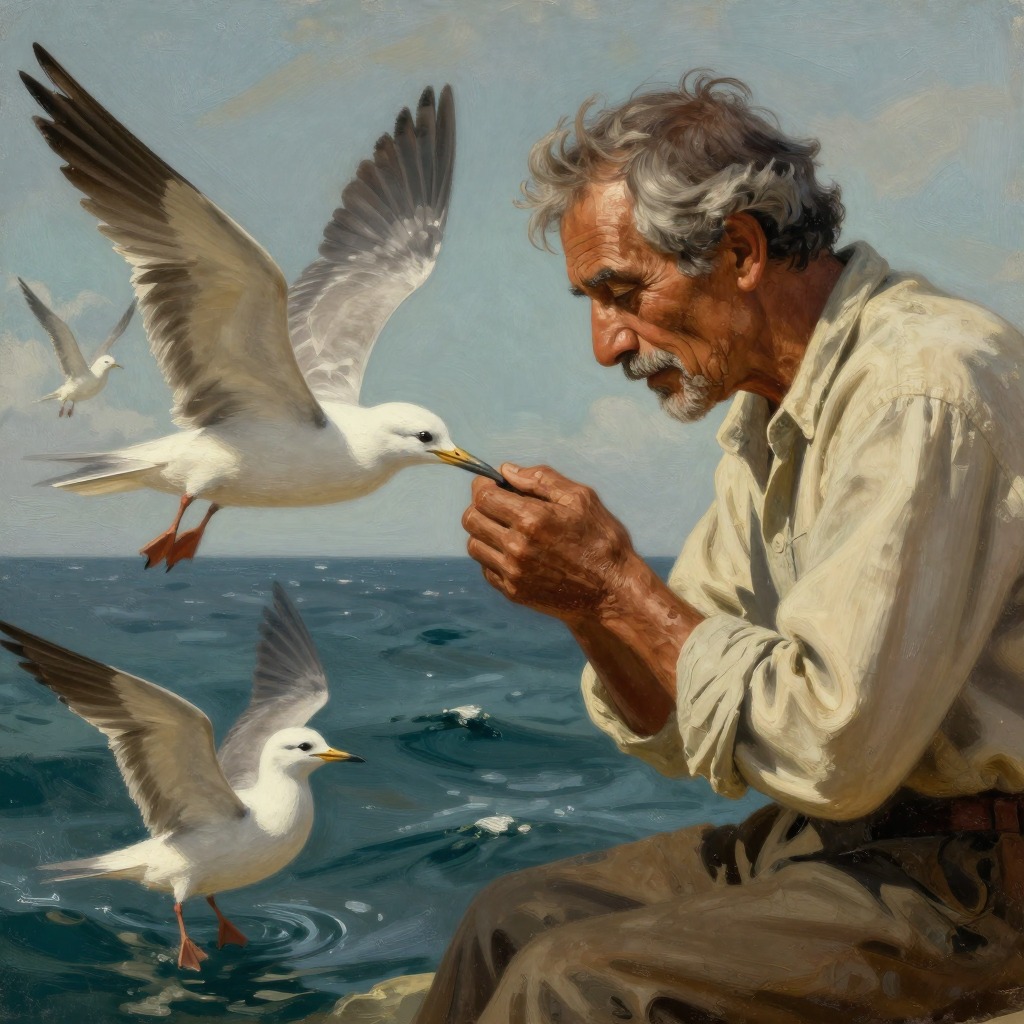
The most explicit reference to the hawks comes during Santiago's long struggle with the marlin, when a small, exhausted warbler lands on his skiff to rest. The old man, speaking to the bird, immediately thinks of the danger it faces: "The hawks, he thought, that come out to sea to meet them." He does not voice this thought to the bird, knowing it "would learn about the hawks soon enough." This moment crystallizes the hawks' role as a natural, inevitable threat—a predator that the delicate warbler, already tired from its journey, must eventually face. Santiago's pity for the bird is deepened by his awareness of this predatory reality, and his silence about it reflects a grim acceptance of the sea's laws.
The Hawks and the Delicate Birds of the Sea
Earlier in the voyage, Santiago reflects on the inherent cruelty of the ocean, contrasting its beauty with its sudden violence. He feels sorry for the birds, especially "the small delicate dark terns that were always flying and looking and almost never finding." He wonders why the sea, which he thinks of as feminine and capable of great favors, would make birds "so delicate and fine as those sea swallows when the ocean can be so cruel." The hawks are the logical extension of this cruelty—the predators that prey on these delicate birds. Santiago's sympathy for the terns and swallows is implicitly a recognition of the hawks' role in the ecosystem, a role that he, as a fisherman, both understands and participates in.
The Hawks in the Context of Santiago's Dreams and Memories
The hawks are absent from Santiago's dreams, which are dominated by the lions playing on the beaches of Africa. This contrast is significant: the lions, which he loved as a boy and still dreams of as an old man, are powerful but not predatory in the same way as the hawks. The lions play like young cats in the dusk, and Santiago loves them as he loves the boy. The hawks, by contrast, are never dreamed of; they belong to the waking world of struggle and survival. This distinction reinforces the hawks' function as a symbol of the harsh, unromantic reality of the sea, as opposed to the idealized, almost mythical past that Santiago carries in his sleep.
The Hawks and the Broader Predatory Cycle
The hawks are part of a larger network of predators that Santiago both respects and fights against. He distinguishes between different kinds of sharks—the noble Mako and the scavenging galanos—and he thinks of the Portuguese man-of-war as "the falsest thing in the sea." The hawks, like the sharks, are killers, but they are not scavengers; they are hunters that come out to sea to meet their prey. Santiago's attitude toward them is not one of hatred but of resigned acknowledgment. They are a fact of life, as inevitable as the wind and the current. This acceptance is part of his broader philosophy: the sea is a place of brothers and enemies, and the hawks are simply one of the enemies that the smaller birds must face.
The Hawks as a Measure of Santiago's Isolation
When Santiago is alone on the sea, his thoughts turn to the hawks as a way of measuring the distance between himself and the world he has left behind. The hawks are a reminder that the sea is not a sanctuary but a battlefield. They are also a link to the land, as they come out from the shore to hunt. In this sense, they represent the connection between the two worlds—the village and the open ocean—that Santiago has crossed. His awareness of the hawks underscores his solitude: he is beyond the reach of human help, but he is still within the domain of the sea's predators. The hawks, like the sharks, are a constant, unseen presence that he must contend with, even if only in his thoughts.