Song of Evil
The PearlIn John Steinbeck's novella The Pearl, the Song of Evil functions as an internal auditory motif that signals the presence of threat, moral decay, and the forces arrayed against Kino and his family. It is the music of the enemy, of any foe of the family—a savage, secret, dangerous melody that first sounds when a scorpion descends toward Coyotito's hanging box, and that thereafter recurs at every crisis point in the narrative, growing in complexity and power until it merges with the pearl's own triumphant music and finally distorts it into something insane. The song is not merely a metaphor but a structural element of Kino's consciousness, inherited from his people's ancient tradition of making songs for everything they saw, thought, or did. It operates in counterpoint to the Song of the Family, the melody of safety, warmth, and wholeness, and the struggle between these two musical forces dramatizes Kino's inner conflict as the pearl transforms from a promise of liberation into an instrument of destruction.
Origin and First Appearance
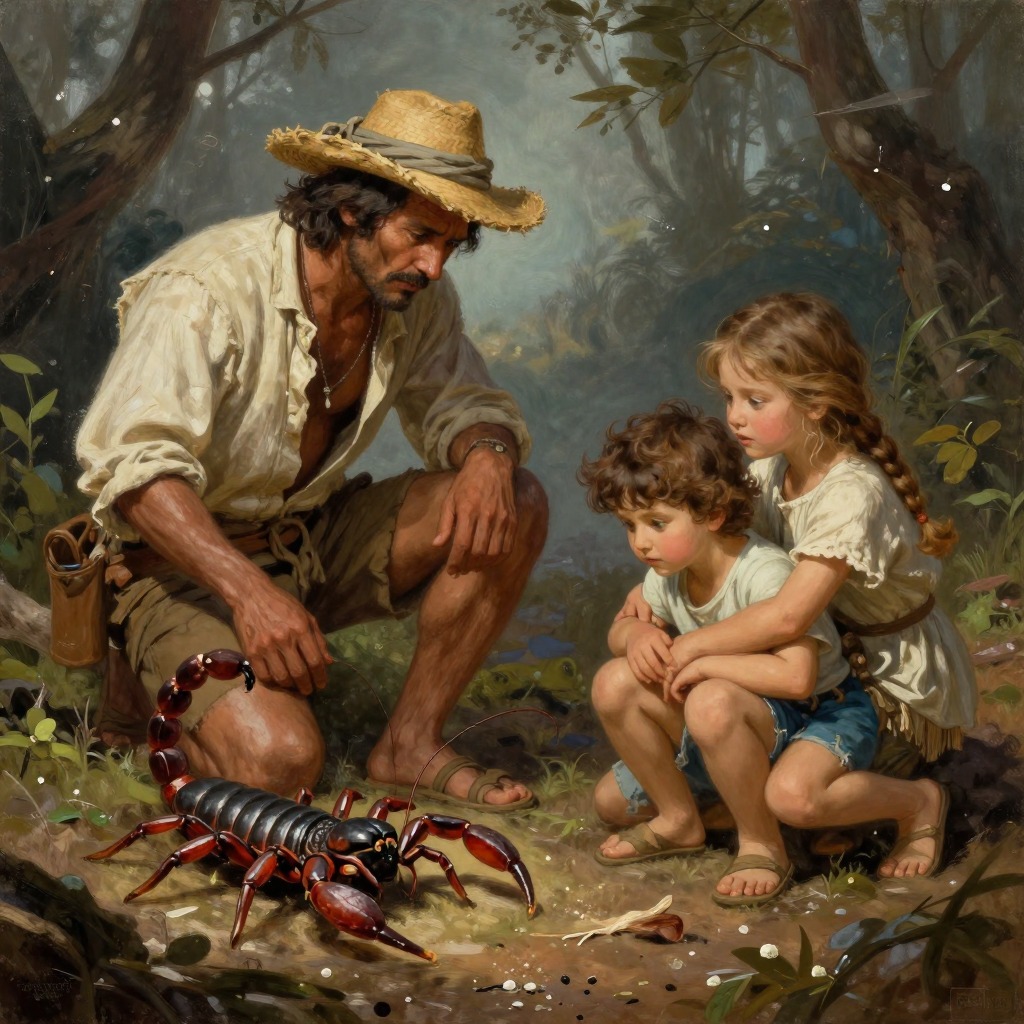
The Song of Evil enters Kino's mind at the moment of greatest domestic vulnerability. As a scorpion moves slowly down the rope that holds Coyotito's hanging box, Kino's breath whistles in his nostrils and he opens his mouth to stop it. The startled look leaves him, the rigidity leaves his body, and in his mind a new song comes: the Song of Evil, the music of the enemy, of any foe of the family, a savage, secret, dangerous melody. Underneath it, the Song of the Family cries plaintively. The scorpion itself is the immediate enemy, but the song already carries a broader resonance: it is the music of every threat that has ever menaced Kino's people, and it will attach itself to every subsequent danger. When Kino later stands before the doctor's gate, rage swells in him and the pounding music of the enemy beats in his ears, his lips drawn tight against his teeth—the same song, now linked to the centuries of subjugation that Kino's race has suffered from the doctor's race.
Association with the Pearl and the Town's Corruption
Once Kino possesses the great pearl, the Song of Evil becomes inseparable from the social forces that the pearl awakens. When the priest visits Kino's brush house, the music of evil sounds faintly and weakly in Kino's head, and he looks at his neighbors to see who might have brought this song in. As the neighbors slip away and Kino steps to the doorway, the scraping crickets and shrilling tree frogs and croaking toads seem to be carrying the melody of evil. The song is no longer a purely internal phenomenon; the natural world itself appears to resonate with it. When the doctor comes to treat Coyotito, uncertainty enters Kino and the music of evil throbs in his head, nearly driving out Juana's song. After the first night attack on his house, Kino probes the darkness with his senses, for the music of evil is sounding in his head and he is fierce and afraid. The song has become his constant companion, a barometer of the danger that now surrounds him. Even in sleep it pursues him: Kino's brain burns during his sleep, and when darkness spreads over his dream of Coyotito reading, the music of evil comes with it, and Kino stirs, and when he stirs, Juana's eyes open in the darkness.
The Song During the Attempt to Sell the Pearl
At the climactic moment when Kino faces the colluding pearl buyers, the Song of Evil intensifies as a direct response to institutionalized greed. Kino feels the creeping of fate, the circling of wolves, the hover of vultures; he feels the evil coagulating about him, and he is helpless to protect himself. He hears in his ears the evil music. The pearl buyers' offices, with their barred windows and wooden slats cutting out the light, become the physical setting of the song. The first buyer's eyes become as steady and cruel and unwinking as a hawk's eyes while the rest of his face smiles in greeting, and his secret hand behind the desk practices legerdemain with a coin—a visual correlative to the deceptive music Kino hears. After Kino refuses the offered price and returns home, a lethargy settles on him and a little gray hopelessness; in his head he hears only the dark music of the enemy. Juana, as though she too can hear the Song of Evil, fights it by singing softly the melody of the family, of the safety and warmth and wholeness of the family, her voice brave against the threat of the dark music.
Transformation During the Flight and Final Confrontation
As Kino and his family flee into the mountains, pursued by trackers, the Song of Evil undergoes its most radical transformation. It sings loud in Kino's head now, singing with the whine of heat and with the dry ringing of snake rattles. It is not large and overwhelming now, but secret and poisonous, and the pounding of his heart gives it undertone and rhythm. The song has become internalized as a physical sensation, indistinguishable from the body's own fear responses. When Kino looks into the pearl to find his vision of the future, he sees instead a huddled dark body on the ground with shining blood dripping from its throat, and Juana with her beaten face crawling home through the night, and Coyotito's face thick and feverish from the medicine. He thrusts the pearl back into his clothing, and the music of the pearl has become sinister in his ears, interwoven with the music of evil. The two songs—the pearl's promise and the enemy's threat—have fused into a single, corrupted melody.
During Kino's stealthy descent to attack the trackers, his own music is in his head, the music of the enemy, low and pulsing, nearly asleep. But the Song of the Family has become as fierce and sharp and feline as the snarl of a female puma, alive now and driving him down on the dark enemy. The harsh cicada seems to take up its melody, and the twittering tree frogs call little phrases of it. The natural world has become an orchestra for Kino's internal struggle. After he kills the three trackers and hears Coyotito's death cry from the cave, the Song of the Family becomes as fierce as a cry in his ears; he is immune and terrible, and his song has become a battle cry.
Resolution and Disappearance
When Kino and Juana return to La Paz and stand at the water's edge, Kino holds the great pearl in his hand and looks into its surface. It is gray and ulcerous; evil faces peer from it into his eyes, and he sees the light of burning, the frantic eyes of the man in the pool, and Coyotito lying in the little cave with the top of his head shot away. The pearl is ugly, gray like a malignant growth, and Kino hears the music of the pearl, distorted and insane. He flings the pearl back into the sea, and the music of the pearl drifts to a whisper and disappears. The Song of Evil, which had been the pearl's music, vanishes with it. The narrative does not say that the Song of the Family returns; it says only that the music of the pearl disappears. The silence that follows is the story's final, ambiguous resolution.