Scorpion and Grasshopper
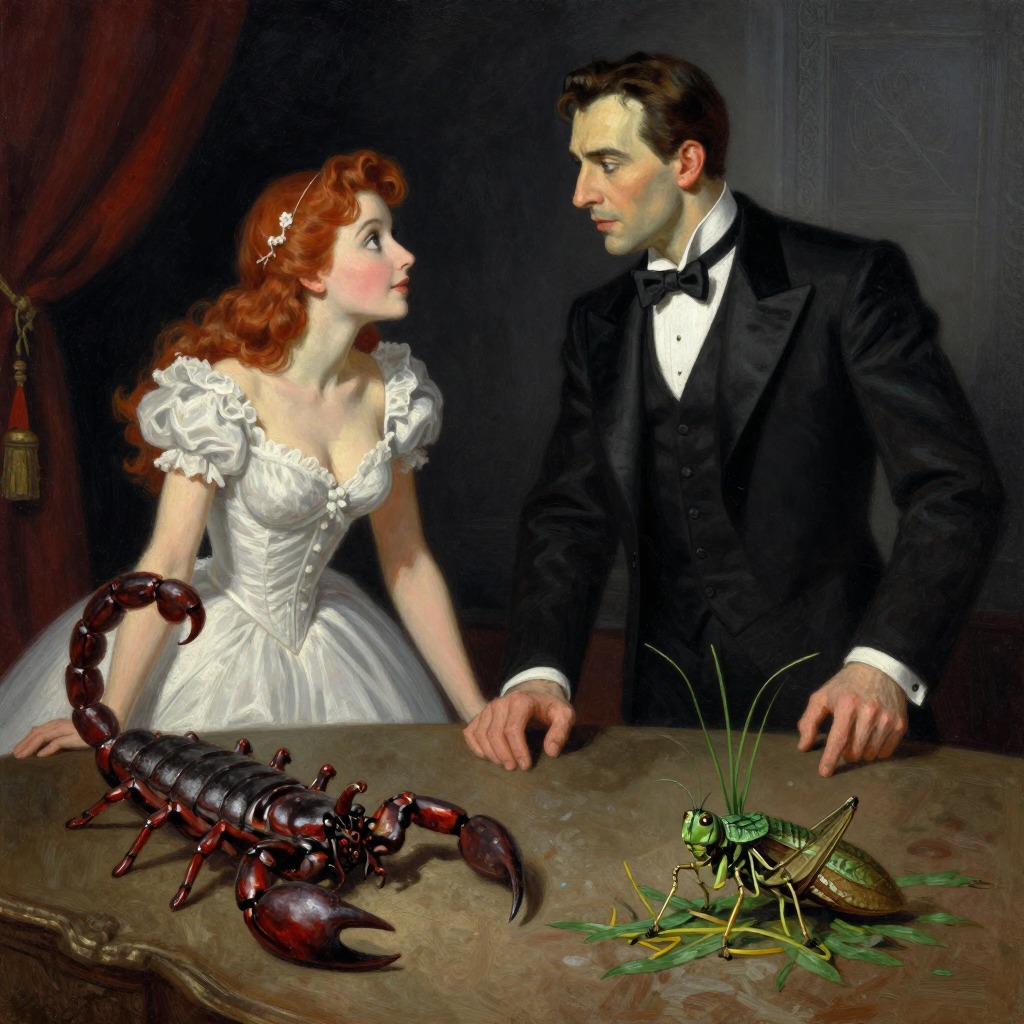
The Phantom of the OperaThe Scorpion and the Grasshopper are two small bronze figures, cleverly imitated in Japanese bronze, that Erik places in the ebony caskets on the mantelpiece of the Louis-Philippe Room. They serve as the physical instruments of the monster's final ultimatum to Christine Daae, a choice that will determine the fate of everyone in the Paris Opera House. The scorpion represents acceptance of marriage to Erik and the preservation of life; the grasshopper represents refusal and triggers a catastrophic explosion. This binary choice condenses the entire novel's central conflict—love, terror, and sacrifice—into a single, devastating mechanical act.
Origin and Purpose
Erik presents the scorpion and the grasshopper to Christine during the climactic hours before the deadline he has set for her decision. He tells her that he has given her five minutes to spare her blushes, and that the two figures will say yes or no for her. He explains that if she turns the scorpion, that will mean to him, when he returns, that she has said yes; the grasshopper will mean no. The figures are housed in two ebony caskets on the mantelpiece, and Erik opens them without a key, demonstrating his complete control over the mechanism. He warns Christine that the grasshopper does not only turn: it hops, and it hops jolly high, a cryptic phrase that foreshadows the explosive consequence.
The Mechanism of Choice
The scorpion and the grasshopper are not merely symbolic; they are directly connected to the gunpowder barrels stored in the cellar beneath the torture-chamber. The Persian, who has discovered the barrels of gunpowder, realizes that the grasshopper controls an electric current intended to blow up the powder-magazine. When Christine hesitates, Erik clarifies the stakes: if she turns the grasshopper, everyone will be blown up, as there is enough gunpowder under their feet to destroy a whole quarter of Paris. If she turns the scorpion, all that powder will be soaked and drowned. The scorpion thus becomes the key to survival, while the grasshopper is the instrument of mass destruction.
The Moment of Decision
Christine, trapped in the Louis-Philippe Room with the Persian and Raoul de Chagny imprisoned in the torture-chamber, faces the ultimatum as the five minutes elapse. The Persian, suspecting that Erik might have deceived her, warns her not to touch the scorpion, fearing that it might be the one that triggers the explosion. But when Erik returns and announces that the two minutes are past, Christine cries out, asking him to swear that the scorpion is the one to turn. Erik confirms that it is, and Christine declares, "Erik! I have turned the scorpion!" The result is not an explosion but the hiss of water flooding the cellar, soaking the gunpowder and saving everyone. The scorpion, by opening a floodgate, neutralizes the threat, while the grasshopper, had it been turned, would have completed the circuit of destruction.
Consequences and Significance
Christine's turning of the scorpion is the decisive act that resolves the novel's central crisis. It demonstrates her willingness to sacrifice herself—to accept marriage to Erik—in order to save Raoul, the Persian, and the entire audience of the Opera. The scorpion and the grasshopper thus embody the novel's thematic opposition between life and death, love and destruction, and the power of a single choice to alter the fate of many. The figures also reveal Erik's character: he is a master of theatrical, mechanical traps, but he is also capable of keeping his word, as the scorpion indeed performs the promised function. The choice of the scorpion leads directly to Erik's renunciation of his claim on Christine, his release of Raoul, and his eventual death, making the bronze figures the pivot on which the entire tragedy turns.