Alan Campbell
The Picture of Dorian GrayAlan Campbell is a minor but pivotal character in Oscar Wilde's The Picture of Dorian Gray, a gifted scientist and musician whose former intimacy with Dorian Gray makes him the only person Dorian can turn to when he needs to dispose of the evidence of a murder. Campbell's forced complicity in the destruction of Basil Hallward's body, and his subsequent suicide, mark the point at which Dorian's corruption shifts from private vice to criminal coercion, and they demonstrate the ruinous reach of Dorian's influence over those who once loved him.
Identity and Background
Alan Campbell is an extremely clever young man with a dominant intellectual passion for science. At Cambridge he spent a great deal of time working in the laboratory and took a good class in the Natural Science tripos. He is also an excellent musician, playing both the violin and the piano better than most amateurs. It was music that first brought him and Dorian Gray together, along with that indefinable attraction Dorian seemed able to exercise whenever he wished. They met at Lady Berkshire's the night Rubinstein played there, and after that they were always seen together at the Opera and wherever good music was going on. For eighteen months their intimacy lasted, and Campbell was constantly either at Selby Royal or in Grosvenor Square. To him, as to many others, Dorian Gray was the type of everything wonderful and fascinating in life. Campbell has no real appreciation of the visible arts, and whatever little sense of the beauty of poetry he possesses he gained entirely from Dorian.
The Broken Friendship
Suddenly, without any public explanation, the intimacy between Campbell and Dorian came to an end. People remarked that they scarcely spoke when they met, and that Campbell always seemed to go away early from any party at which Dorian Gray was present. Campbell himself changed: he became strangely melancholy at times, appeared almost to dislike hearing music of any passionate character, and would never himself play, giving as his excuse that he was so absorbed in science that he had no time left to practice. This was certainly true; every day he seemed to become more interested in biology, and his name appeared once or twice in scientific reviews in connection with certain curious experiments. When they met in society after the rupture, only Dorian Gray smiled; Alan Campbell never did.
The Blackmail and the Disposal of the Body
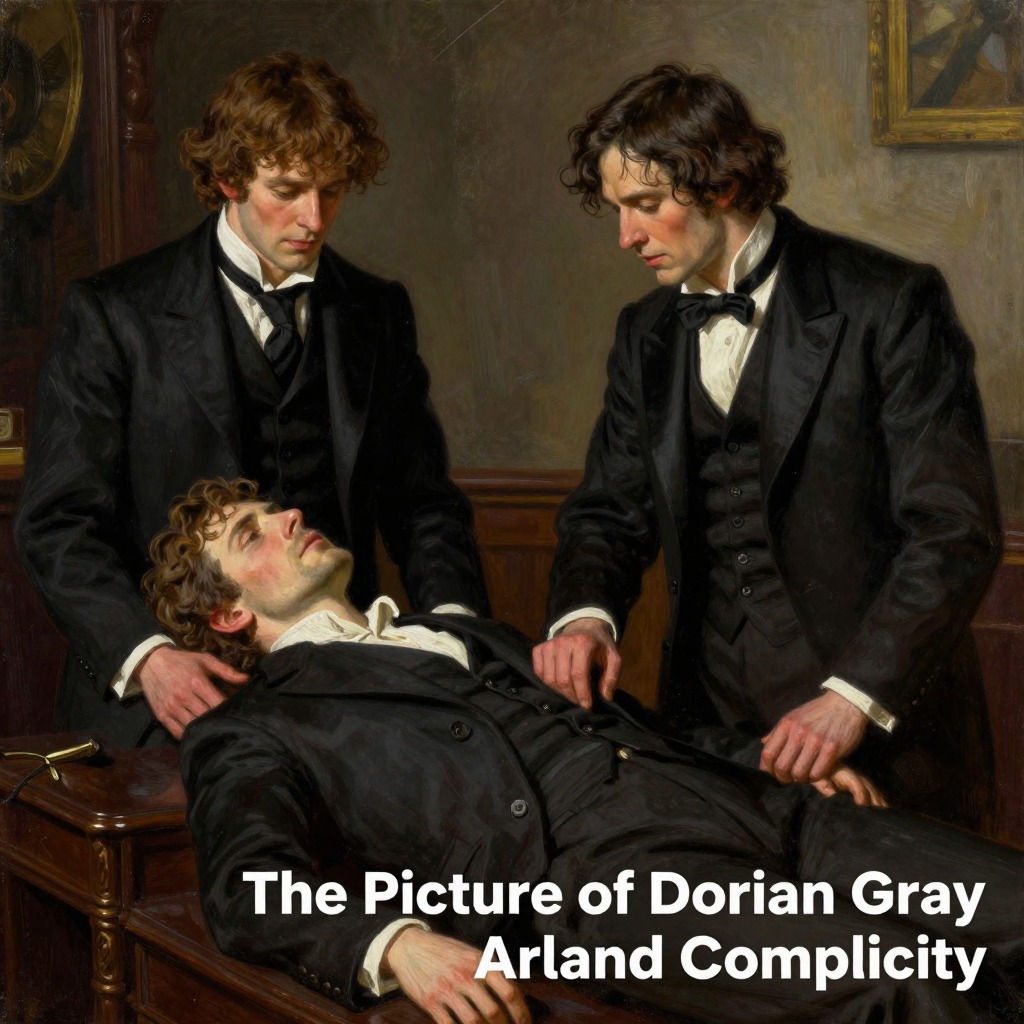
On the morning after Dorian murders Basil Hallward, Dorian sends a note to Campbell at 152, Hertford Street, Mayfair, summoning him on a matter of life and death. Campbell arrives looking very stern and rather pale, his pallor intensified by his coal-black hair and dark eyebrows. He declares he had intended never to enter Dorian's house again. Dorian tells him that in a locked room at the top of the house a dead man has been seated at a table for ten hours, and that Campbell must destroy the body and everything belonging to it so that not a vestige remains. Campbell refuses absolutely, saying he will have nothing to do with it and that Dorian deserves whatever shame comes to him. Dorian then reveals that it was murder, not suicide, and that he killed Hallward. Still Campbell refuses. Finally, Dorian writes something on a piece of paper and pushes it across the table. When Campbell reads it, his face becomes ghastly pale and he falls back in his chair, feeling as if his heart is beating itself to death. Dorian tells him he has a letter already written and that if Campbell does not help him, he must send it. Campbell, now trapped, asks if there is a fire in the room upstairs. He writes a list of chemicals and equipment for his assistant to bring. Dorian sends his servant Francis to fetch the items, and also sends him on an errand to Richmond to order orchids, ensuring the servant will be away for hours. Campbell performs the scientific destruction of the body, using a mahogany chest of chemicals, a small electric battery, a long coil of steel and platinum wire, and two curiously shaped iron clamps. The process takes about five hours. When he finishes, he returns to the library, pale but absolutely calm, and says, "I have done what you asked me to do. And now, good-by. Let us never see each other again." Dorian thanks him for saving him from ruin, but Campbell makes no reply.
Suicide and Aftermath
Some time later, Alan Campbell shoots himself one night in his laboratory. Crucially, he does not reveal the secret he had been forced to know. His suicide removes the last living witness to Dorian's crime, and the matter of Basil Hallward's disappearance gradually fades from public attention. Campbell's death is mentioned by Lord Henry Wotton as one of the topics of the season, alongside his own divorce case and the mysterious disappearance of an artist. Campbell's silence, even in death, underscores the completeness of Dorian's power over those who once loved him, and the terrible cost of that power to everyone who comes within its orbit.