Murder of Basil Hallward
The Picture of Dorian GrayOn the night of November 7th, the eve of his thirty-second birthday, Dorian Gray was walking home through a cold, foggy London when he encountered Basil Hallward at the corner of Grosvenor Square and South Audley Street. Hallward, who had been waiting for Dorian since nine o'clock, was on his way to catch the midnight train to Paris and insisted on speaking with him. Reluctantly, Dorian allowed the painter into his house, where Hallward confronted him with the dreadful rumors circulating about his life—the suicide of a young guardsman, the ruined career of Sir Henry Ashton, the fate of Adrian Singleton, and the disgrace of Lord Kent's only son. Hallward pleaded with Dorian to deny the charges, declaring that he could not believe them when he saw Dorian's pure, innocent face, yet the evidence of corruption seemed overwhelming.
The Confrontation and the Confession
Hallward's moral appeal only provoked Dorian's contempt and a bitter, mocking laugh. Seizing a lamp from the table, Dorian declared that Hallward would see his soul that very night, and led him up the stairs to the locked schoolroom. As they ascended, Dorian felt a terrible joy at the thought that the man who had painted the portrait—the origin of all his shame—would now be burdened with the hideous memory of what he had done. Inside the dusty, mildewed room, Dorian tore the purple-and-gold curtain from the portrait, revealing the hideous, leering face on the canvas. Hallward, recognizing his own brushwork and the frame of his own design, recoiled in horror. He insisted that the thing was impossible, that the damp or some mineral poison in the paints must have caused the change. But Dorian coldly told him that the portrait was the face of his soul, and that Hallward's own romance—his confessed idolatry of Dorian—was written in its degradation.
The Murder
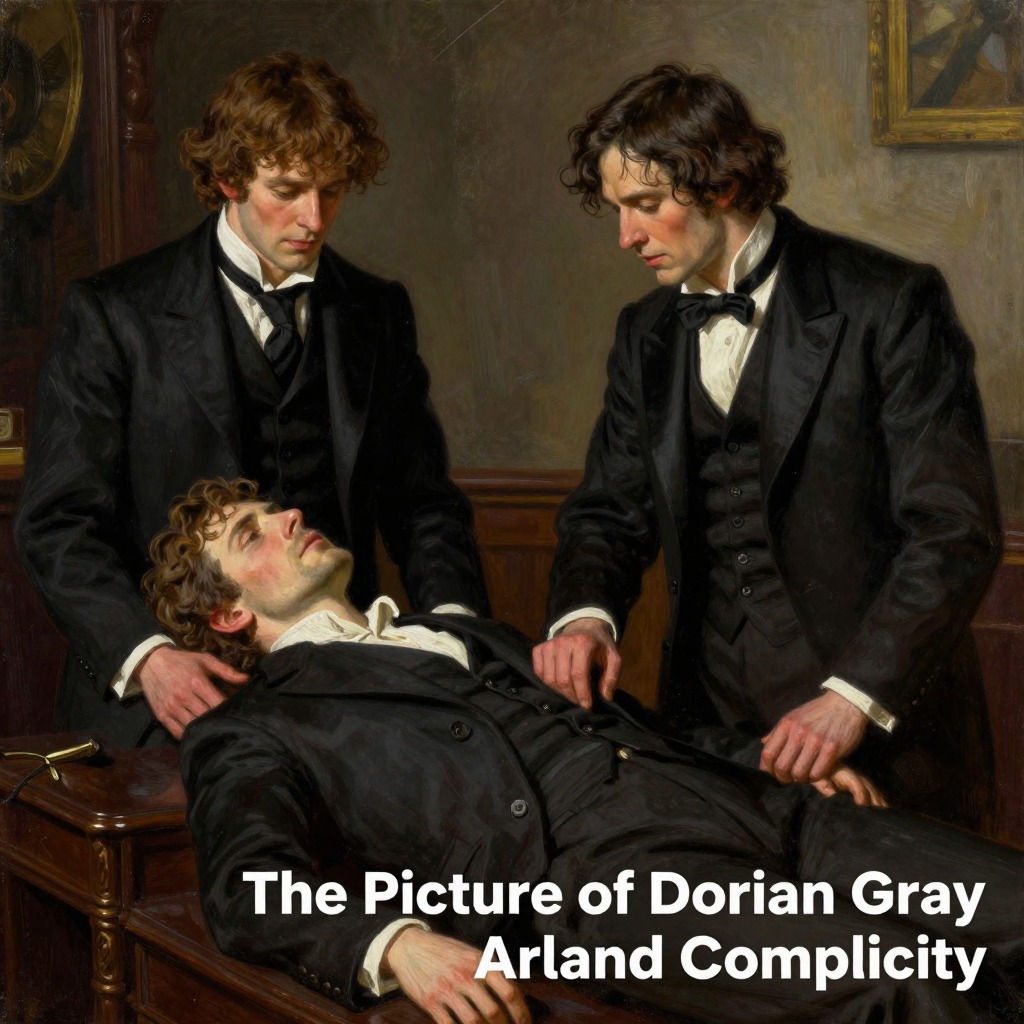
As Hallward sat in the rickety chair, his face buried in his hands, he urged Dorian to pray, to repent, to remember the promise that sins as scarlet could be made white as snow. But Dorian, glancing at the portrait, felt an uncontrollable hatred for the man who had painted it. The mad passions of a hunted animal stirred within him. His eye fell on a knife he had brought up days before to cut a piece of cord and had forgotten to take away. Moving slowly behind Hallward, he seized the knife, rushed at him, and dug it into the great vein behind the ear, crushing the man's head down on the table and stabbing again and again. There was a stifled groan, the horrible sound of someone choking with blood, and the outstretched arms shot up convulsively three times before the man lay still. Dorian waited, still pressing the head down, then threw the knife on the table and listened to the drip, drip on the threadbare carpet.
Aftermath and Concealment
Dorian felt strangely calm. He opened the window and stepped onto the balcony, watching a policeman making his rounds and a woman staggering through the fog. He then returned to the library, hid Hallward's bag and coat in a secret press, and rang the bell to wake his valet, Francis, pretending he had forgotten his latch-key. The next morning, he wrote to Alan Campbell, a former friend and a brilliant chemist, and forced him—by threatening to expose a secret letter—to destroy the body using chemicals and a gas-fire. Campbell complied, and by evening the corpse was gone, leaving only a horrible smell of chemicals. Dorian had crossed the final threshold: he was no longer merely a corruptor of others but a murderer who had killed the man who had loved him most.