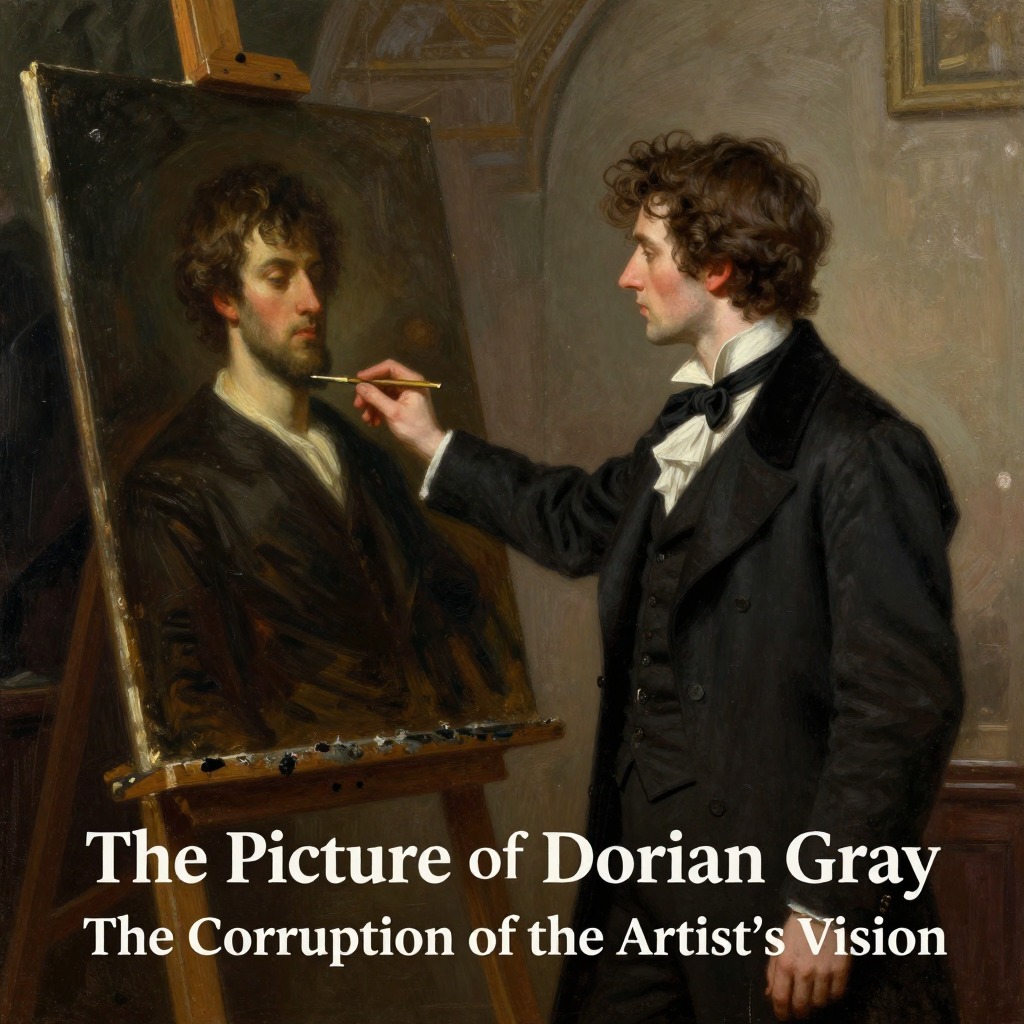
Portrait painting
The Picture of Dorian GrayThe painting of Dorian Gray's portrait by Basil Hallward is the pivotal magical event that triggers the entire plot, as Dorian's wish that the canvas age instead of himself is mysteriously granted, binding his soul to the picture and setting him on a path of hedonism, cruelty, and murder.
Creation and the Artist's Secret
In the center of Basil Hallward's studio, clamped to an upright easel, stood the full-length portrait of a young man of extraordinary personal beauty. As Basil looked at the gracious and comely form he had so skillfully mirrored in his art, a smile of pleasure passed across his face, but he suddenly started up, closing his eyes as though to imprison a curious dream. Lord Henry Wotton, lounging on a divan and smoking innumerable cigarettes, declared it Basil's best work and urged him to send it to the Grosvenor. Basil refused, confessing, "I have put too much of myself into it." He later explained to Lord Henry that every portrait painted with feeling is a portrait of the artist, not the sitter, and that he was afraid he had shown with it the secret of his own soul. The portrait was the masterpiece of Basil's career, the work into which he had poured all the extraordinary romance he had never dared to speak of to Dorian.
Dorian's Revelation and the Wish
When Dorian first saw the finished portrait, he drew back, his cheeks flushing with pleasure, a look of joy coming into his eyes as if he had recognized himself for the first time. The sense of his own beauty came on him like a revelation. As he stood gazing at the shadow of his own loveliness, the full reality of Lord Henry's panegyric on youth and its terrible brevity flashed across him. He thought of the day when his face would be wrinkled and wizen, his eyes dim, the grace of his figure broken. "How sad it is!" he murmured. "I shall grow old, and horrid, and dreadful. But this picture will remain always young. If it was only the other way! If it was I who were to be always young, and the picture that were to grow old! For this—for this—I would give everything!" This mad wish, uttered in a moment of passionate despair, was mysteriously granted, and the portrait became the visible emblem of his conscience, bearing the burden of his sins and age while he remained untouched.
The Portrait as a Mirror of the Soul
The portrait became the magical mirror of Dorian's soul. After his cruel rejection of Sibyl Vane, he noticed the first change: a touch of cruelty in the mouth. He later saw the portrait had received the news of Sibyl's death before he knew it himself, the vicious cruelty marring the fine lines of the mouth appearing at the very moment the girl drank the poison. Over the years, as Dorian pursued a life of exquisite pleasures and hidden sins, the portrait grew old and hideous, bearing the leprosies of sin. He would creep upstairs to the locked room, stand with a mirror in front of the portrait, looking now at the evil and aging face on the canvas and now at his own fair young face, growing more enamoured of his own beauty and more interested in the corruption of his own soul. The portrait was the one piece of evidence against him, the thing that would reveal his secret to the world.
The Destruction of the Portrait and Dorian's Death
After sparing Hetty Merton in what he thought was his first good action, Dorian went to the locked room to see if the portrait had changed for the better. He saw no change except a look of cunning and the curved wrinkle of the hypocrite; the scarlet dew on the hand seemed brighter, more like blood newly spilt. Realizing the portrait was the only evidence left against him, he seized the knife that had stabbed Basil Hallward and stabbed the canvas, ripping it right up from top to bottom. A horrible cry was heard, and a crash. When the servants entered, they found hanging upon the wall a splendid portrait of their master in all the wonder of his exquisite youth and beauty. Lying on the floor was a dead man, in evening dress, with a knife in his heart, withered, wrinkled, and loathsome of visage. It was not until they had examined the rings that they recognized who it was.