sextant
The RoadThe sextant is a brass navigational instrument that the man discovers aboard the wrecked sailboat Pájaro de Esperanza, a twin-masted vessel keeled over in shallow water off the coast. It is the first object he has seen in a long time that stirs him, and its appearance marks a brief, luminous pause in the relentless struggle for survival. Yet the man, after holding it and examining it, chooses to leave it behind in its fitted case, a decision that underscores the gulf between the world the sextant once served and the world he now inhabits.
Discovery and Appearance
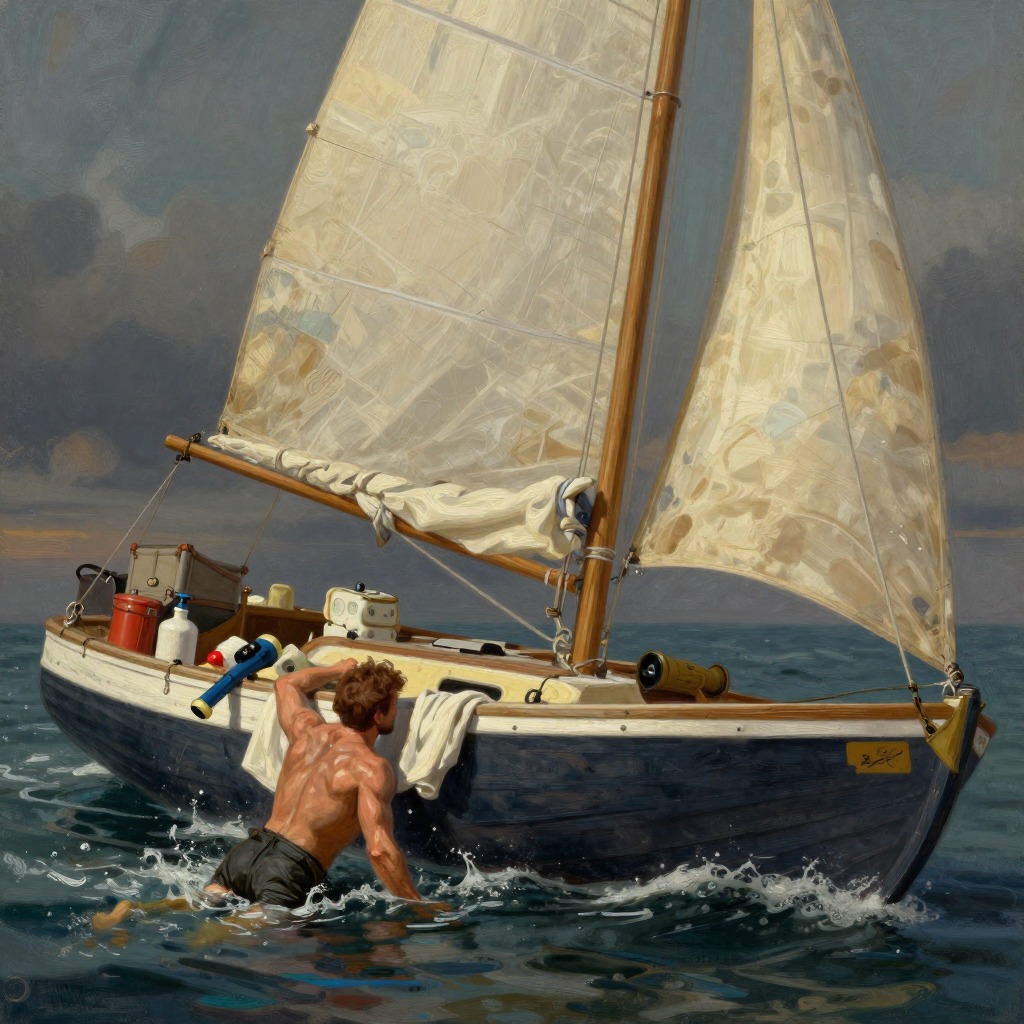
The man finds the sextant in a square oak box with dovetailed corners and a brass plate let into the lid, stowed in a locker in the saloon of the sailboat. He unsnaps the corroding latches and opens the case to reveal the instrument: a brass sextant, possibly a hundred years old, fitted into a blue baize lining. The brass is dull and there are patches of green verdigris on it that take the form of another hand that once held it, but otherwise it is perfect. He lifts it from the case in both hands and turns it, struck by its beauty. He wipes the verdigris from the plate at the base, which reads "Hezzaninth, London." Holding it to his eye, he turns the wheel. It is the first thing he has seen in a long time that stirs him.
The Man's Response and Decision
After examining the sextant, the man fits it back into the blue baize lining of the case, closes the lid, snaps the latches shut, and sets it back in the locker, closing the door. He does not take it with him. This deliberate abandonment is consistent with his earlier acts of discarding objects that belong to a vanished world: he had pitched his sweat-blackened billfold into the woods and laid his wife's photograph down in the road. The sextant, like those personal relics, is a thing of grace and beauty whose common provenance is pain, and the man cannot carry it into a future that has no use for celestial navigation. The instrument's precision and beauty are irrelevant to a world where the sun is banished and the stars are invisible behind the murk.
Significance and Thematic Resonance
The sextant embodies the knowledge, craft, and order of the lost world. It is a tool for measuring the angle between celestial bodies and the horizon, for fixing one's position on the earth—a practice that presupposes a known geography, a reliable sky, and a destination worth navigating toward. In the world of the novel, the sky is a permanent overcast, the maps are tattered and useless, and the man and the boy follow roads that lead only south, without any certainty of what they will find. The sextant, like the sextant the man once saw in a camera store that he thought he might use to average out light readings, is a relic of a time when measurement and prediction were possible. The man's decision to leave it behind is a quiet acknowledgment that the old ways of knowing are no longer applicable. The sextant's beauty, however, remains a testament to what was once made, and the man's brief, reverent handling of it is a moment of grace in a world stripped of grace.
Contrast with Other Objects
Unlike the grocery cart, the pistol, the map, the binoculars, the tarp, the lamp, the flare gun, the knife, the first-aid kit, the gas stove, the morels, the Coca Cola, the ham, the apples, the canned goods, the toy truck, the flute, the motorcycle mirror, the bunker, the boat, the truck, the train, the trout, the dog, the crows, and the snakes—all of which are used, consumed, or fought over for survival—the sextant is purely aesthetic and symbolic. It serves no practical function in the post-apocalyptic landscape. The man does not attempt to use it for navigation; he simply holds it and admires it. This distinguishes it from the flare gun, which he takes and uses as a weapon, or the sextant from the ship's log, which he searches for but does not find. The sextant is the only object in the novel that the man encounters and then deliberately leaves behind, not because it is useless, but because its use belongs to a world that no longer exists.