Eyes motif
The SandmanThe eyes motif is the central symbolic and structural device in E. T. A. Hoffmann's 'The Sandman,' recurring across the narrative to link childhood terror, adult obsession, and the collapse of reality into madness. Eyes are simultaneously the object of violent threat, the medium of deceptive vision, and the final token of the automaton's revelation, binding Nathaniel's fate to the figures of Coppelius, Coppola, and Olympia.
Origins in Childhood Terror
The motif first appears in the nursery tale told to Nathaniel by the old woman who cared for his youngest sister. She describes the Sandman as a bad man who flings a handful of sand into the eyes of children who refuse to sleep, so that they scratch themselves bloody; he then carries them off to the half-moon to feed his children, who sit in their nest with crooked beaks like owls and pick out the eyes of naughty human brats. This grisly image takes firm hold of Nathaniel's childish imagination and becomes entrenched in his mind as a hair-raising spook. Years later, when he spies on his father's secret nighttime activities with the barrister Coppelius, the threat becomes literal: Coppelius, working at a hidden hearth, swings red-hot tongs and hammers a bright, flickering mass of ore, and Nathaniel sees human faces all about, but without eyes — dreadful, deep, black hollows where the eyes ought to be. Coppelius then cries out, 'Eyes out, eyes out!' and, grabbing Nathaniel, whispers that he has 'a lovely pair of children's eyes' and intends to strew glowing cinders into them. Nathaniel's father pleads with folded hands, 'Master! Master! Let my Nathaniel keep his eyes! Let him keep them, I beg you!' The eyes are spared, but the trauma is permanently inscribed.
The Looking-Glass and the Deceptive Gaze
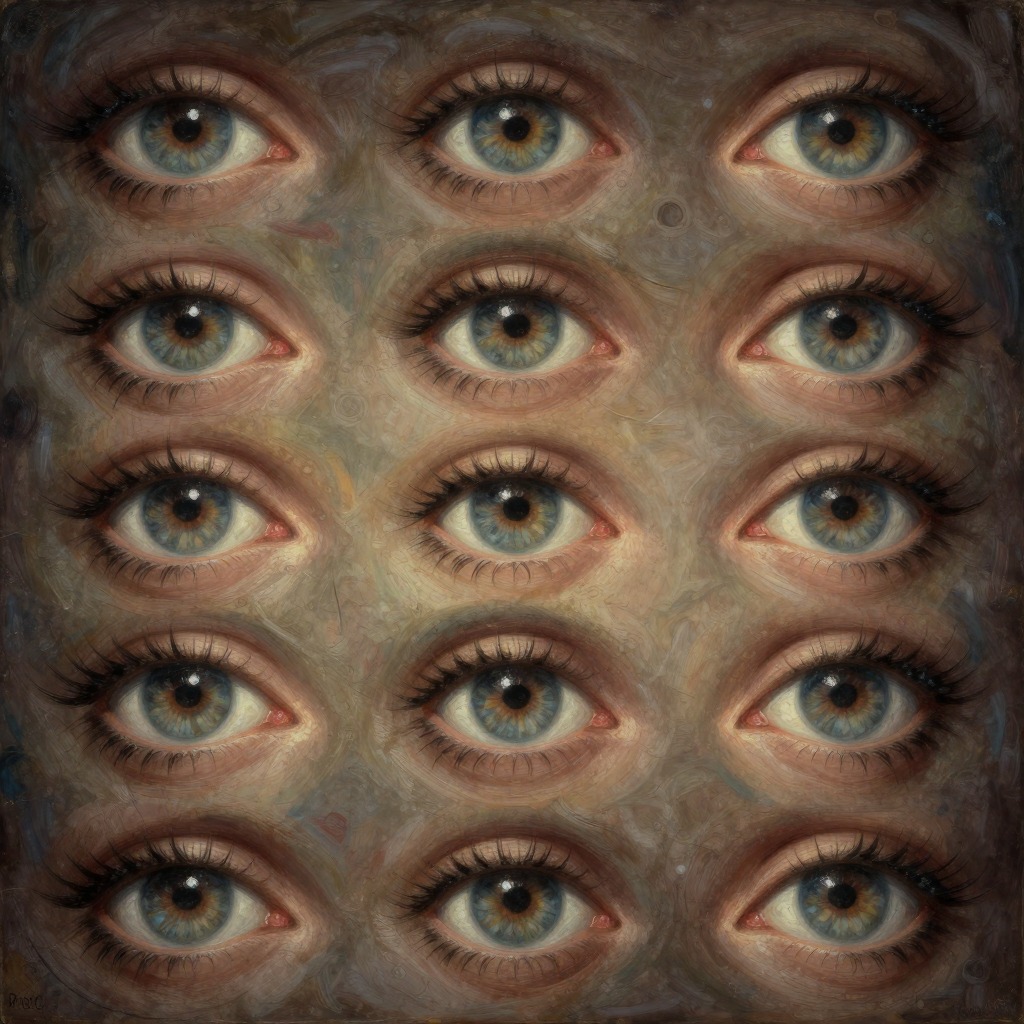
When Nathaniel returns to his studies in the city of G., the motif resurfaces through the barometer pedlar Giuseppe Coppola, whom Nathaniel recognizes as the same Coppelius. Coppola offers not barometers but 'a pair o' lovely peepers!' — spectacles and eyeglasses that he pulls from his deep coat pocket and lays out on the table. A thousand eyes peep and twitch and stare at Nathaniel, shooting blood-red rays at his breast, until he cries out in frantic horror. After Coppola sweeps the eyeglasses away, he produces telescopes and field glasses, and Nathaniel buys a small, finely crafted pocket looking-glass. Peering through it into the room of Spalanzani's daughter Olympia, he sees her exquisitely lovely face for the first time; her eyes, which had appeared strange, blank, and dead, seem to flash open in moist moonbeams, growing livelier and livelier. The looking-glass thus becomes the instrument through which Nathaniel's desire is awakened and his perception distorted, replacing Clara's image in his heart with the illusion of Olympia's living gaze.
The Automaton's Eyes and the Revelation
The motif reaches its climax in the revelation scene. Nathaniel bursts into Spalanzani's study to find the Professor and Coppola fighting over Olympia, tugging and tearing her figure. Coppola yanks the figure free and, swinging her, strikes Nathaniel so that he tumbles backward over the work table. As Coppola flees down the steps with the figure over his shoulder, Nathaniel sees all too clearly that Olympia's deathly pallid wax face has no eyes — only black hollows in their stead. She is a lifeless doll. Spalanzani, bleeding from glass shards, cries out that Coppola has robbed him of his finest automaton — 'the eyes — the eyes robbed from you' — and then Nathaniel spots a pair of bloody eyes peering at him from the floor. Spalanzani grasps them with his uninjured hand and flings them at Nathaniel, striking him on the breast. At that moment madness seizes Nathaniel, and he begins to rave about a ring of fire and a wooden doll.
The Final Return of the Motif
After a period of apparent recovery, Nathaniel, Clara, and Lothar climb the tall town hall tower. Clara points out a strange little grey bush drawing near, and Nathaniel mechanically reaches into his coat pocket, finds Coppola's looking-glass, and turns it sideways. Clara stands in the eye of the lens. A spasmodic quiver starts up in his veins and arteries; turning deathly pale, he peers at Clara, then sparks of fire flash from his rolling eyes. He lets out a horrible cry like a hunted animal and screams, 'Turn, little wooden doll, turn!' He grabs Clara and tries to hurl her off the balcony. Lothar rescues her, but Nathaniel, now on the lookout gallery, spots Coppelius below in the crowd and shrieks, 'Ha! Eyes a pretty! Eyes a pretty!' before leaping over the parapet to his death. The eyes motif thus completes its arc: the nursery threat of eye-stealing, the looking-glass that creates a false beloved, the automaton's empty eye sockets, the bloody eyes flung as a weapon, and finally the madman's last cry echoing the pedlar's sales pitch, all converge in the moment of suicide.