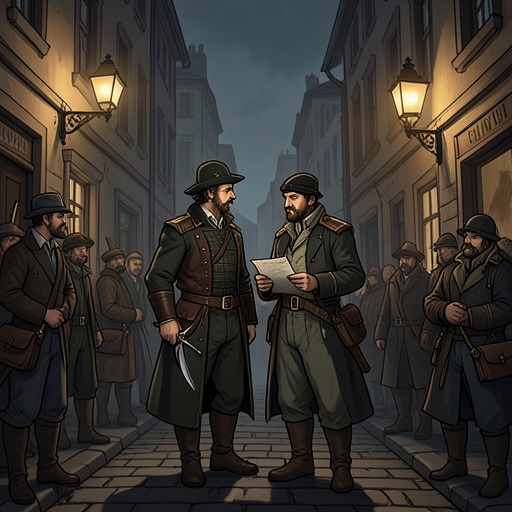
Anglo-French belligerent state (1627–1629)
The Three MusketeersThe Anglo-French belligerent state (1627–1629) makes the political dangers surrounding the novel’s private adventures into open war. Its principal theatre is the struggle around La Rochelle and the Isle of Ré, but its pressures travel across the Channel through fleets, envoys, intercepted papers, and competing claims on Anne of Austria. The conflict is at once a campaign against a Protestant stronghold, an international contest over France’s security, and a personal rivalry conducted with the resources of two kingdoms.
Causes and Political Stakes
The immediate French objective is to eliminate La Rochelle as the last important city granted to the Huguenots as a place of safety. The narrator presents it as the final bulwark of Calvinism and a focal point where religious division, civil unrest, and foreign intervention converge. After other Calvinist cities have fallen, La Rochelle’s position gives it exceptional strategic weight: its port is the last in France open to the English. Closing it would therefore weaken both domestic resistance and England’s access to the French coast.
The threat is not confined to a single foreign army. Spaniards, Englishmen, Italian malcontents, and soldiers of fortune from different nations and religious backgrounds gather under the Protestant standard. The account depicts an international network whose branches extend across Europe, making the siege a collision between the French monarchy and a wider coalition of interests. The city’s religious identity and its maritime access are inseparable: control of the port is also control over the routes by which foreign assistance can reach the rebels.
The novel gives this national strategy a sharply personal dimension. Cardinal Richelieu understands that defeating England will also humble Buckingham, his rival, in the eyes of Anne of Austria. Buckingham, in turn, presents his intended entry into France not as an ambassador but as a conqueror. The narrator stresses the disjunction between the scale of the contest and its intimate stake: two powerful kingdoms are drawn into a struggle whose personal prize is the queen’s favor. The conflict thus does not reduce to romance, but romance helps explain the intensity with which its leaders pursue political and military advantage.
Campaigns Across the Channel
Buckingham opens the campaign with a sudden landing on the Isle of Ré. He appears with ninety vessels and nearly twenty thousand men, catching the French commander by surprise and securing a landing after a bloody engagement. The French garrison withdraws into the citadel of Saint-Martin, while a hundred men are placed in the small fort of La Prée. These movements establish the island as a forward position in the contest: the English expedition has crossed the sea in force, while the French defend fortified points and seek to contain it.
The expedition’s prospects are affected by material conditions as much as by courage. The English camp suffers from invalids after its soldiers are left with salt meat and poor biscuit. Rough seas destroy small vessels, and wreckage from pinnacles, roberges, and feluccas covers the shore between l’Aiguillon and the trenches. The French command believes these shortages and losses may eventually compel Buckingham to abandon the island even without a decisive assault. When reports indicate that another English attack is being prepared, however, the king orders a final action rather than simply waiting for hardship to take its course.
The resulting French expedition drives the English back through repeated encounters and defeats them in the passage of the Isle of Loie. The English re-embark, leaving two thousand dead, including five colonels, three lieutenant colonels, two hundred and fifty captains, and twenty gentlemen of rank. The French also capture four cannon and sixty flags, which are carried to Paris and displayed in the arches of Notre Dame. Celebrations of thanksgiving follow in the army’s camp and across France. The victory removes the immediate English threat and allows Richelieu to continue the siege of La Rochelle, but it does not end the wider war or settle the international danger.
Alliances, Intelligence, and Escalation
The French victory proves temporary in its political reassurance. Montague, an envoy of Buckingham, is captured, and evidence emerges of a league directed against France involving the German Empire, Spain, England, and Lorraine. Papers found in Buckingham’s abandoned lodging confirm the alliance and, according to Richelieu’s memoirs, implicate Madame de Chevreuse and consequently the queen. The discovery turns the conflict into an intelligence crisis: military success has not removed the possibility of coordinated foreign action, and documents found in a hurriedly abandoned residence bring court connections into the field of suspicion.
Richelieu is left to manage the consequences, and the narrative emphasizes the burden attached to his power. Reports from the kingdoms of Europe must be monitored while the siege continues; intercepted letters and envoys become part of the war’s machinery. At La Rochelle, the besieged inhabitants still hope for Buckingham’s relief. A captured spy carries a letter warning that, unless help arrives within fifteen days, the Rochellais will be dead of hunger. Their dependence on the English expedition makes military news a direct threat to the city’s remaining hope, while Richelieu waits for confirmation that Buckingham will not come.
The English preparations remain visible at Portsmouth. Four newly built ships have been launched, and Buckingham appears at the harbor amid a brilliant staff as Milady arrives on a mission intended to destroy the preparations she has been commissioned to oppose. Her solitary assignment, backed by only a few bags of gold, is set against the fleet and the army she is expected to confront. This episode gives the war a maritime and logistical dimension beyond the battlefield: ships, money, agents, and access to ports are all instruments in the contest.
Personal Loyalties Under Wartime Rules
The meaning of crossing the Channel changes as the political situation changes. Before open war, d’Artagnan had travelled to England and reached Buckingham in London; at that time, Buckingham was an ally rather than an enemy. Later, when d’Artagnan proposes returning to England to find him, Athos rejects the plan on the ground that the two countries are now at war and that such a journey would amount to treason. The episode makes the change in status concrete: an earlier act of service cannot simply be repeated once the same route connects hostile powers.
The queen’s letter to Buckingham reveals the human cost of that transformation. She urges him to countermand the great armaments he is preparing against France and end a war publicly explained in religious terms but privately attributed to his love for her. She warns that the conflict may bring catastrophe to both kingdoms and place his own life in danger. Her appeal exposes the gap between the public justification of war and the private attachment that the novel presents as one of its concealed causes; it also shows how a personal relationship can become entangled with military decisions that neither correspondence nor affection can easily undo.
Narrative Significance
The war supplies the larger political structure within which individual choices acquire altered consequences. A journey once possible as an alliance becomes treasonous; a captured envoy and a bundle of papers can implicate powerful figures; a fleet’s arrival can determine whether a besieged population lives or starves. The narrative repeatedly sets personal motives beside material pressures, refusing to treat either as sufficient on its own. La Rochelle’s port, the English ships, the shortages in camp, and the intercepted messages give physical form to the strategic conflict, while the rivalry over Anne of Austria explains why the struggle is charged with more than territorial calculation.
The conflict also exposes the unequal reach of state power. The two kingdoms can send armies, fleets, and diplomatic agents across borders, while individual figures must navigate rules of loyalty that shift with the outbreak of war. Through that contrast, the Anglo-French belligerent state is not merely a backdrop: it changes what actions mean, magnifies private rivalries into public dangers, and keeps the siege’s military outcome connected to the novel’s continuing struggles over allegiance, secrecy, and survival.