Anne of Austria–Buckingham relationship
The Three MusketeersThe Anne of Austria–Buckingham relationship is a clandestine love whose private tenderness repeatedly becomes a matter of state. Anne of Austria’s attachment to the Duke of Buckingham is never allowed to remain merely personal: it is watched, threatened, converted into evidence, and exploited by Cardinal Richelieu, while Buckingham’s devotion draws military action into the orbit of a frustrated rivalry. The relationship therefore supplies one of the novel’s central mechanisms, linking desire, espionage, diplomatic crisis, and war.
A Secret Attachment Under Political Constraint
Anne of Austria is queen of France and the wife of Louis XIII, while the Duke of Buckingham is the leading figure on the English side of an increasingly dangerous international conflict. Their intimacy is consequently constrained by rank, marriage, national hostility, and the surveillance of the French court. The relationship’s secrecy does not make it politically insignificant; it makes it vulnerable. In the world surrounding the queen, a private letter, a meeting, or a jewel can be treated as proof of treasonous correspondence rather than as an expression of affection.
The novel also places this attachment within the divided political order of Louis XIII’s reign. France is troubled by open and concealed wars: nobles fight one another, the king contends with Cardinal Richelieu, Spain opposes the king, and religious and foreign enemies threaten the kingdom. Against that background, Anne of Austria’s connection with Buckingham becomes legible to officials as a possible channel through which England and the queen might be joined. The relationship is thus endangered not only by jealousy but by the political habit of interpreting personal loyalty as national allegiance.
Gifts, Meetings, and Proof
The relationship is repeatedly embodied in objects that carry intimacy across guarded spaces. Anne of Austria gives Buckingham a rosewood casket bearing her cipher in gold. She presents it as a memorial of herself, and Buckingham receives it with intense reverence, falling to his knees. The casket is more than a keepsake: it is a portable sign of the relationship, valuable precisely because it preserves a private bond within a hostile public world.
The diamond studs create an even more dangerous exchange. When the queen’s jewels become necessary to her appearance at the royal ball, the mission to recover them sends d’Artagnan and the three Musketeers into an international race. Buckingham has the missing studs imitated so perfectly that neither he nor experts can distinguish the copies from the originals. Yet he refuses to surrender the rosewood casket, explaining that it is the more precious object because it is all that remains to him. The contrast separates political utility from emotional value: the diamonds must travel back to France, but the casket remains the personal relic of his attachment.
The jewel later reaches d’Artagnan through the queen herself, and M. de Treville immediately recognizes it as a royal object. D’Artagnan insists that it did not come from an enemy but from the queen. The exchange is therefore both a token of trust and a danger to its bearer. Gifts in this relationship do not simply express affection; they create obligations, expose connections, and place couriers and protectors in peril.
Richelieu’s Jealousy and the Politics of War
Cardinal Richelieu’s opposition to Buckingham is presented as both statecraft and personal vengeance. The narrative states that Richelieu had loved Anne of Austria, while Buckingham had gained the advantage over him, particularly through the diamond-stud episode, in which the devotion of the three Musketeers and the courage of d’Artagnan frustrated the cardinal. Richelieu consequently seeks more than the defeat of an English commander. He wants a victory large enough to punish a rival and to humiliate Buckingham before the queen.
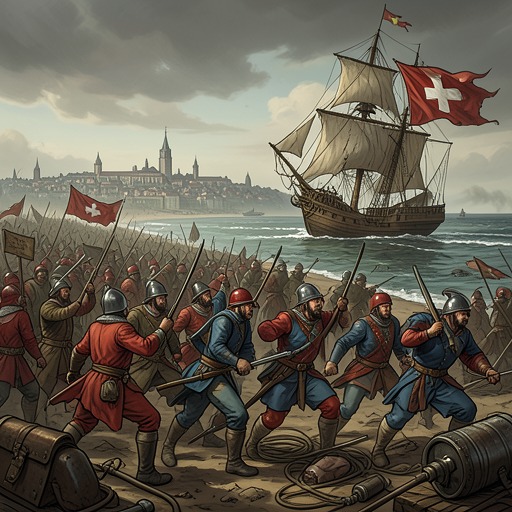
The siege of La Rochelle gives this private antagonism the scale of national policy. La Rochelle is the last major refuge of the Huguenots and the last French port open to the English. Its destruction would weaken French Calvinism and close an avenue through which England could intervene. Yet the narrative also insists that Richelieu’s personal motive remains active within these public aims: in combating England, he combats Buckingham; in triumphing over England, he triumphs over Buckingham; and in humiliating England before Europe, he humiliates Buckingham before Anne of Austria.
Buckingham’s motives mirror Richelieu’s. He claims to defend the honor of England, but the narrative presents him as pursuing private vengeance as well. He cannot enter France as an ambassador and therefore wishes to enter as a conqueror. The resulting war is described with deliberate irony: two powerful kingdoms expend military force for the satisfaction of two amorous rivals, while the real prize is only a favorable look from Anne of Austria. Their relationship does not soften political conflict; it intensifies it by giving national hostility an intimate emotional center.
Threats, Surveillance, and Consequences
Richelieu’s knowledge of the relationship is a weapon. He instructs Milady the English spy to tell Buckingham that he knows the preparations being made against France and that he can ruin the queen at the first step Buckingham takes. The threat depends on proofs, not merely suspicion. Richelieu also claims control over Montague, who is imprisoned in the Bastille, and invokes the possibility that torture may make him reveal what he knows—or what he does not know.
The most dangerous evidence is a letter from Madame de Chevreuse that Buckingham allegedly left behind when he hurried away from the Isle of Ré. Richelieu says that the letter compromises the queen because it appears to prove both that she can love the king’s enemies and that she can conspire with the enemies of France. The document turns the relationship into an accusation with two dimensions: sexual or emotional disloyalty to Louis XIII and political treason against France. Milady’s recollection of the ball, the Louvre night, the evening at Amiens, Montague’s arrest, and Madame de Chevreuse’s letter shows how separate incidents can be assembled into a prosecutorial narrative.
This pressure also reveals the relationship’s structural imbalance. Anne of Austria and Buckingham possess intimacy, memory, and tokens, but Richelieu controls courts, prisons, intelligence, and the machinery of accusation. The queen’s danger is not limited to exposure of her feelings; she faces the possibility that those feelings will be redescribed as conspiracy. The relationship survives in secrecy only by relying on intermediaries such as d’Artagnan, whose missions convert private trust into movement through a militarized and surveilled political system.
Narrative Significance
The relationship establishes the novel’s recurring contrast between loyalty and legality. Louis XIII’s government forbids fighting even while royal and cardinal factions cultivate armed rivalry, and the king’s official rules coexist with private rewards, backstairs audiences, and political exceptions. In the same way, Anne of Austria’s public position demands marital and dynastic conformity, while her private attachment generates acts of trust that cannot be acknowledged openly. The relationship exposes the distance between formal order and the personal forces operating beneath it.
Its objects also create a pattern of emotional value opposed to official value. The queen’s diamond studs are treated as evidence of courtly legitimacy and public appearance; Buckingham’s rosewood casket is precious because it preserves the memory of the beloved. The difference explains why the casket cannot be surrendered with the diamonds. One object serves the restoration of political appearances, while the other retains the emotional remainder of a relationship threatened by politics.
Most importantly, the Anne of Austria–Buckingham relationship enlarges the novel’s adventure plot into a meditation on the cost of turning love into strategy. Richelieu uses affection as leverage, Buckingham converts devotion into conquest, and the queen’s tokens become causes for pursuit and suspicion. The lovers’ bond is therefore both sincere and politically combustible: it inspires courage and loyalty in others, but it also gives their enemies the means to endanger the queen, provoke international conflict, and make a single private favor appear to govern the fate of kingdoms.