Armentières
The Three MusketeersArmentières is a small town on the Lys whose importance arises not from military prominence or political authority, but from its function as a concealed rendezvous and the last identifiable destination in the pursuit of Milady the English spy. A single place-name, first encountered in writing and then confirmed through questioning and travel, transforms uncertainty into a practical plan: the four companions can follow Milady's route, reach the town, and prepare to intercept her.
The Name as a Clue
Armentières first enters the action as a fragment of information rather than a fully described setting. When Porthos reads the name, he admits that he does not know the place; Athos immediately recognizes that the name is written in Milady's own hand. Its evidentiary force therefore lies in authorship as much as geography. The word is not merely a location on a map but a trace left by the fugitive herself, linking her movements to the pursuit.
The clue becomes decisive because it is deliberately innocuous. Milady explains that there is nothing compromising in the name of a town, and she can use it as a rendezvous without exposing the purpose of her correspondence. The apparent harmlessness of the place-name conceals its operational value: once the companions understand that Armentières is the meeting point, a neutral geographic term becomes the key to reconstructing her escape.
A Frontier Destination
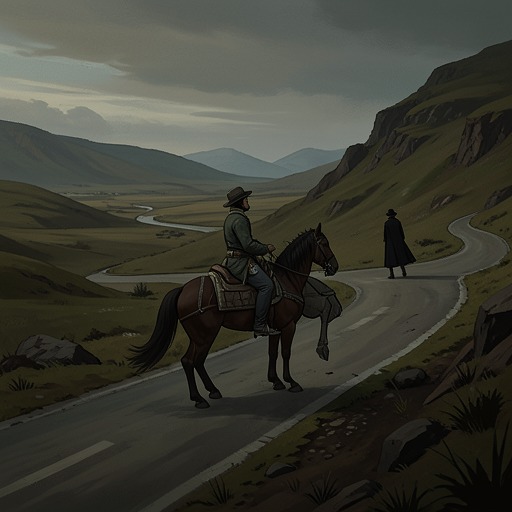
Armentières is described as a little town on the Lys. Its position matters because crossing the river places a traveler in a foreign country, giving the town a strategic significance beyond its modest size. For Milady, the locality offers proximity to a frontier and therefore the possibility of slipping beyond French control. The town belongs to a border landscape in which movement, concealment, and jurisdiction are closely connected.
The route to Armentières is established through a chain of physical and human evidence. Planchet follows the road, notices stains of blood, and identifies the places where the horses had stopped. At Festubert, he learns that a wounded man traveling with a woman in a post-chaise had been forced to halt after the vehicle was attacked in the wood. The man remained behind, while the woman obtained fresh horses and continued. The postillion then confirms that he carried the woman as far as Fromelles, after which she set out for Armentières.
The Rendezvous and the Pursuit
Planchet's investigation turns the town into a destination with an exact timetable. He reaches Armentières by seven o'clock in the morning and finds only one tavern, the Post. Disguised as a lackey seeking employment, he speaks with the tavern's occupants and learns that a woman had arrived alone at about eleven o'clock the previous night. She had taken a room, summoned the master of the hotel, and announced that she intended to remain in the neighborhood for some time.
This information confirms that Armentières is not simply the place Milady named in advance; it is the place where she has actually established a temporary refuge. Planchet does not need further inquiry. He hurries to the rendezvous, places lackeys as sentinels at every outlet of the hotel, and returns to Athos with the news just as the other companions come back. The town thus becomes a contained tactical space: its single inn and guarded exits turn an open pursuit into an impending capture.
From Private Escape to Public Conflict
Armentières stands at the intersection of Milady's personal flight and the wider political violence surrounding the Siege of La Rochelle. The siege is presented as the cardinal's effort to destroy the last major bulwark of French Calvinism and to close the last French port open to the English. English support, disrupted supplies, illness, rough seas, and the eventual expulsion of Buckingham's force establish the military pressure that gives Milady's movements their urgency.
The same political world also makes the town part of a larger network of secret messages and threatened lives. The Rochellais depend on Buckingham for relief, while the cardinal waits for news that Buckingham will not come. Against this background, Milady's escape is not an isolated criminal flight. D'Artagnan the younger has already deceived her in love, humiliated her pride, frustrated her ambition, damaged her fortune, deprived her of liberty, and threatened her life; he has also exposed the secret concealed beneath her mask and taken from her the carte blanche granted by Cardinal Richelieu. Armentières is where those personal and political struggles acquire a concrete geographical endpoint.
Narrative Significance
The town's narrative power comes from its sparseness. It is not elaborated through monuments, civic life, or spectacle. Instead, the Post, the road, the river, the frontier, and the guarded exits provide exactly the elements required for a pursuit narrative. Armentières is made legible through action: a name is read, a route is reconstructed, a wounded traveler is traced, a postillion is found, and a solitary woman is identified at the only tavern.
By the time the companions assemble there, the town has changed from an obscure name into a trap. Milady's intended anonymity has failed because her written rendezvous, her movements through Festubert and Fromelles, and her arrival at the Post can all be connected. Armentières therefore marks the transition from pursuit to confrontation. Its significance lies in the way geography, intelligence, disguise, and loyalty converge there, making a small frontier town the decisive threshold of Milady's capture.