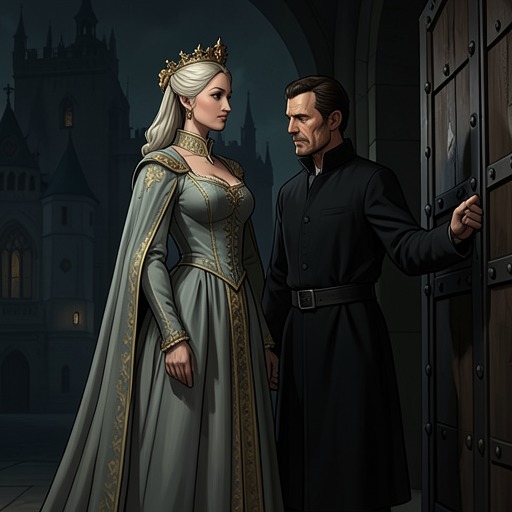
Assassination of George Villiers, 1st Duke of Buckingham
The Three MusketeersThe Assassination of George Villiers, 1st Duke of Buckingham is both a political murder and a private tragedy. It ends the life of England’s most powerful minister at the moment when he is preparing further military action against France, while also exposing the destructive convergence of Milady the English spy’s vengeance, Felton’s fanatic obedience, and Anne of Austria’s concealed love. The event turns the siege struggle around La Rochelle from a contest still shaped by hope and rescue into a catastrophe whose consequences cannot be recalled.
Political and Military Background
The assassination grows out of the larger conflict surrounding the Siege of La Rochelle. La Rochelle remained the last major refuge of French Calvinism after the other cities surrendered their protected status, and the cardinal sought to destroy it as a center where religious revolt, civil unrest, and foreign intervention could converge. Its harbor was also the last port in the Kingdom of France open to England. Closing it would weaken English access to the French coast and complete the political and military consolidation associated with the cardinal’s campaign.
Buckingham’s intervention was therefore not merely a straightforward act of national policy. He had arrived near the Isle of Ré with ninety vessels and nearly twenty thousand men, surprised the Comte de Toiras, and landed after a bloody conflict. The English force initially gained the advantage, but its position deteriorated under material pressure. The troops were living on salt meat and poor biscuit; illness spread through the camp; rough seas destroyed small vessels; and the coast filled with the wrecks of pinnacles, roberges, and feluccas. Even without a decisive French assault, the expedition was being pushed toward withdrawal.
The besieged inhabitants of La Rochelle continued to look toward Buckingham as their indispensable hope. A captured letter stated that unless aid arrived within fifteen days, the Rochellais would already be dead of hunger. Their dependence on him gave his presence an almost messianic force, while the cardinal waited anxiously for news that Buckingham would not return. The assassination consequently strikes at more than one man: it destroys the figure on whom the city’s remaining resistance had emotionally and strategically depended.
The Attack by Felton
The immediate scene takes place in Buckingham’s residence. Felton, acting under the influence of Milady the English spy, confronted the duke and refused to yield. When Buckingham called for help and sprang toward his sword, Felton was already prepared. He carried the knife with which Milady had staged her self-stabbing, held it open against his bosom, and crossed the room in a single rush.
At that instant Patrick entered with a letter from France. The announcement distracted Buckingham, who momentarily forgot the confrontation while wondering from whom the letter had come. Felton used that brief interruption to plunge the knife into Buckingham’s side up to the handle. Buckingham recognized the act as treachery and cried, "Ah, traitor," cried Buckingham, "you have killed me!" Patrick’s alarm brought the household into motion, while Felton fled through the adjoining chamber where deputies from La Rochelle were waiting.
Felton’s escape lasted only until he reached the staircase. Lord de Winter, already suspicious, seized him by the throat and condemned the delay that had allowed the attack to occur. He had learned that a rope ladder had floated from a castle window, found Milady’s room empty, and ridden to warn Buckingham as quickly as possible. He had arrived only a minute too late. The timing gives the murder its defining structure: warning exists, pursuit follows, and recognition comes, but each arrives after the decisive action has already occurred.
Buckingham’s Last Moments
The wound does not kill Buckingham immediately. He recovers consciousness, and for a short time hope returns to those around him. He asks to be left with Patrick and Monsieur Laporte, then addresses Lord de Winter and describes Felton as the strange madman sent to him that morning. The duke’s temporary recovery creates a brief reversal from apparent death toward possible survival, but the narrative quickly withdraws that hope.
Laporte reads the letter from France at Buckingham’s request because Buckingham can no longer see and fears that he may soon be unable to hear. The letter comes from Anne of Austria and asks him to countermand the armaments being prepared against France. It presents the public explanation of the conflict as religious, but identifies his love for Anne as its concealed cause. She warns that the war may bring catastrophe upon both England and France and asks him to protect his life, which will become dear to her once she is no longer forced to regard him as an enemy.
The letter makes Buckingham’s death more painful by arriving at the boundary between political hostility and personal reconciliation. His military enterprise has been linked to love, revenge, and national honor, yet Anne’s message offers the possibility that he might abandon the campaign and cease to be her enemy. Before any response can be made, the assassination has already rendered the appeal useless. Buckingham attempts a final smile, but death interrupts the gesture; the surgeon arrives from the admiral’s ship, takes the duke’s hand, and declares that all treatment is useless. Buckingham is dead, and the palace and town fall into consternation and tumult.
Causes, Agency, and Reversal
The murder is enabled by Milady’s campaign against Buckingham and by her wider struggle with d'Artagnan the younger. D'Artagnan has deceived her in love, humiliated her pride, obstructed her ambition, damaged her fortune, deprived her of liberty, and threatened her life. He has also exposed part of the secret identity concealed beneath her mask. In Milady’s eyes, Buckingham is not simply an enemy of France: he is a figure bound to the people she hates and to the political danger represented by the queen’s affection for him.
Milady has obtained from Cardinal Richelieu a carte blanche with which she intends to take vengeance on her enemies. Yet d'Artagnan has prevented her from using it and has helped place her under restraint. Her defeat changes the direction of her power. Unable to strike openly, she works through Felton, whose susceptibility allows her private vengeance to become a political assassination. The knife is therefore both a physical weapon and a transferred instrument of agency: Milady’s staged wound becomes the means by which Felton kills Buckingham.
The event’s value shift is absolute. Buckingham begins the scene as an armed political leader, still capable of receiving a message that might end the war; he ends it mortally wounded, then dead. Felton begins as an apparent subordinate or prisoner of circumstance and becomes the immediate agent of irreversible violence. Lord de Winter’s protective action is morally and practically sincere, but his arrival is marked by the repeated recognition that he has come too late. The assassination thus converts vigilance into helpless witness and turns the possibility of peace into final loss.
Consequences and Narrative Significance
Buckingham’s death removes the central English force behind relief for La Rochelle. The siege had already been shaped by hunger, sickness, wrecked shipping, and the failure of English endurance. After the murder, the city’s hope in Buckingham is severed at its source. The political struggle that had been animated by the rivalry between Cardinal Richelieu and Buckingham, and complicated by Buckingham’s love for Anne of Austria, loses its most important personal and military counterweight.
The murder also confirms the destructive logic governing Milady’s world. She has been exposed, defeated, and deprived of the freedom and authority on which her power depended, but her retaliation still reaches across national and military boundaries. D'Artagnan’s victory over her is therefore double-edged: he ruins her immediate plans, yet the pressure created by that victory helps drive her toward a murder that kills Buckingham before her own downfall is complete.
For Buckingham, the final irony is that the letter asking him to abandon the war arrives during the attack itself. The war’s ostensible religious justification and its concealed romantic motive are placed side by side, but neither can now be disentangled from bloodshed. His death is consequently not only the end of a political career. It is the point at which love, vengeance, military ambition, and private manipulation collapse into one irreversible act.