Athos's mistaken arrest
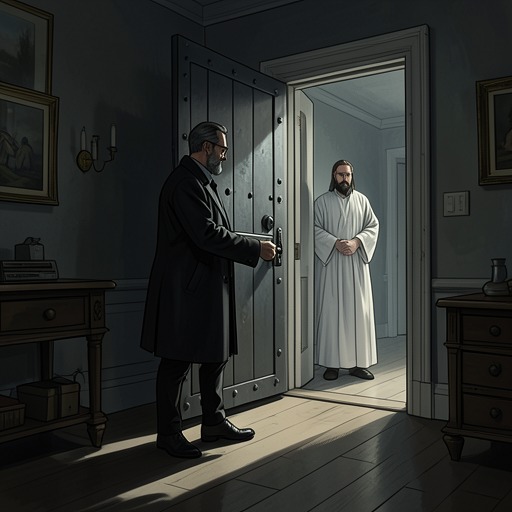
The Three MusketeersAthos's mistaken arrest is the moment when a police error becomes an act of conscious self-sacrifice. After promising Madame Bonacieux that he would not follow or spy upon her, d'Artagnan keeps his word and returns to the Rue des Fossoyeurs, where Planchet tells him that Athos has been arrested in his lodging. The Guards have taken Athos for d'Artagnan, but Athos has chosen not to correct them: he accepts imprisonment so that his friend, who knows the real danger surrounding the affair, can remain at liberty.
The Arrest and Its Immediate Cause
D'Artagnan reaches his lodging after separating from Madame Bonacieux under circumstances that already suggest surveillance and danger. She has disappeared behind a door after giving three light, regular knocks, while d'Artagnan, bound by his promise, refuses to watch where she goes or who accompanies her. His return therefore carries a double significance: he has preserved his word, but he has also left himself ignorant of the movement that may determine his fate.
Planchet's report abruptly replaces this uncertainty with a more immediate crisis. Athos is under arrest, and the reason is simple but perilous: the officers found him in d'Artagnan's lodging and assumed that he was the young Gascon. The arrest is not an isolated misunderstanding. Guards have been brought by the men in black whom d'Artagnan earlier put to flight, linking the seizure of Athos to the wider political and clandestine operation directed against d'Artagnan and his associates.
Athos's Deliberate Substitution
Athos does not defend himself by stating his name or denying knowledge of the affair. Instead, he approaches Planchet and insists that d'Artagnan is the man who needs liberty, while Athos knows nothing and can afford to remain in custody. He expects that the authorities will believe d'Artagnan has been captured, giving d'Artagnan time to act; after three days, Athos plans to reveal his identity and expects that the authorities will then have no reason to keep him.
This decision changes the meaning of the arrest. What begins as mistaken identity becomes a calculated exchange of freedom for safety. Athos treats his own imprisonment as a temporary resource that can be spent on behalf of a friend. His restraint is especially striking because he does not know the full affair and cannot be certain that the authorities will honor the logic of his plan. He acts nonetheless, placing loyalty above self-protection and allowing d'Artagnan to continue the mission that Athos himself cannot yet understand.
The Search of the Lodging
The arrest is followed by a systematic intrusion into d'Artagnan's private space. Four officers carry Athos away, though Planchet cannot determine whether he has been taken to the Bastille or Fort l'Eveque. Two others remain with the men in black and search every part of the lodging, removing all the papers they find. The final two guards keep watch at the door while the examination continues.
Once the search is complete, the officers leave the house empty and exposed. The consequence is therefore broader than Athos's removal. D'Artagnan loses his papers, his lodging is compromised, and the enemy demonstrates that it can penetrate the companions' domestic refuge as easily as it can pursue them in the street. The uncertainty over Athos's destination deepens the danger: the rescue problem is immediate, but the confiscated papers may also reveal the network of relationships and plans that the searchers are trying to uncover.
Loyalty, Knowledge, and Freedom
D'Artagnan's response is not merely alarm. On hearing Athos's explanation, he praises him as a noble heart because the act confirms what he already understands about Athos's character. Athos's loyalty is expressed through a peculiar form of silence: he withholds the name that would free him, while d'Artagnan's own loyalty has just been expressed through obedience to Madame Bonacieux's request not to follow her. Both men are therefore caught between secrecy and trust, but Athos uses secrecy to protect a comrade rather than to conceal an independent design.
The episode also establishes freedom as a divisible value within the fellowship. Athos's liberty is surrendered so that d'Artagnan's may continue; d'Artagnan's freedom, in turn, carries an obligation to use the time Athos has purchased. The arrest thus binds the men more tightly even while physically separating them. It is a practical demonstration of the comrades' code before that code is reduced to a slogan: one man bears the danger so that another can pursue the common cause.
Narrative Consequences and Significance
Athos's mistaken arrest advances the plot by removing one of d'Artagnan's strongest allies at the exact moment when the young man is entangled in the disappearance and secret movements surrounding Madame Bonacieux. It also provides the authorities with a temporary illusion that d'Artagnan has been captured, creating the interval in which he can move freely. The same deception that threatens the companions therefore gives d'Artagnan an unexpected advantage.
The episode's irony lies in the contrast between the officers' confidence and their ignorance. They believe they have taken the man they seek, yet their prisoner has deliberately allowed the error to stand. Athos understands that identity, in a world of warrants, informers, and searches, can function as a weapon. By accepting the wrong identity, he turns the machinery of persecution against itself, at least for a limited time.
Athos's later conduct reinforces the episode's importance. When he speaks privately with d'Artagnan, he is capable of recounting painful and obscure matters, but the narrative also presents him as a man who can return to his usual impenetrability after revelation. That contrast clarifies the arrest: his self-sacrifice is not an accidental impulse but part of a larger pattern in which reserve, endurance, and controlled action protect the fellowship. The mistaken arrest consequently stands as an early, concrete expression of the deep partnership between Athos and d'Artagnan, and of the principle that one companion's captivity can become another's chance to act.