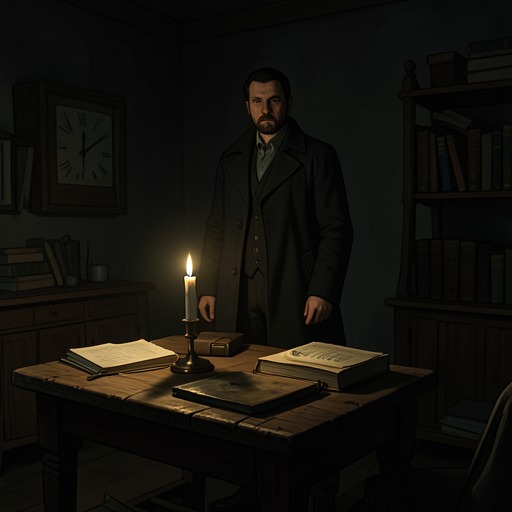
Athos's story of the fair lady
The Three MusketeersAthos's story of the fair lady is the closest approach the narrative permits to Athos's concealed past. Told during a night of heavy drinking to d'Artagnan, it presents a beautiful young woman as both apparent angel and marked criminal, and links Athos's distrust of romantic love to an act of private execution. The story's decisive force lies in its unstable form: Athos calls the woman the wife of a friend, yet abandons that fiction at the end, while his renewed denials the next morning turn confession into a dangerous half-revelation.
The Drunken Confession
Athos introduces the tale after d'Artagnan complains of his own misfortune. He dismisses the young man's troubles as laughable beside a real tale of love and, after d'Artagnan insists that he wishes to hear one, begins with emphatic distancing. The woman, he says, belonged to the story of one of his friends, not to himself; the friend was one of the counts of Berry, a man of the highest rank, and therefore not an ordinary lover overwhelmed by circumstances. Yet Athos's melancholy smile, his rapid shifts of tone, and his growing intoxication make the disclaimer visibly fragile. The story sounds less like casual entertainment than like a wound approached through disguise.
The count is described as twenty-five years old when he fell in love with a girl of sixteen. She is beautiful, intellectually ardent, and poetically gifted, living in a small town with a brother who served as a curate. The pair had recently arrived from an unknown place, but their beauty, piety, and supposedly good extraction discouraged questions about their origin. The count, as seigneur of the province, possessed the power to seduce the girl or take her by force, since few would have defended two obscure strangers. Athos makes the decisive moral contrast explicit: the count was honorable, so he married her. He then brought her to his chateau, raised her to the position of first lady in the province, and acknowledged that she carried her rank with becoming dignity.
Discovery of the Brand
The apparent romance turns during a hunt. The countess falls from her horse and loses consciousness. When the count rushes to help her, he sees that her clothing seems to oppress her and cuts it open with his poniard. The gesture intended as assistance exposes the hidden mark on her shoulder: a fleur-de-lis. Athos names the discovery with shocking brevity and then explains that she had been branded. The mark transforms every earlier sign of innocence. Her youth, beauty, poetic intelligence, and religious surroundings no longer guarantee virtue; they become part of a mask whose meaning the count had failed to recognize.
The revelation is not presented as a carefully verified legal finding. Athos says that the young woman was a demon and that she had stolen sacred vessels from a church, but the account provides no independent witness, trial, or explanation of the branding. Its authority comes from the horror of the scene and from Athos's emotional certainty rather than from public evidence. The fleur-de-lis therefore functions in two ways at once: it is a sign of an officially condemned criminal identity, and it is the object around which a private catastrophe has been organized. Later revelations about Milady the English spy make the story's concealed identity legible, but the tale itself remains shaped by concealment and delayed recognition.
The Hanging and Its Immediate Consequences
Once the count sees the brand, he does not surrender his wife to a court. Athos states that the count possessed on his estates the rights of high and low tribunals. He tears the countess's dress to pieces, ties her hands behind her, and hangs her from a tree. The action is presented as an exercise of seigneurial jurisdiction, but its emotional character is unmistakably personal. A husband who had elevated the girl into provincial nobility becomes her judge and executioner. The value of marriage, honor, and aristocratic authority reverses into violence, death, and irreversible guilt.
D'Artagnan recognizes the act as murder, and Athos does not meaningfully deny it. He grows as pale as a corpse, demands wine, and empties the last bottle in a single draught. Afterward he lets his head sink into his hands while d'Artagnan stands stupefied. The physical behavior supplies the confession's most reliable evidence: drinking, pallor, silence, and collapse reveal a burden that the polished fiction of an unnamed count cannot contain. Athos finally says that the experience cured him of beautiful, poetic, loving women and wishes d'Artagnan the same cure. The conclusion is not merely cynical. It converts a particular execution into a general renunciation of romantic idealism.
The Morning Denial
The following morning d'Artagnan remembers Athos's words with extraordinary clarity, despite the three or four bottles of Burgundy that had clouded the conversation. The uncertainty of the circumstances does not erase the memory; instead, it intensifies d'Artagnan's desire to know what really happened. He approaches Athos determined to resume the subject, but finds him sober, shrewd, and impenetrable. Athos himself raises the matter first, admitting only that he had been very drunk and might have spoken a thousand extravagances.
When d'Artagnan recalls that they had spoken of hanging, Athos claims that the hanging of people is his nightmare. When d'Artagnan specifies that the subject was a woman, Athos grows almost livid, calls it his grand story of the fair lady, and says that he must be very drunk whenever he relates it. D'Artagnan adds the remembered details of a tall, fair woman with blue eyes, but Athos does not confirm the history. The scene thus produces a narrative structure based on delayed recognition: the first telling exposes the secret through disguise, while the second attempts to seal it again through sobriety, irony, and strategic ambiguity.
Narrative Function and Thematic Meaning
Athos's story is a tale within the main narration, but it is not a stable tale. Its teller is compromised by alcohol, its central identity is concealed, and its facts are filtered through a self-protective third-person fiction. The next day's denial does not cancel the confession; it makes the reader weigh the two versions against one another. This unreliable presentation prepares the larger revelation of Milady's history, in which she repeatedly uses stories of persecution to control listeners. Milady tells Felton that, as a young and beautiful woman, she resisted snares, violence, religious insults, and attempts to defile her body permanently. At the Carmelite convent of Bethune, she likewise seeks sympathy by claiming persecution from the cardinal, while warning that a former friend betrayed her after she spoke against him.
The contrast between Athos's drunken confession and Milady's persuasive self-narration is central. Athos's story is broken by shame, intoxication, and silence; Milady's is designed to produce belief and action. Yet both accounts center on the fleur-de-lis, on the collision between outward innocence and a hidden past, and on the power of narration to determine who appears victim or criminal. The executioner of Lille later confirms that Milady had once been a beautiful young woman and a nun at the Benedictine convent of Templemar, establishing that the branded woman has a history extending beyond Athos's private memory. The story of the fair lady therefore operates as both confession and foreshadowing: it reveals the emotional origin of Athos's despair while withholding enough information for the later recognition to remain devastating.
Its final significance lies in the failure of noble authority and romantic faith to protect either husband or wife. The count's honor leads him to marry; his aristocratic judicial rights then enable him to kill. Athos's attempt to master the memory by calling it a friend's story fails because the narrative returns through his body, his drinking, his pallor, and his inability to answer d'Artagnan plainly. The event does not offer a clean moral verdict. It leaves a private execution standing beside a public symbol of criminality, and leaves Athos suspended between remorse, self-justification, and the conviction that love itself has been exposed as a fatal deception.