Ballet of La Merlaison
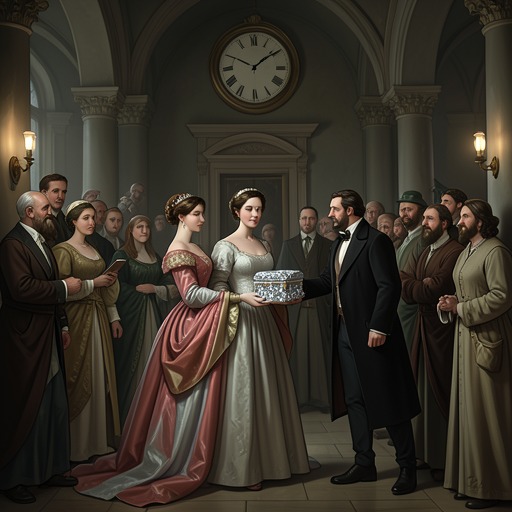
The Three MusketeersThe Ballet of La Merlaison is the royal ball at which Anne of Austria must appear wearing the twelve diamond studs demanded by Louis XIII. Beneath its elaborate ceremony, music, costumes, and public magnificence, the event is a tightly staged confrontation among the queen, the king, Cardinal Richelieu, and the concealed network of loyal agents that includes d’Artagnan. The ballet’s decisive significance lies in its transformation of political suspicion into a visible spectacle: the queen’s jewels become evidence, the dance becomes an examination, and a court entertainment becomes a contest over who can control appearances.
Preparation and Courtly Setting
Eight days of preparation turned the Hotel de Ville into a ceremonial stage for the favorite ballet of Louis XIII. City carpenters erected platforms for the invited ladies, the city grocer decorated the chambers with two hundred white-wax flambeaux, and twenty violins were engaged to play throughout the night. Fifty archers and two companies of Guards, one French and one Swiss, were distributed through the building before the guests arrived, giving the celebration a distinctly military perimeter beneath its festive surface.
The guests entered from six o’clock onward and were placed on the prepared platforms. At nine, Madame la Premiere Presidente arrived and received a place opposite the box reserved for the queen. At ten, the king’s collation of preserves and other delicacies was prepared beside the church of St. Jean and guarded by four archers. At midnight, cries and acclamations announced Louis XIII’s passage from the Louvre to the Hotel de Ville through streets illuminated by colored lanterns. The aldermen, in cloth robes and preceded by sergeants carrying flambeaux, met him at the steps, where the provost of the merchants delivered a welcoming speech.
The king arrived in full dress with a large retinue, but observers noticed that he looked dull and preoccupied. Private rooms had been prepared for him, Monsieur, the queen, and Madame the President, with masquerade costumes waiting inside. The choreography of arrival, reception, dressing, and dance therefore established two simultaneous realities: the public celebration of royal magnificence and the private anxiety of a court awaiting the result of the diamond test.
The Queen’s Arrival and the Threat of Exposure
Half an hour after Louis XIII entered, Anne of Austria arrived. Like the king, she appeared dull and weary, a visible sign that the ball was not merely a diversion. At the moment she entered the great hall, a previously closed gallery was opened and Cardinal Richelieu appeared dressed as a Spanish cavalier. His eyes fixed on the queen, and his smile expressed a terrible satisfaction because she was not wearing the diamond studs.
The cardinal’s appearance made the political nature of the entertainment unmistakable. He did not need to accuse Anne of Austria openly; the absence of the jewels created the accusation for him. The queen received the compliments of the city officials while the cardinal watched, and then Louis XIII appeared beside him, pale as the cardinal spoke to him in a low voice. The king crossed the hall without a mask, his doublet ribbons scarcely tied, and demanded that the queen explain why she had failed to wear the studs when she knew that doing so would please him.
Anne of Austria answered that, amid such a crowd, she had feared an accident might happen to the jewels. Louis XIII ordered her to send immediately to the Louvre for them, insisting that the ballet would begin within an hour. She submitted and withdrew with the ladies assigned to conduct her to her room. The low voices of the exchange prevented the assembly from understanding the cause of the disturbance, but everyone perceived that something serious had passed between the royal couple. Even when the violins began playing at full strength, the music could not dispel the tension.
The Hidden Mission Behind the Jewels
The queen’s apparent failure was the final danger in a chain of secret movements. The Duke of Buckingham had come to Paris because of a forged message falsely attributed to Anne of Austria. Once he discovered the trap, he refused to leave without seeing her, and Anne initially resisted before deciding that his exasperation might lead him into folly. The mission by which Madame Bonacieux was to bring him into the Louvre had already been delayed because she had been abducted for two days. After her release and renewed contact with Monsieur Laporte, she completed the perilous undertaking.
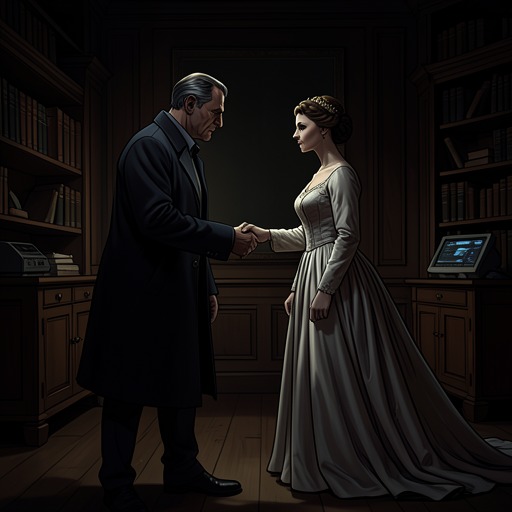
Anne of Austria received Buckingham in a hidden apartment of the Louvre, where Madame Bonacieux led him through servants’ passages and locked him in until someone came. Buckingham, accustomed to adventure and romance, did not lose courage even after recognizing that the forged message had been a snare. When Anne of Austria came to him, she gave him the rosewood casket bearing her cipher encrusted with gold as a remembrance. That private gift intensified the danger surrounding the later public ceremony: the queen’s jewels were not merely ornaments but tokens moving through a clandestine political and emotional network.
The recovery of the studs depended on the same covert chain. Buckingham had given d’Artagnan a chamber adjoining his own so that the young man could remain close while Buckingham spoke of the queen. An English ordinance then prohibited every vessel bound for France from leaving port, including the packet boat carrying letters; to everyone, this appeared to announce war between the two kingdoms. Nevertheless, two replacement studs were completed so perfectly that Buckingham himself could not distinguish them from the originals. He gave them to d’Artagnan, while retaining the rosewood casket because it was the more precious object left to him.
D’Artagnan’s return to France completed the race against the ball. He changed horses at Eccuis and Pontoise and reached M. de Treville’s hotel after covering nearly sixty leagues in a little more than twelve hours. The public spectacle at the Hotel de Ville therefore rested on an unseen journey across political borders, with the duplicated jewels serving as the material proof that the secret mission had succeeded.
The Ballet as Political Examination
Once the queen had returned in costume, her appearance converted uncertainty into suspense. She wore the dress of a huntress: a beaver hat with blue feathers, gray-pearl velvet fastened with diamond clasps, and a blue satin petticoat embroidered with silver. On her left shoulder, attached to a bow matching the blue of her plumes and petticoat, shone the diamond studs. From their distance, Louis XIII and the cardinal could not count them. The entire crisis narrowed to a single question: were there ten or twelve?
The violins gave the signal, and the ballet began. Louis XIII danced facing the queen, while Monsieur danced with her. Each time the king passed Anne of Austria, he devoured the studs with his eyes, trying to determine their number. The cardinal, by contrast, watched in mounting anxiety; a cold sweat covered his brow. The dance thus made royal intimacy into surveillance. Every formal passage offered the king another opportunity to inspect the queen, while the cardinal’s position changed from confident observer to threatened participant.
The ballet lasted an hour and contained sixteen entrées. Its duration prolonged the uncertainty, but its conclusion brought the decisive revelation. After the applause, Louis XIII used the privilege of leaving his assigned partner and hurried toward the queen. He told her that he thanked her for obeying his wishes but believed that she lacked two studs, which he had brought back to her. He then held out the two studs supplied by the cardinal.
Anne of Austria answered with feigned surprise that the king was giving her two more and that she would therefore possess fourteen. Louis XIII counted the jewels and found all twelve studs already on her shoulder. The supposed proof of the queen’s failure became proof of her success. The cardinal’s attempt to expose her had been neutralized by the recovered set, while the two additional studs revealed nothing except his own intervention.
Aftermath and Significance
Louis XIII summoned Cardinal Richelieu and demanded an explanation. Richelieu replied that he had wished to present the queen with the two studs and, lacking the courage to offer them directly, had adopted this method to induce her to accept them. Anne of Austria answered with a smile that showed she was not deceived by the ingenious gallantry. She added that she was especially grateful because she was certain that those two studs alone had cost the cardinal as much as all the others had cost the king.
Her response preserved courtly manners while reversing the balance of power. She neither confessed the secret journey nor exposed the political conspiracy behind the jewels. Instead, she accepted the cardinal’s public fiction and turned it against him, making the expense of his attempted maneuver part of his humiliation. The king’s suspicion was also redirected: the twelve studs demonstrated that the queen had met his demand, while the cardinal was left to explain why he possessed two more.
The queen then saluted the king and the cardinal and returned to the chamber where she had dressed. The narrative’s attention shifts at this point to d’Artagnan, who stood confounded and unknown in the crowd, watching a scene comprehensible only to four people: Louis XIII, Anne of Austria, Cardinal Richelieu, and himself. His invisibility is essential to the event’s structure. He is the agent who made the triumph possible, yet the court can recognize only the visible result and not the danger, speed, and loyalty that produced it.
The ballet also clarifies the broader political world in which the episode occurs. Louis XIII and Richelieu publicly condemned duels and disorder while competing through rival bodies of elite swordsmen, and the king’s favor depended upon devoted service even when an edict formally prohibited fighting. In that setting, the La Merlaison celebration does not restore ordinary order so much as stage its temporary appearance. The jewels, like the rosewood casket, the queen’s gift to d’Artagnan, the money given by the king, and the later commission offered by Richelieu, circulate as instruments of obligation and power. The ballet is therefore both a festive performance and a test of competing loyalties, ending with Anne of Austria’s public triumph, Richelieu’s temporary defeat, and d’Artagnan’s secret vindication.