Battle of Bastion Saint-Gervais
The Three MusketeersThe Battle of Bastion Saint-Gervais is one of the defining military episodes of the Siege of La Rochelle: Athos, Porthos, Aramis, and d'Artagnan occupy an abandoned bastion, withstand repeated attacks, and convert an apparently reckless breakfast wager into a tactical victory. Its decisive significance lies in the contrast between the small scale of the action and its widening consequences. What begins as a test of courage becomes a demonstration of the four companions' unity, earns them the admiration of the army, and prompts Cardinal Richelieu to draw d'Artagnan into the same company as his three friends.
Strategic Background
The action takes place within a siege whose stakes extend far beyond one fortification. La Rochelle is presented as the last remaining stronghold granted to the French Huguenots after the other Calvinist cities had fallen. Its survival links religious resistance with civil revolt and foreign intervention, while its harbor remains the last French port open to England. For Cardinal Richelieu, taking the city would therefore suppress a domestic political danger and close an important channel through which England could assist France's enemies.
The international character of the conflict makes the military situation especially unstable. Spaniards, Englishmen, Italian malcontents, adventurers, and soldiers of fortune from many confessions have gathered under the Protestant standard, turning La Rochelle into a European network of opposition rather than an isolated rebellious city. England's intervention gives the siege a maritime dimension, and the presence of the English fleet makes the struggle over the surrounding positions inseparable from the larger contest between the two kingdoms.
Before the Bastion Saint-Gervais episode, Buckingham has landed on the Isle of Ré with ninety vessels and nearly twenty thousand men. After surprising the Comte de Toiras and forcing him, following a bloody engagement, into the citadel of Saint-Martin, Buckingham maintains pressure on the French position. The English, however, suffer from inadequate provisions and deteriorating conditions: their soldiers live on salt meat and poor biscuit, many are invalid, and rough seas destroy vessels along the coast. Wreckage covers the shore from the point of l'Aiguillon toward the trenches. These logistical pressures make a French counterstroke increasingly possible, even before the four Musketeers turn one bastion into their private battlefield.
The Wager and the Seizure
The immediate episode follows the taking and dismantling of the bastion. When d'Artagnan returns to the lodgings of his three friends, Athos is meditating, Porthos is twisting his mustache, and Aramis is praying from a small blue-velvet Book of Hours. The contrast captures the companions' different temperaments, but it also establishes their common readiness for danger. Athos proposes that the four men go to the Bastion Saint-Gervais, eat breakfast there, and remain for an hour by the watch, whatever the enemy does to dislodge them.
The proposal is framed as a wager with M. de Busigny, a dragoon, and a Swiss light-horseman. Athos bets not merely his own life but the collective endurance of Athos, Porthos, Aramis, and d'Artagnan. d'Artagnan immediately recognizes the lethal risk, fearing that Athos is about to get them all killed, yet the group accepts the challenge. The wager turns military exposure into a question of honor: retreat before the appointed hour would mean losing publicly, while remaining would require the four men to rely on discipline and one another rather than on numerical strength.
When they reach the bastion, they discover that it is occupied only by about a dozen corpses, French and Rochellais. Athos assumes command and orders Grimaud to prepare the table while the others collect the guns and cartridges. The dead become part of the practical landscape of the action: the living must secure weapons among bodies before they can eat, and the proposed meal becomes a deliberately ordinary ritual performed inside a place marked by recent violence. Their calm is not ignorance of danger but a chosen posture toward it.
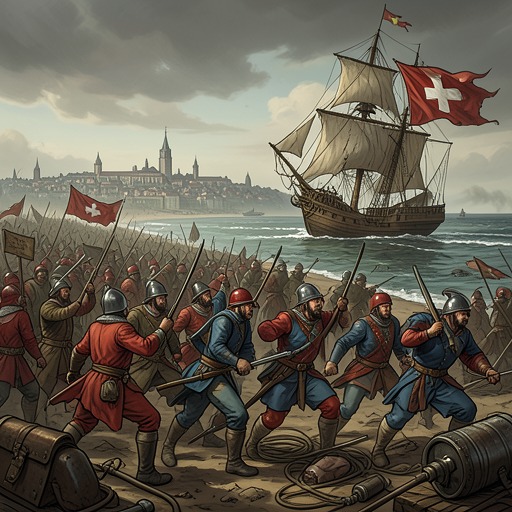
The first attack tests that posture. Four shots strike around Athos, flattening themselves against the wall without touching him. The reply is immediate and accurately aimed: three soldiers are killed and one pioneer wounded. Athos calls for another musket; Grimaud supplies it at once, while the three companions reload. Their second discharge kills the brigadier and two pioneers, causing the remainder of the attacking troop to flee. Athos then orders a sortie, and the four friends rush from the fort, recover the enemy's four muskets and the brigadier's half-pike, and return with these trophies. The action is therefore both defensive and aggressive: they do not merely survive an assault but exploit the enemy's retreat to improve their own position.
Back inside the bastion, the companions reload and resume breakfast as though the interruption had been minor. That recurrence of the meal gives the episode its peculiar rhythm. Food, conversation, and military violence alternate without any of them wholly displacing the others. The breakfast is a sign of composure, but it is also a measure of time: the wager is not won simply by defeating one troop, since the four must continue to hold the position until the promised hour has passed.
The Assault and the Turning Point
The enemy renews the attack in greater numbers. The four muskets produce a single report, and four men fall. A drum sounds, and the Rochellais advance at charging pace. The companions' fire remains precise; at least two men fall for every three shots, yet the advancing troop does not slow. The scene shifts from a private contest of marksmanship to a test of whether individual accuracy can stop massed momentum.
By the time the attackers reach the foot of the bastion, more than a dozen remain. A final volley fails to halt them. They leap into the ditch and prepare to scale the breach, bringing the confrontation to its most dangerous point. Athos responds by directing the companions to the wall. Assisted by Grimaud, the four men push with their musket barrels against a large sheet of masonry. The wall bends, detaches from its base, and crashes into the ditch, burying or disabling the attackers beneath a cloud of dust. The fort's physical structure becomes their final weapon: instead of waiting for the enemy to climb into the bastion, they collapse the breach upon the assault itself.
Only three or four of the attackers, covered in dirt and blood, escape along the hollow way and regain the city. Athos then looks at his watch and declares that the four have remained for an hour and won the wager. Even at that moment he insists on fairness, noting that d'Artagnan has not yet given his own idea. The victory is thus not treated as an excuse for haste or self-congratulation. Athos reseats himself before the remains of breakfast, preserving the coolness with which he has commanded the entire action while the battlefield around him records the cost of the wager.
Public Triumph and Institutional Consequences
The four men’s return transforms a dangerous improvisation into a public spectacle. More than two thousand people in the camp have watched the undertaking without understanding its private motive, and their response is immediate: cries acclaim the Musketeers and the Guards, while M. de Busigny first shakes Athos’s hand and admits that the wager is lost. The soldiers’ congratulations, embraces, and laughter at the expense of the defeated Rochellais give the action a communal afterlife. What had begun as four men’s wager is absorbed into the army’s culture of admiration, where audacity becomes reputation and reputation becomes power.
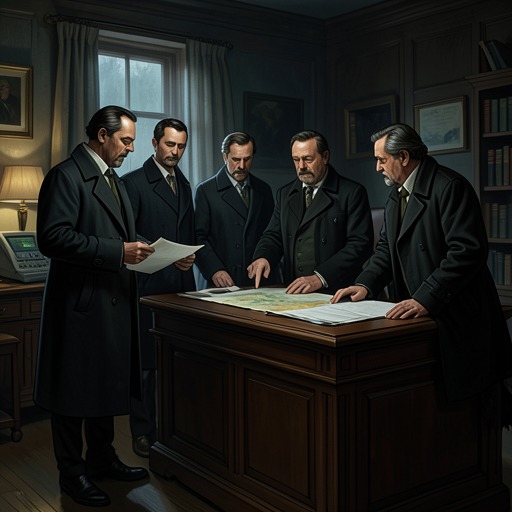
The commotion grows so great that Cardinal Richelieu suspects a riot and sends La Houdinière, his captain of the Guards, to investigate. Once the exploit is explained, the cardinal recognizes not merely a successful skirmish but a concentration of military value in the four companions. He identifies Athos, Porthos, Aramis, and d'Artagnan as men who ought to be on his side, even though the first three serve under M. de Treville and d'Artagnan under Monsieur Dessessart. The cardinal’s remark reveals the political meaning of the spectacle: battlefield distinction can unsettle the division between rival companies and even attract the attention of the kingdom’s most powerful minister.
That evening, Richelieu recounts the exploit to M. de Treville, who supplies the details, including the episode of the napkin. Richelieu proposes having the napkin embroidered with three fleur-de-lis in gold and presenting it to the company as a standard. The proposed emblem would convert an improvised breakfast and a private wager into an official military sign, preserving the action within the institutional memory of the royal army. M. de Treville objects that such recognition would be unjust to the Guards, because d'Artagnan is not yet one of his Musketeers.
Richelieu resolves the objection by ordering M. de Treville to take d'Artagnan into the company. The order is not simply a reward for courage; it reunites the four friends within the same military structure. M. de Treville announces the decision that evening and invites all four to breakfast the next morning. d'Artagnan is overwhelmed with joy because becoming a Musketeer has long been the dream of his life, while Athos, Porthos, and Aramis are equally pleased. The battle therefore produces a lasting change in status: d'Artagnan’s partnership with the three veterans, previously secured by adventure and loyalty, is now recognized by formal service.
Tactical Meaning and Value Shift
The action’s tactical logic depends on the conversion of scarcity into advantage. The four defenders possess neither a large force nor the security of a permanent garrison; they rely on the bastion’s walls, the weapons left among the dead, Grimaud’s rapid obedience, and their own coordinated fire. After the first attackers retreat, the companions collect four muskets and the brigadier’s half-pike, immediately enlarging the resources with which they can resist the next assault. Their discipline makes every shot consequential, while the attackers’ numerical superiority becomes vulnerable to the bastion’s confined approach and unstable breach.
The decisive shift is from a wager that appears to stake only honor to a victory that secures life, weapons, prestige, and position. At the beginning, d'Artagnan fears that Athos’s idea will lead to the deaths of all four. During the action, the same choice gives them control over the abandoned fort, repels successive attacks, and leaves the enemy with only a few survivors. At the end, the wager’s value is no longer merely positive because they have endured an hour; it has multiplied through public acclaim and official recognition. The companions have made a military asset out of an act that the camp initially regarded as a wild undertaking.
The breakfast functions as the event’s recurring counterpoint to violence. Grimaud spreads the table among corpses, the friends eat while collecting and reloading weapons, and Athos returns to the remains of the meal after the final assault. This ritual does not erase the deaths around them. Instead, it dramatizes the men’s ability to impose order and fellowship upon a battlefield. Their composure is a form of tactical discipline, but it also establishes the distinctive code of the four: danger may interrupt their ordinary fellowship, yet it cannot dissolve it.
Place in the Siege of La Rochelle
The Battle of Bastion Saint-Gervais gains its wider significance from the material pressures of the Siege of La Rochelle. The French campaign is directed against the last remaining Huguenot stronghold, whose harbor permits English access to the French conflict. The siege thus combines religious division, royal consolidation, foreign intervention, naval logistics, and the private ambitions of powerful figures. The bastion episode is a small action within that enormous system, but its outcome illustrates how local control of fortified ground could contribute to the larger French effort.
The English position is already weakened by hunger, sickness, and maritime loss. Soldiers receive salt meat and poor biscuit, many are invalid, and rough seas destroy small vessels along the coast, leaving wrecks spread across the shore. These conditions make Buckingham’s continued presence on the Isle of Ré increasingly untenable. The four companions’ action does not itself decide the campaign, but it belongs to the sequence of French successes that forces the English expedition toward re-embarkation and leaves Cardinal Richelieu freer to continue the siege.
The broader contest remains entangled with intelligence and political suspicion. After the English withdrawal, the capture of Montague reveals a league joining the German Empire, Spain, England, and Lorraine against France, while papers abandoned in Buckingham’s lodging appear to compromise Madame de Chevreuse and, consequently, the queen. The siege therefore supplies the political pressure under which military exploits are interpreted. A bastion taken for a wager can become a symbol of royal strength; an envoy or a packet of papers can turn the same theater of war into evidence of treason.
Narrative and Thematic Significance
The battle crystallizes the four companions’ friendship as an operative force rather than a sentimental attachment. Athos commands, Porthos and Aramis answer his direction, d'Artagnan contributes both courage and judgment, and Grimaud’s service helps sustain their position. Their unity is visible in the synchronized firing that makes four muskets sound like one report and in the collective assault on the collapsing wall. The episode gives physical form to the principle of shared loyalty: each man’s survival depends on the others’ precision, courage, and obedience.
It also exposes the tension between gentlemanly honor and military necessity. The wager begins as a matter of reputation, yet the men’s survival requires calculated fire, ammunition recovery, fortification, and a precisely timed use of the wall. Their courage is not simple recklessness. Athos accepts danger, but he also assumes command, gathers resources, observes the watch, and refuses to leave before the hour is complete. Honor becomes credible because it is carried through practical action rather than separated from it.
Finally, the episode links personal adventure to political incorporation. Cardinal Richelieu’s admiration does not abolish the rivalry between the royal Musketeers and the Cardinal’s Guards, nor does it make the cardinal an ally of the four men in every matter. It does, however, show that exceptional action can cross institutional boundaries. d'Artagnan enters the Musketeers because the battle has made his existing friendship publicly legible as a military strength. The ending is therefore both celebratory and strategic: the four men win their wager, the army wins a story of valor, and the state gains a more tightly organized group of capable soldiers.