Battle of the Île de Ré
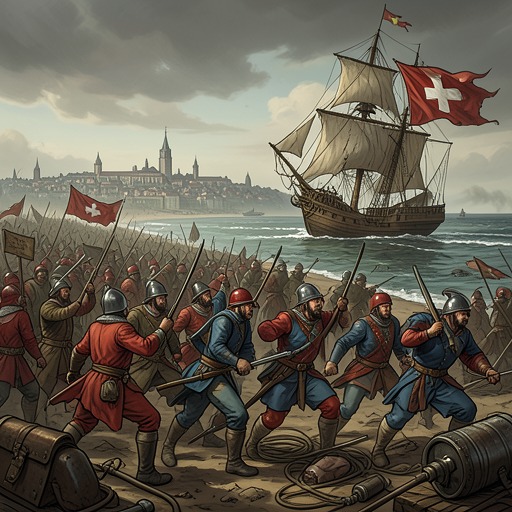
The Three MusketeersThe Battle of the Île de Ré, also remembered through the English defeat at the Passage of the Isle of Loix, was the turning point that transformed the siege of La Rochelle from a conflict threatened by English intervention into a campaign dominated by the forces of Louis XIII and Cardinal Richelieu. It was fought after the Duke of Buckingham had landed on the island with a large expedition, and it ended with the English beaten, forced to re-embark, and unable to prevent the French blockade and siege from continuing.
Causes and Strategic Background
The battle grew out of the wider struggle over La Rochelle, the last important city still serving as a refuge for the Huguenots after the other fortified places granted protection under Henry IV had been lost. Richelieu regarded the city as more than a rebellious stronghold: it was the remaining focus of Calvinist resistance, civil unrest, and foreign intervention. Its harbor was also the last port in France open to the English, so closing it would both weaken the Huguenot position and block English access to the French coast.
The conflict therefore joined religious policy, royal consolidation, and international rivalry. Spaniards, Englishmen, Italian malcontents, foreign adventurers, and soldiers of fortune from several confessions rallied to the Protestant cause, forming a network whose branches extended across Europe. Against this coalition, the French monarchy mobilized its army and naval works. The battle belonged to an Anglo-French struggle in which the stated interests of kingdoms were inseparable from the private passions of powerful individuals: the Duke of Buckingham sought both the honor of England and revenge, while his deeper stake was connected to his desire for a favorable glance from Anne of Austria.
The English Landing and French Response
Buckingham gained the first advantage by appearing unexpectedly before the Île de Ré with ninety vessels and nearly twenty thousand men. The scale and suddenness of the expedition surprised the Comte de Toiras, who commanded the island for the king. After a bloody conflict, Buckingham secured a landing. Toiras withdrew with his garrison into the citadel of Saint-Martin, while one hundred men were placed in the smaller fort of La Prée, preserving French positions from immediate collapse.
The landing accelerated Richelieu’s preparations for the larger siege. Until Louis XIII and Richelieu could personally direct the operations against La Rochelle, the king sent Monsieur to command the first movements and ordered every available troop toward the theater of war. d'Artagnan formed part of this vanguard. The king’s departure was delayed when fever forced him to stop at Villeroy, and because the Musketeers halted whenever the king halted, d'Artagnan was temporarily separated from Athos, Porthos, and Aramis. The military crisis thus also altered the pattern of the protagonists’ movements, placing d'Artagnan in the advancing force while his companions remained elsewhere.
Conditions Before the Decisive Action
Once the French command structure had been organized, the army set about driving the English from the island. The conditions favored France even before the final assault. English troops suffered from inadequate provisions, living on salt meat and poor biscuit, and many had become invalids in the camp. Rough seas destroyed small vessels along the coast, and the shore between l'Aiguillon and the trenches was repeatedly covered with the wreckage of pinnacles, roberges, and feluccas.
These material pressures made Buckingham’s position increasingly precarious. Even without a major French attack, the expedition risked being forced to abandon the siege. Buckingham nevertheless remained in the Île de Ré out of obstinacy, while French commanders watched for the moment when weather, supply, and military pressure would converge. When the Comte de Toiras reported that the English were preparing another assault, Louis XIII judged that delay was dangerous and ordered a decisive action.
Course and Outcome
The French expedition succeeded, to the astonishment of Louis XIII and the glory of Richelieu. English forces were repulsed step by step, defeated in successive encounters, and finally beaten in the passage of the Isle of Loix. They were compelled to re-embark and leave the field to the French. The reported losses were severe: two thousand Englishmen remained on the battlefield, including five colonels, three lieutenant colonels, two hundred and fifty captains, and twenty gentlemen of rank. The French also captured four pieces of cannon and sixty flags, which Claude de St. Simon carried to Paris and displayed with ceremony beneath the arches of Notre Dame.
The victory produced an immediate public celebration. Te Deums were sung in the camp and afterward throughout France, turning the military success into a national and royal triumph. More importantly, it removed the immediate English danger from the French operations. Richelieu could continue the siege of La Rochelle without, for the moment, fearing an English relief force.
Consequences and Political Aftermath
The victory was decisive but did not end the international crisis. An envoy of the Duke of Buckingham, Montague, was captured, and evidence was obtained of a league joining the German Empire, Spain, England, and Lorraine against France. Papers found in Buckingham’s hastily abandoned lodging appeared to confirm the alliance and, according to Richelieu’s account, seriously implicated Madame de Chevreuse and therefore the queen. The battle consequently intensified suspicion around Anne of Austria and expanded the conflict from a battlefield contest into a struggle over intelligence, treason, and court politics.
The English defeat also made the French blockade more effective. With the Île de Ré no longer available as a secure base for intervention, the siege of La Rochelle could proceed under the protection of the dyke that prevented vessels from entering the besieged city. The blockade might still last a long time, and the city’s resistance remained formidable: its mayor had executed mutineers who sought surrender, after which the inhabitants resolved to endure starvation rather than submit. The battle therefore changed the strategic balance without making the subsequent siege easy.
Its importance also lies in the way it joins private adventure to institutional power. The novel repeatedly presents a kingdom where war, royal command, religious division, and personal loyalty overlap. Louis XIII’s edict still formally forbade fighting, even while the king’s political world rewarded military courage and used armed retainers to contest the cardinal’s influence. In the same atmosphere, the king could order a case sent to judges while the crown and the cardinal maneuvered through exceptional pressures. The Île de Ré campaign gives that contradiction a military form: a formally organized royal war absorbs the risks created by private vengeance, courtly desire, and international conspiracy, then converts victory into greater central authority.
The event also marks a value reversal in the narrative. Before the battle, English intervention gives the Huguenot cause renewed strength and threatens to prolong or overturn the French campaign. After the passage of the Isle of Loix, English power is broken, the French army controls the initiative, and the siege moves toward the isolation of La Rochelle. The sea, initially the route by which Buckingham brings ninety vessels and nearly twenty thousand men, becomes the barrier through which the defeated expedition must retreat. That reversal makes the battle the essential hinge between foreign intervention and French consolidation.