Buckingham enters the Louvre
The Three MusketeersBuckingham enters the Louvre at the point where d'Artagnan’s private emotions collide with the international politics surrounding the French court. Sent toward the Louvre in the uniform of Dessessart's Guards, d'Artagnan sees a veiled woman whose figure resembles Madame Bonacieux and a disguised Musketeer who appears to be Aramis. His pursuit begins as an attempt to expose what he believes is a betrayal, but ends by making him an armed escort for the Duke of Buckingham. The decisive movement of the episode is therefore from jealousy to recognition, and from wounded pride to loyal service.
A Secret Passage Through Paris
D'Artagnan is trying to reach M. de Treville so that the captain may learn what is happening, and he counts on his Guardsman’s costume as a passport into the Louvre. His route takes him down the Rue des Petits Augustins toward the New Bridge. Even the practical difficulty of crossing the river underscores his precarious position: he considers the ferry, then discovers that he cannot pay the passage. The mission is political, but its immediate circumstances remain those of a young adventurer moving through Paris with little money and only his uniform, sword, and ingenuity to rely upon.
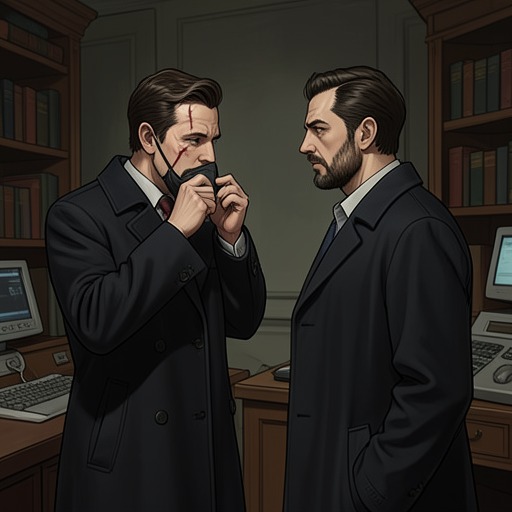
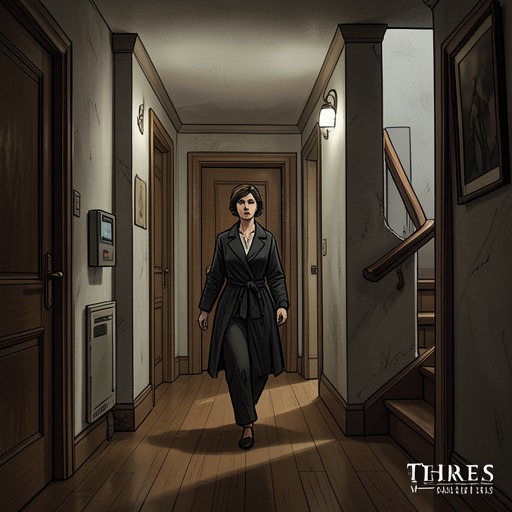
At the top of the Rue Guenegaud, he sees the pair emerge from the Rue Dauphine. The woman wears a black mantle like the one previously associated with Madame Bonacieux, while the man wears a Musketeer uniform and conceals his face with a handkerchief. The woman’s lowered hood and the man’s disguise make their common need for secrecy unmistakable. Because they take the bridge in the same direction as d'Artagnan, he follows them, turning an official errand into a personal pursuit.
Jealousy and Misrecognition
After fewer than twenty steps, d'Artagnan convinces himself that the woman really is Madame Bonacieux and that her companion is Aramis. The apparent confirmation strikes him with disproportionate force. He has known Madame Bonacieux only for a few hours, and she has promised him nothing beyond the gratitude owed for rescuing her from the men in black who intended to carry her off. Nevertheless, he imagines himself an outraged and ridiculed lover. Her earlier denial that she knew Aramis now seems to him proof of deliberate deception, while the sight of her hanging on the Musketeer’s arm appears to betray both his friend and the woman he already loves.
The emotional charge of the mistake propels the action. Blood and anger rise to d'Artagnan’s face, and he resolves to uncover the mystery rather than continue toward M. de Treville. When the pair notice that they are being watched, they accelerate. D'Artagnan passes them, turns back, and intercepts them before the Samaritaine, where a lamp illuminates the bridge and prevents the encounter from remaining hidden in darkness. The bridge becomes a threshold between conjecture and revelation: what d'Artagnan thinks he knows must now be tested against the strangers’ own words.
Recognition of Buckingham
The confrontation immediately exposes the limits of d'Artagnan’s first interpretation. The Musketeer recoils and asks what d'Artagnan wants in a foreign accent, making clear that he is not Aramis. D'Artagnan recognizes the error just as the encounter threatens to become a duel. The disguised man pushes him aside; d'Artagnan springs backward and draws his sword, and the stranger responds with equal speed. Madame Bonacieux throws herself between them and seizes the swords with her hands, addressing the stranger as “My Lord.”
Her intervention supplies the crucial revelation. She identifies the man as the Duke of Buckingham and warns d'Artagnan that recognition may ruin them all. The disguise is not a private theatrical gesture but protection for a politically explosive visit. Buckingham, the English minister of Charles I, is in Paris under circumstances that make his presence perilous, while Madame Bonacieux is acting as his guide. D'Artagnan’s supposed discovery of an illicit meeting is thus transformed into an encounter with the secret diplomatic and amorous crisis linking Buckingham and Anne of Austria.
From Rival to Escort
Once he understands whom he has challenged, d'Artagnan abandons his jealousy and asks forgiveness. He also offers to risk his life in Buckingham’s service. Buckingham answers by acknowledging him as a brave young man and accepting the offer with practical directness: d'Artagnan must follow twenty paces behind the duke and Madame Bonacieux, killing anyone who watches them. The command turns d'Artagnan’s sword from an instrument of threatened personal honor into a safeguard for a clandestine political operation.
D'Artagnan obeys precisely. He places his naked sword beneath his arm, allows the duke and Madame Bonacieux to gain the prescribed distance, and follows ready to carry out the order. The scene briefly reverses the expected hierarchy. A young provincial adventurer who had just confronted an apparent rival is entrusted with the safety of one of the most powerful men in the conflict between England and France. Yet the reversal is also conditional: Buckingham grants the trust because d'Artagnan has shown courage, and d'Artagnan’s usefulness depends on his ability to move between social levels without surrendering his initiative.
Entry and Political Consequences
The escort fortunately encounters no watcher whom d'Artagnan must kill. Buckingham and Madame Bonacieux enter the Louvre through the wicket of the Echelle without interference, while d'Artagnan goes to the Pomme-de-Pin, where Porthos and Aramis are waiting. He gives them no explanation of the alarm and inconvenience he has caused and merely says that he has settled alone the affair in which he had briefly believed their help necessary. His silence preserves both the duke’s safety and the secret of his own mistaken jealousy, while his return to the tavern reconnects the isolated episode with the fellowship of the three Musketeers.
The episode acquires its full weight from the larger conflict surrounding the Louvre mission. La Rochelle is the last major refuge left to the Huguenots, and Cardinal Richelieu seeks to destroy it as a remaining center of Calvinism, civil revolt, and possible foreign intervention. Its port is also the last in France open to the English. Buckingham’s later military intervention begins when he arrives before the Isle of Ré with ninety vessels and nearly twenty thousand men, surprises the Comte de Toiras, and lands after a bloody conflict. The private movement through the Louvre therefore belongs to a wider struggle in which military resources, religious policy, English access to France, and Buckingham’s personal motives are inseparable.
Buckingham’s campaign is presented as both public warfare and private vengeance. He wishes to enter France as a conqueror rather than as an ambassador, while the cardinal’s policy likewise carries a private dimension. The great kingdoms are made to serve the rivalry of powerful men whose real stake is a favorable look from Anne of Austria. Against that background, d'Artagnan’s escort is not a minor act of chivalry. It protects the physical passage of a foreign minister whose presence embodies a secret relationship and whose subsequent military role will determine the fate of the besieged city.
Narrative Significance
The event is built around a double discovery. D'Artagnan first discovers that his apparent certainty about Madame Bonacieux and Aramis is false; he then discovers that the stranger is Buckingham and that Madame Bonacieux is involved in a mission whose danger exceeds personal romance. The value shift is sharp: love turns into jealousy, jealousy into threatened violence, and threatened violence into an alliance founded on courage and mutual recognition.
The episode also establishes d'Artagnan’s characteristic position within the novel’s political machinery. He is neither a court insider nor a formal diplomat, yet his speed, boldness, and readiness to act allow him to protect a secret that reaches from Madame Bonacieux and Buckingham to Anne of Austria and the Anglo-French conflict. Later developments confirm the stakes of this hidden traffic: the English suffer from bad provisions, invalids, wrecked vessels, and a failing campaign before the king’s forces compel them to re-embark; the Rochellais continue to hope for Buckingham’s relief even when hunger threatens to kill them before help arrives. The Louvre entrance is the intimate doorway into that larger crisis, and d'Artagnan crosses it by first mistaking political secrecy for romantic betrayal.