Buckingham's meeting with Anne of Austria
The Three MusketeersBuckingham's meeting with Anne of Austria is the clandestine encounter that gives the novel's political intrigue its most intimate charge. Hidden inside the Louvre, it brings together a queen whose honor is threatened by surveillance and jealousy and an English duke who has crossed into Paris under a false summons, knowing that the snare may cost him his life. Their meeting does not produce a settled romance or safety; instead, it produces a pledge, a separation, and the chain of obligations that later makes the recovery of the Queen’s diamond studs urgent.
Causes and Secret Setting
The meeting becomes possible only because Buckingham refuses to leave Paris after discovering that the forged letter luring him to Paris did not come from Anne of Austria. Rather than return to England, he insists on seeing the queen, placing both his life and her honor in danger. Anne initially refuses, but his persistence and the fear that his frustration may drive him into some reckless act finally lead her to consent to a meeting whose purpose is to force his departure.
Madame Bonacieux serves as Buckingham's guide through the Louvre. Her association with the queen allows her to enter without difficulty, while Buckingham disguises himself in the uniform of M. de Treville's Musketeers. She accepts the risk that, if the visit is discovered, her reputation will be ruined. Once inside, she leads him through a servants' door, dark passages, stairs, corridors, and a locked apartment. The arrangement briefly makes Buckingham a prisoner even before the queen appears, but the confinement is part of the concealment required by the royal household's danger.
The Encounter and Its Emotional Reversal
Buckingham waits in the lamplit room with confidence rather than fear. He knows the message was false, yet his appetite for adventure and his conviction that ordinary laws do not restrain him sustain his resolve. When a door hidden in the tapestry opens, he sees Anne of Austria reflected in the glass and recognizes her before she speaks. Her appearance in a simple white-satin robe, accompanied by Donna Estafania, intensifies the contrast between the splendor of the queen and the secrecy of the room.
Anne immediately explains that she did not summon him. Buckingham accepts that he was deceived, but treats the journey as worthwhile because it has brought him into her presence. Anne answers with the political and moral facts that divide them: the sea, the hostility between their kingdoms, and the sanctity of their vows. She has come to tell him that they must never see each other again. The value at stake changes from the hope of reunion to the immediate preservation of honor and life.
Buckingham presses the emotional claim that their shared dreams and presentiments prove their love. Anne cannot give him a simple confession. She says that she does not know whether she loves him, but knows that she will not perjure herself. Her fear is not abstract: if he is struck or killed in France and his love for her is the cause, she believes the guilt would destroy her. The scene therefore holds desire and refusal together. Anne's affection appears through her alarm, while her refusal establishes the boundary that political marriage and religious vows impose upon it.
The Rosewood Casket as Pledge
Buckingham agrees to depart if Anne will give him an object that proves the meeting was real and preserves a memory of her. He asks for something she has worn, such as a ring, necklace, or chain. The request turns affection into an exchange: his departure becomes conditional upon a gift, and the gift becomes a material reminder capable of surviving separation.
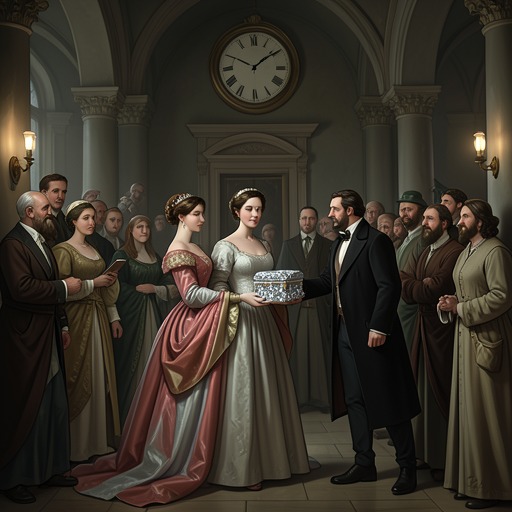
Anne returns almost immediately with a rosewood casket bearing her cipher in gold. She gives it to Buckingham as a keepsake, and he receives it on his knees. The casket is more than a token of sentiment. It is a private object carrying royal identity into the hands of a foreign duke, so its value lies simultaneously in intimacy, secrecy, and danger. Buckingham's acceptance binds the emotional promise to a physical possession that can later become the last remnant of the encounter.
After receiving it, Buckingham keeps his word. Anne extends her hand with her eyes closed and leans upon Estafania because the strain has nearly overcome her. Buckingham kisses her hand passionately and declares that, if he is alive within six months, he will see her again even if he must overturn the world. His promise transforms departure into deferred return rather than final renunciation. Madame Bonacieux then meets him in the corridor and conducts him out of the Louvre by the same precautions that brought him in.
Political Consequences and Narrative Afterlife
The meeting exposes how easily private devotion becomes a matter of state. The king's suspicion of Buckingham leads to the seizure and search for Anne's letter, while the chancellor approaches the queen with the coercive persistence of an executioner's attendant. The royal household is thus treated as a disciplinary space: doors, servants, hidden passages, searches, and interrogations convert personal movement into evidence. In the wider mousetrap established in Monsieur Bonacieux's apartment, the cardinal's agents question visitors about messages passing between the Bonacieux household and the queen because they are trying to discover whether Buckingham is in Paris and whether he has met Anne.
The casket's emotional promise soon develops into a political and military crisis. Buckingham returns to England, and an order is published forbidding vessels bound for France from leaving port, including the packet boat carrying letters; to the public, this is effectively a declaration of war. When the queen must appear at the royal ball wearing her diamond studs, the secret meeting explains why the recovery of the missing jewels cannot be separated from the preservation of her reputation and the prevention of a diplomatic catastrophe.
Buckingham responds to the crisis by having two replacement diamond studs made so perfectly that even he cannot distinguish them from the originals. He gives the completed studs to d'Artagnan while keeping the rosewood casket, explaining that the casket is more precious because it is all that remains to him. The contrast is decisive: the jewels are instruments of public deception and political rescue, whereas the casket is the private residue of the meeting. Later exchanges echo the same economy of dangerous gifts. d'Artagnan insists that the diamond he carries comes from the queen, while Athos and d'Artagnan obtain three hundred pistoles by pledging Athos's sapphire ring, and Richelieu gives d'Artagnan a lieutenant's commission by replacing one carte blanche with another. In each case, an object or document creates obligation, access, or power; the rosewood casket is the most intimate and politically volatile instance.
Significance and Outcome
The meeting is a romance scene structured by refusal rather than fulfillment. Buckingham arrives expecting the possibility of renewed intimacy, but Anne turns the encounter into a plea for departure. He receives the gift he desires, yet not the unrestricted future he wants; she offers proof of feeling without surrendering her vows. The exchange therefore produces a temporary emotional victory and a lasting practical separation.
Its consequences also reveal the novel's recurring collision between private loyalty and public authority. Buckingham's willingness to risk his life, Anne's fear of dishonor, Madame Bonacieux's willingness to risk her reputation, and d'Artagnan's later service all arise from the same hidden bond. The encounter's ending is not a peaceful resolution but a promise made under threat: Buckingham leaves the Louvre alive, carrying the casket, while the queen remains behind in a court where surveillance can turn affection into treason. The later diamond-stud mission is the meeting's public afterlife, converting a secret kiss of the hand and a royal keepsake into a crisis involving the crowns of France and England.