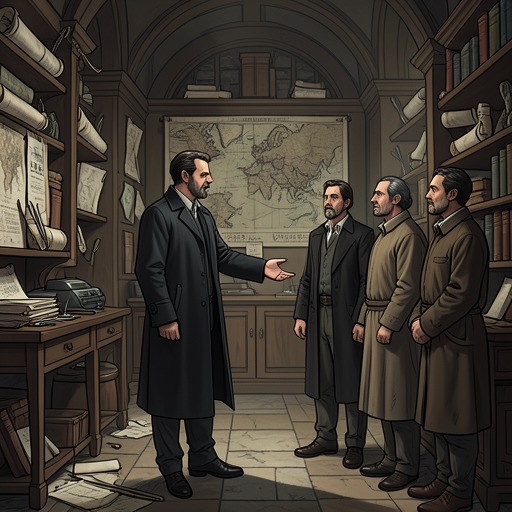
Cardinal Richelieu–the Four Musketeers
The Three MusketeersCardinal Richelieu–the Four Musketeers is one of the novel’s central power relationships: the cardinal and the king’s Musketeers belong to rival institutions, compete for influence, and repeatedly confront one another through arrests, surveillance, military suspicion, and political maneuvering. Yet the hostility is never simple. Richelieu recognizes that the four men possess the loyalty, courage, and practical force that make them valuable to the state, and the relationship therefore moves between persecution, testing, strategic restraint, and an unwilling desire to claim them for his own service.
Rival Guards and Rival Sovereignties
The antagonism begins within the divided political order of France. Citizens live amid overlapping conflicts involving nobles, the king, the cardinal, Spain, robbers, mendicants, Huguenots, wolves, and other enemies. In this atmosphere, Louis XIII establishes the Musketeers as a chosen body devoted to him, while Richelieu creates his own guard in direct response. The two establishments recruit celebrated swordsmen from the provinces of France and from foreign countries, and their masters publicly condemn duels while privately taking pleasure in the victories and defeats of their respective combatants. The conflict between Richelieu and the four companions is therefore not merely personal: it is the sharpest expression of a rivalry between royal allegiance and ministerial power.
M. de Treville’s position intensifies that institutional contest. Louis XIII appoints him captain of the Musketeers because of his faithfulness, quick judgment, and readiness to act for the king. The king values him as a dependable fighting man, even regarding Treville as a model second in a duel. Richelieu consequently faces not a loose group of adventurers but a disciplined corps protected by a captain who can challenge police authority in the king’s presence. The four companions inherit that protection, but they also inherit the danger of belonging to the king’s armed household while operating in a political world dominated by the cardinal.
Arrest, Law, and Political Suspicion
The relationship repeatedly turns on the conflict between formal law and exceptional political authority. After a street encounter involving three of Treville’s Musketeers and d'Artagnan against five of the cardinal’s Guardsmen, Louis XIII reminds Treville that an edict still forbids fighting. Treville answers that the incident was not an ordinary duel but a brawl, since the numbers and circumstances made it exceptional. The king accepts the distinction sufficiently to receive the men secretly by the back staircase, while still insisting on the existence of the law. The episode establishes the unstable ground on which the four men stand: royal favor can protect them, but their conduct remains vulnerable to administrative interpretation.
That vulnerability becomes explicit when Athos is arrested by procurators, police officers, and commissioners, taken through the open street, and thrown into the Fort l'Eveque under an order that the officials refuse to show. Treville protests that Athos is a Musketeer of irreproachable conduct and an almost illustrious reputation, known to the king for having seriously wounded Monsieur de Cahusac in an earlier duel. Richelieu supports the presumption of culpability, whereas Treville insists that guilt must be decided by judges. Louis XIII orders the case sent before the judges, formally preserving judicial procedure while leaving Athos exposed to the machinery that has already imprisoned him. Treville’s protest that even an uncontested life cannot exempt a man from infamy and persecution reveals how the cardinal’s power operates: suspicion itself becomes a political weapon.
The same logic appears in the secret arrest procedure known as a mousetrap. A suspected person is detained without public explanation; several men wait in ambush in the first room; everyone who enters is admitted, then arrested, until the establishment’s regular visitors have been gathered. Richelieu’s conflict with the Musketeers unfolds within this culture of concealed detention and controlled access. The men are not simply opposing an individual minister but resisting a system that treats secrecy as an instrument of governance.
The Beach Confrontation at La Rochelle
During the siege of La Rochelle, Richelieu’s political and military authority reaches its most concentrated form. The siege is directed against the last major refuge of the Huguenots, whose city has become a focus for Calvinist resistance, foreign intervention, and political ambition. Its harbor is also the last port in France open to England. The cardinal’s blockade therefore joins religious policy, national security, and the struggle against English power. The siege is materially sustained by the dyke, which prevents vessels from entering the city, but the blockade remains slow, costly, and politically embarrassing while the Rochellais endure famine and contemplate surrender.
Richelieu’s personal anxieties are intertwined with the wider war. Buckingham arrives at the Isle of Ré with ninety vessels and nearly twenty thousand men, surprises the Comte de Toiras, and lands after a bloody conflict. Richelieu must therefore manage both the prolonged siege and the threat from England, while the king’s army continues its dangerous amusements and expeditions around the dyke and sea. He rides constantly among the works constructed under his orders, watching engineers whose progress does not keep pace with his wishes. When he sees a Musketeer of Treville’s company, he studies the man closely; if the soldier is not one of the four companions, Richelieu turns away, as though the absence of the particular men only redirects his suspicion.
One day, burdened by exhaustion, failed negotiations, and the absence of news from England, Richelieu rides along the beach with Cahusac and La Houdiniere. Behind a hedge he discovers seven men gathered around empty bottles: the four Musketeers and their three lackeys. The companions have abandoned cards and dice to listen to an important letter, while the lackeys open a large flagon of Collicure wine. Richelieu’s depression is sharpened by the sight of their gaiety, and he secretly approaches in the hope of overhearing them. He recognizes d'Artagnan first and then identifies Athos, Porthos, and Aramis as the Inseparables.
The encounter begins with Richelieu’s accusation that the Musketeers appear to be keeping guard and may consider themselves superior officers. Athos answers that, when off duty, the Musketeers drink and play dice, and that they are certainly superior officers to their lackeys. Richelieu rejects the harmless distinction: lackeys who warn their masters of approaching persons are, in his view, sentinels. The exchange converts ordinary companionship into evidence of conspiracy. D'Artagnan attempts to explain that they would have come to meet Richelieu had they known that he was approaching with so few attendants, but the cardinal replies that the armed and guarded group looks like four conspirators.
Athos does not retreat. He admits that they do conspire, but says that their conspiracy is against the Rochellais. His answer turns Richelieu’s suspicion back toward the public enemy and asserts that the four men’s actions serve the war rather than a private plot. Richelieu then points to the letter they concealed when he approached and suggests that it might contain the secret of many unknown things. The letter becomes the immediate object around which their entire relationship is organized: information is power, concealment is incriminating, and possession of a private message can transform soldiers into suspected traitors.
Restraint, Recognition, and the Desire to Possess Them
Athos’s next reply brings the confrontation to its most dangerous point. He indicates that the letter is a woman’s letter, but not one signed by Marion de Lorme or Madame d'Aiguillon. Richelieu turns pale, his eyes flash, and he moves as though he might order Cahusac and La Houdiniere to seize the group. Athos steps toward the muskets, while the other three companions fix their attention on them. The cardinalists are only three; the Musketeers and their lackeys number seven. Richelieu calculates that an arrest could become an unequal fight, especially if the four men are truly conspiring, and his anger abruptly changes into a smile.
His retreat is not forgiveness. Richelieu praises them as brave in daylight and faithful in darkness, recalls the night when they escorted him to the Red Dovecot, and says that he would request their company if danger lay on the road ahead. He then leaves them to finish their wine, game, and letter. The gesture combines acknowledgment of their service with a warning that he could still have demanded it. He does not renounce authority; he chooses not to exercise it because the immediate balance of force and the political value of the men make restraint more useful than violence.
As he rides away, the cardinal’s private response makes the relationship unmistakable: he decides that the four men must become his. The thought reveals the paradox at the heart of the antagonism. Richelieu sees their independence as a threat because they belong to the king, possess their own loyalty, and act together outside his control. At the same time, their courage and cohesion are precisely what attract him. He would rather appropriate such power than destroy it, if appropriation is possible.
The Limits of the Rivalry
The confrontation at La Rochelle does not dissolve the hostility. Richelieu continues to treat the men as potential conspirators, and they remain alert to the possibility that his guards, police, or agents may move against them. His political system depends on surveillance, secret detention, written orders, and the ability to define enemies through accusation. Their survival depends on comradeship, weapons, speed, and the protective ambiguity of royal service. Each side therefore interprets the other’s ordinary behavior as a possible political act.
The cardinal’s authority also contains a contradiction. He insists that those who punish without legal license are assassins, yet he is associated with the very practices of secret arrest, political persecution, and discretionary command that make such accusations possible. When he later confronts the consequences of the private justice carried out against Milady, he reminds the men that they have constituted themselves judges without authorization to punish. The rebuke places the four companions under the law, but it also confirms the wider struggle over who may decide guilt, punishment, and necessity. Their conflict with Richelieu is thus a contest between official state power and a rival code of honor that claims to act when institutions appear compromised.
The relationship remains adversarial because neither side can fully submit to the other. The four Musketeers are useful to the royal war effort, but their loyalty is not automatically transferable to Richelieu. Richelieu can admire their service, protect himself by invoking their past escort, and imagine possessing them, yet he cannot erase the political distinction between the king’s men and his own. Their encounters repeatedly end without open battle because calculation intervenes: royal favor, numerical strength, military necessity, and the uncertain contents of a letter all make immediate violence costly.
Narrative and Thematic Significance
Cardinal Richelieu–the Four Musketeers gives the novel its most sustained collision between friendship and state power. The four men act through mutual trust and a shared readiness to defend one another; Richelieu acts through hierarchy, information, policing, and command. Their fellowship makes them appear conspiratorial to an authority that cannot tolerate unmonitored solidarity, while Richelieu’s institutions make ordinary political life resemble a permanent trap.
The rivalry also complicates the opposition between good and evil. Richelieu is not portrayed as incapable of recognizing courage. He can see that the Musketeers are faithful, brave, and effective, and his final wish to make them his own is born from that recognition. The men, for their part, are not outside politics: they fight in the royal army, participate in the siege of La Rochelle, and claim that their conspiracy serves the war. Their conflict is therefore not between political action and innocence, but between competing loyalties and competing definitions of legitimate service.
At its deepest level, the relationship dramatizes the early modern struggle over the meaning of obedience. Louis XIII’s edict forbids fighting, yet royal favor shields the fighters; the cardinal invokes law while deploying exceptional suspicion; Treville demands judgment while threatening political disruption; and the Musketeers defend themselves while insisting that their private alliance serves the public cause. Richelieu’s hostility is consequently inseparable from reluctant respect. He sees in the four men a force that his state needs but cannot entirely command, and that unresolved tension keeps their rivalry alive.