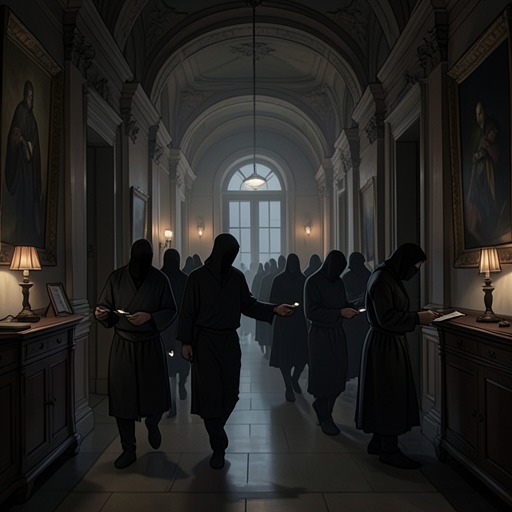
Carmelite Convent at Bethune
The Three MusketeersThe Carmelite Convent at Bethune is both a religious refuge and the final enclosed arena of Milady’s destructive career. She reaches it under a cardinal’s order, expecting protection and future advancement; instead, the convent becomes the place where she meets Constance Bonacieux, poisons her, and is ultimately exposed and pursued. The convent’s sacred setting does not prevent violence. It gives that violence a ritual and tragic form, culminating in Constance’s burial and the revelation of Milady’s past by the executioner of Lille.
Arrival and Setting
Milady travels to the convent after a paper bearing the name “Armentieres” leads d'Artagnan and his three friends to race toward Bethune. Her own journey begins from Boulogne: she travels by night, sleeps at an inn, resumes the road at five in the morning, and reaches Bethune three hours later. She immediately asks for the Carmelite convent, where the superior receives her and examines the cardinal’s order before assigning her a chamber and arranging breakfast.
For Milady, the convent initially appears to erase the danger of the past. She looks toward the future and the high fortunes she expects from Cardinal Richelieu, believing that her service has protected him from any direct association with the bloody affair surrounding her. The convent therefore functions at first as a shelter granted by political power, not as a place of moral transformation. Its religious authority gives Milady cover while leaving her habits of intrigue intact.
Sanctuary and Deception
The convent contains a community of Carmelites and a novice who has heard that Milady suffered persecution from the cardinal. Milady recognizes the usefulness of this supposed bond. She presents herself as another victim of a “wicked priest,” while simultaneously warning the novice not to speak openly against the cardinal. Her account turns persecution into a tool of sympathy: she suggests that both women have been betrayed and invites the novice to disclose whether she too has suffered treachery.
This exchange reveals how Milady occupies the convent’s moral language without submitting to its discipline. Religious suffering, friendship, betrayal, and innocence become materials for manipulation. The convent offers her a vocabulary of victimhood, and she uses that vocabulary to approach Constance Bonacieux. What should be a protected space for the vulnerable becomes, through Milady’s presence, a place where vulnerability can be identified and exploited.
Constance Bonacieux and the Poisoning
The Musketeers eventually reach the convent and break into the cell where Constance is being held. D'Artagnan enters with a still-smoking pistol, while Athos, Porthos, and Aramis follow with drawn swords. Constance, unable to move from her armchair, recognizes d'Artagnan and receives the rescue she has awaited. The scene briefly converts the convent from a place of confinement into a place of reunion and apparent safety.
That safety is immediately overturned. The following morning, the superior informs the Musketeers that Constance’s burial will take place at midday. The convent has heard nothing of the poisoner except that she escaped through the garden. Footprints remain in the sand, but the garden door is shut and the key has disappeared. The locked door and missing key turn the convent into a forensic space: the evidence of escape is visible, yet the culprit has vanished, leaving death inside the enclosure.
Burial and Revelation
The convent’s religious order gives Constance’s death a formal public shape. At the appointed hour, Lord de Winter and the four friends return to the convent. Bells toll, the chapel opens, and the grating of the choir remains closed. Constance’s body, dressed in her novitiate habit, lies in the middle of the choir while the Carmelite community gathers behind the convent gratings. The nuns hear and join the divine service without seeing the secular mourners or being seen by them.
This separation between the community and the outsiders emphasizes the convent’s divided space. Its rituals continue, but the sanctuary cannot contain the consequences of Milady’s crime. The sacred ceremony surrounds a victim whose death was produced by deception within the convent itself. The walls and gratings preserve religious enclosure while also making the scene resemble a theatre of withheld knowledge: the living mourn in one space, the hidden community prays in another, and the fugitive remains absent.
The wider truth of Milady’s history is later forced into the open when the executioner of Lille identifies himself and declares that she will recognize him. His testimony connects the woman now being pursued with an earlier history involving a Benedictine convent at Templemar, a young priest, seduction, and religious betrayal. The Carmelite convent at Bethune thus becomes the setting from which the investigation of Milady’s crimes expands backward into the buried history that explains the fleur-de-lis brand and the executioner’s claim upon her.
Narrative Significance
Bethune is a threshold between apparent refuge and final judgment. Milady arrives believing that political patronage has secured her future, but the convent instead brings her into proximity with Constance and places her within reach of the Musketeers. Its protected enclosure delays justice without preventing it. The garden, the missing key, the locked spaces, the grating, and the chapel all make confinement and escape visible as opposing possibilities.
The convent also exposes the instability of moral appearances. A cardinal’s order can make a dangerous woman welcome; a religious house can shelter both a fugitive and a victim; and a burial service can follow a murder committed under the protection of sacred walls. In this setting, holiness does not automatically produce justice. Justice arrives through pursuit, testimony, and a private tribunal organized outside ordinary legal procedure, while the convent supplies the solemn architecture in which the consequences of violence are finally witnessed.
Its final importance lies in that collision between institutional sanctuary and human retribution. The Carmelite community preserves its rituals behind the grating, but the plot’s decisive acts occur in the spaces those rituals cannot govern: the cell, the garden, the vanished key, and the road leading away from Bethune. The convent is therefore not merely a backdrop for Milady’s escape. It is the place where her refuge collapses, Constance’s death becomes public, and the story’s hidden past begins to speak.